Band 5.5 IELTS Writing Task 1 Model Answer
Overall Band Score: 5.5 · Cambridge IELTS 19 · 2026-11-11
IELTS Writing Task 1 question
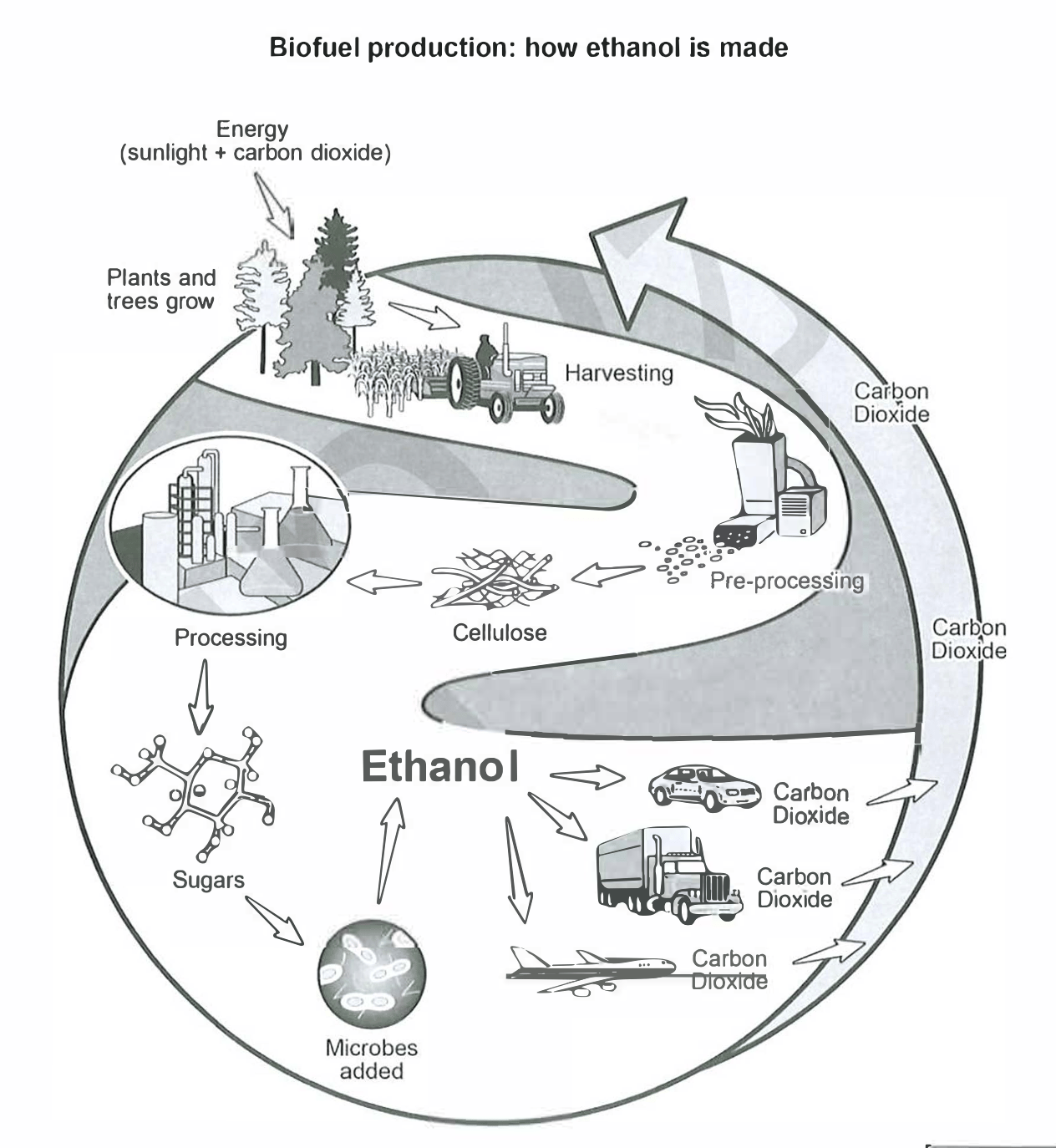
The diagram below shows how a biofuel called ethanol is produced.
Summarise the information by selecting and reporting the main features, and make comparisons where relevant.
Student answer (Band 5.5)
The diagram discribe prodution of a biofuel called ethanol.
Overall, there are few steps involed it mainly it produced from plants and trees and then after harvesting it converted into celluose and after process on industriel level in laboratories it converted into sugars and with help of microbe finally ethanol produced which is reversible process.
Carbon dioxide is wasted wasted gas from vehicles which is essnetial enery sourse for plants. Farmers harvest plant and trees and after somr process they cut and seprated their parts and then they send cellulose to big industries where with help of different chemicels and mechines it is converted into suger molecules.
these suger molecules are soure of nutriention for microbe. Addition of microbes with suger can make ethanol which is biofuel for cars and other vehicles.
After processing biofuel again conert other form of enery which is carben dioxide so this is a cycle which is reapetble again and again
AI examiner evaluation
| Criterion | Band |
|---|---|
| Task Achievement / Task Response | 6.0 |
| Coherence and Cohesion | 5.5 |
| Lexical Resource | 5.0 |
| Grammatical Range and Accuracy | 5.0 |
| Overall | 5.5 |
Task Achievement / Task Response: Band 6.0
You identify the main stages from plant growth and harvesting through cellulose, sugars, microbes and ethanol, and you recognise that the process forms a cycle. This gives the reader a relevant account of the diagram. However, some stages are described imprecisely: the diagram shows pre-processing before cellulose and processing after it, but your account compresses these into “some process” and “process on industriel level.” It also shows ethanol being used by cars, trucks and aircraft, with carbon dioxide returning to support plant growth; your response mentions vehicles generally but does not clearly report all three uses or explain the sunlight input. The claim that cellulose is sent to industries and that chemicals and machines are used is not specified in the diagram. A more complete, precise overview and closer attention to the labelled stages would strengthen the report.
Coherence and Cohesion: Band 5.5
The response has a recognisable overall shape: an introduction and overview are followed by details about the production stages and the carbon cycle. The sequence from plants to ethanol is generally understandable, and phrases such as “after harvesting” and “with help of” attempt to connect steps. However, progression is weakened by unclear links and repetition, especially “wasted wasted gas” and the repeated references to processing. The overview sentence is overloaded, while the final paragraph introduces the cycle without a clear transition from the production description. Paragraphing is present, but the stages would be easier to follow if each paragraph had a clear purpose and the process were described in order using precise links such as “next,” “then,” and “finally.”
Lexical Resource: Band 5.0
You use some relevant process vocabulary, including “harvesting,” “cellulose,” “microbe,” “ethanol,” and “carbon dioxide,” which helps communicate the subject. However, the range is limited and several spelling and word-choice errors make parts difficult to read, for example “prodution,” “essnetial enery sourse,” “suger molecules,” and “carben dioxide.” Some expressions are also imprecise or unnatural, such as “wasted gas” and “converted into other form of energy.” Aim to use accurate process terms and standard collocations, for example “carbon dioxide is released” and “the sugars are converted into ethanol.” Proofreading spelling and choosing precise nouns and verbs would make the description clearer and more appropriate for an academic report.
Grammatical Range and Accuracy: Band 5.0
You attempt both simple statements and longer sentences, including a sequence linked with “and then,” and the reader can usually infer the intended process. However, sentence control is inconsistent, particularly in longer constructions. For example, “Overall, there are few steps involed it mainly it produced…” joins clauses without suitable punctuation and has unclear subject and verb forms. Other examples include “ethanol produced” and “this is a cycle which is reapetble,” where articles or auxiliary verbs are missing. There is also limited control of sentence boundaries, as seen in the final paragraph. Build accuracy by using complete subject–verb clauses, checking tense and agreement, and separating long sequences into shorter sentences. More reliable control of these basics would support your attempts at complex sentences.
See this exact question answered at other band scores. The same prompt compared across bands.
Browse more IELTS Writing model answers or get your own writing scored by the same AI examiner.