Band 6.5 IELTS Writing Task 1 Model Answer
Overall Band Score: 6.5 · Cambridge IELTS 19 · 2026-11-11
IELTS Writing Task 1 question
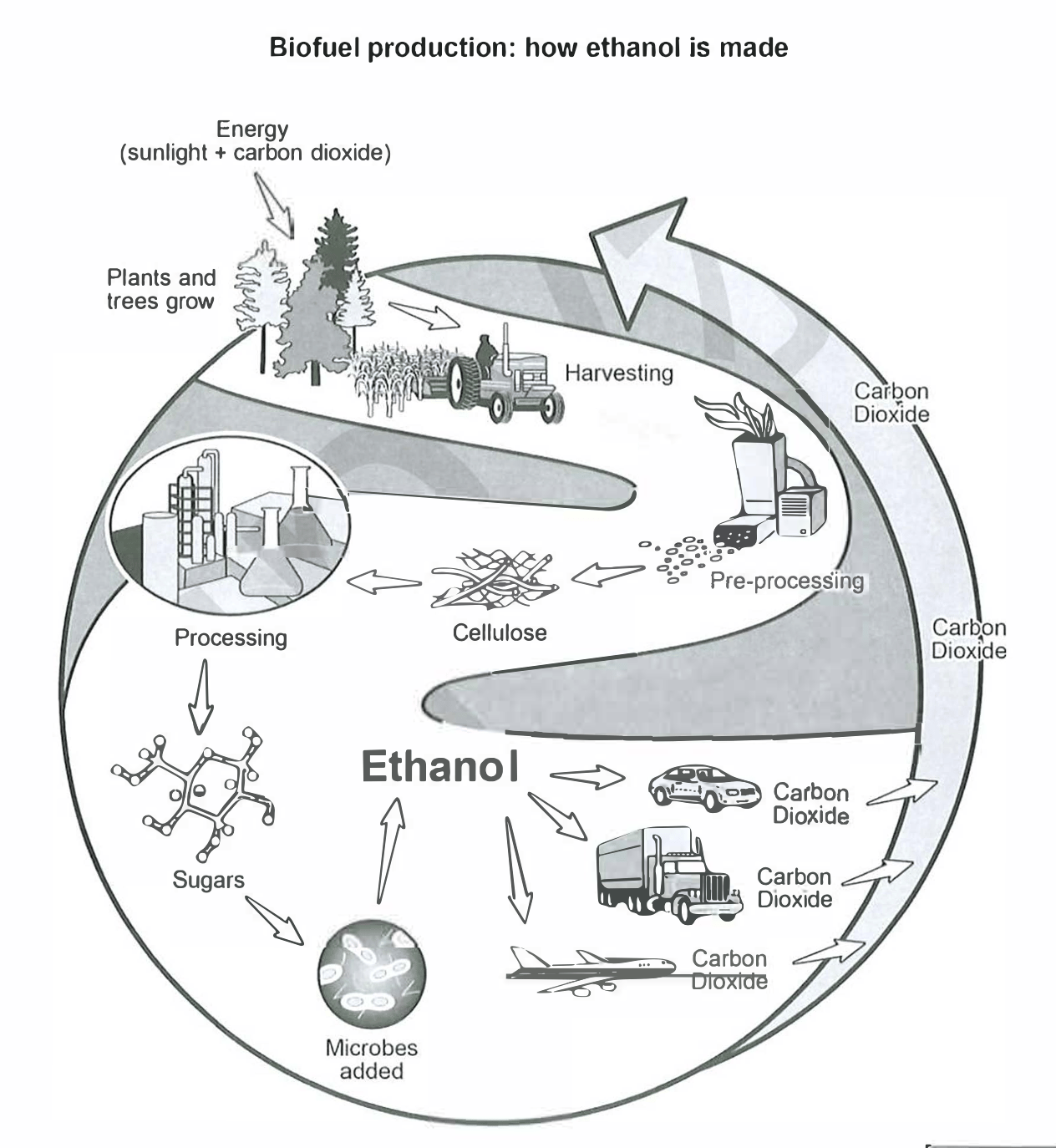
The diagram below shows how a biofuel called ethanol is produced.
Summarise the information by selecting and reporting the main features, and make comparisons where relevant.
Student answer (Band 6.5)
The given process diagram illustrates that how a biofuel called ethanol is produced.
Overall, it is a circular process, beginning with the growth of plants and tress, while ending with microbes added to the sugar and get ethanol. Therefore, vehicles use ethanol as a fuel and produce carbon dioxide which is again use for the growth of plants.
At the first stage, plants and trees take energy from sunlight and carbon dioxide to grow. After that, farmers harvest the trees and plants with the help of the tractor. Then harvested trees and plants processed in a machine. After being processed, cellulose is obtained. Following this, the cellulose is processed in a laboratory. Next sugar is produced by processing the cellulose.
Finally, microbes is added in the sugar. Eventually, ethanol is produced which is then used in many vehicles as a fuel. However, cars, trucks and planes produced carbon dioxide which is then used by plants and trees as a energy source.
AI examiner evaluation
| Criterion | Band |
|---|---|
| Task Achievement / Task Response | 7.0 |
| Coherence and Cohesion | 6.5 |
| Lexical Resource | 6.0 |
| Grammatical Range and Accuracy | 5.5 |
| Overall | 6.5 |
Task Achievement / Task Response: Band 7.0
The response covers the main stages and gives a clear overview of the cycle, including plant growth, conversion to ethanol, its use in transport, and carbon dioxide returning to support further growth. The sequence from harvesting through cellulose and sugars to the addition of microbes is also reported. This is a strong account of the process, though a few details are imprecise: the overview says the process ends with microbes being added and ethanol obtained, when the diagram continues through transport and carbon dioxide recirculation. Also, describing cellulose processing as occurring “in a laboratory” is not shown; the diagram depicts processing at a factory or refinery. Keep the overview focused on the complete cycle and avoid adding unsupported settings.
Coherence and Cohesion: Band 6.5
The response is organised into an introduction, an overview and two chronological detail paragraphs, so the reader can follow the process from plant growth to fuel use. Sequencing expressions such as “After that,” “Following this,” and “Finally” help signal the stages. The overview, however, gives a misleading endpoint before later describing the cycle’s return to plant growth, and “Therefore” does not clearly express the relationship between the preceding and following ideas. Some links are also repetitive and mechanical. To strengthen progression, present the cycle’s full start-to-return pattern in the overview, then use fewer, more precise transitions to connect the stages.
Lexical Resource: Band 6.0
The vocabulary is adequate for describing a process, with relevant terms such as “harvest,” “cellulose,” “microbes,” and “carbon dioxide.” The writer also uses some variation in process language, including “obtained,” “produced,” and “processed.” However, several choices are imprecise or repetitive: “trees and plants” is repeated where “biomass” or “plant material” would be more concise, and “processed in a laboratory” is not an accurate description of the diagram’s factory/refinery stage. There are also word-form or collocation problems, including “as a energy source” and “used in many vehicles as a fuel.” Aim for precise process vocabulary and natural collocations rather than repeating general terms.
Grammatical Range and Accuracy: Band 5.5
The response attempts a mix of simple and more complex sentences, including clauses beginning “After being processed” and “which is then used…”. Meaning is generally clear, but some grammatical errors recur and occasionally make the process less precise. For example, “illustrates that how” should be “illustrates how,” while “plants and trees processed” needs a passive verb (“are processed”). There are agreement errors in “microbes is added” and “cars, trucks and planes produced,” and the latter also needs a passive form. Articles and forms are inaccurate in “a energy source.” Review passive constructions, subject–verb agreement, and articles; these are especially important when describing stages carried out on materials.
See this exact question answered at other band scores. The same prompt compared across bands.
Browse more IELTS Writing model answers or get your own writing scored by the same AI examiner.