Band 5.5 IELTS Writing Task 1 Model Answer
Overall Band Score: 5.5 · Cambridge IELTS 19 · 2026-11-11
IELTS Writing Task 1 question
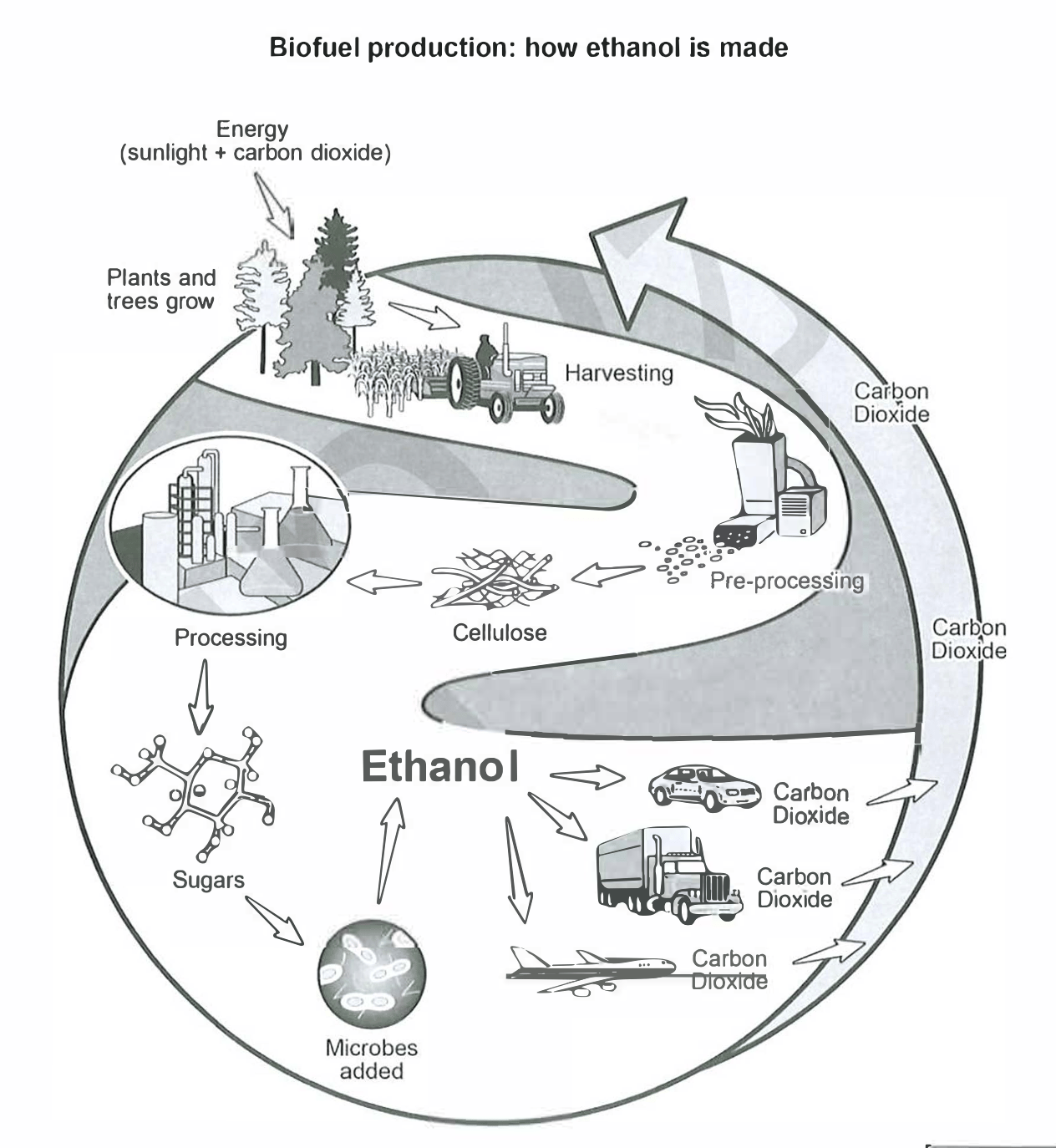
The diagram below shows how a biofuel called ethanol is produced.
Summarise the information by selecting and reporting the main features, and make comparisons where relevant.
Student answer (Band 5.5)
The diagram illiustrate the production process of the biofuel know as ethanol.
Overall,It is a chain of production which includes eight distinct steps while the primary source is plants and trees and the carbondioxides after burning the ethanol again absorbsby the plants and trees and the process is enviormentaly sustainable.
Initially, when the plants and trees are grew up with proper source of energy such as sunlight and carbon dioxides which are the primary sources.After that the harvesting process takes place and arrived to the particular destination for processing. Altough pre processing occured in which the stripes palced into the crusher and it converts inthe form of powder known as cellulose.Moreover,after cellulose formation undergoes for main processing step then it will made in form of sugars.
Furthermore, when it converted into sugar the chemical named microbes incorporated into it .After the long procedure and time the ethanol is became ready to supply for the commercial use it isthe fuel which is used by transportation forr instance cars,trucks and aeroplanes. When the vehciles emits smoke from their exhauste it contain high amount of carbon dioxide and again the process takes place it will absorbed by the trees and plants for growing.
AI examiner evaluation
| Criterion | Band |
|---|---|
| Task Achievement / Task Response | 5.5 |
| Coherence and Cohesion | 5.5 |
| Lexical Resource | 5.5 |
| Grammatical Range and Accuracy | 5.0 |
| Overall | 5.5 |
Task Achievement / Task Response: Band 5.5
You identify the diagram as a production process and give a broad overview of plant growth, ethanol use in transport, and carbon dioxide returning to support further growth. These are relevant central features. However, the account is only partly accurate and developed: the diagram shows a sequence from harvesting through pre-processing, cellulose, processing, sugars and microbes, but several stages are vague or misrepresented. For example, “arrived to the particular destination for processing” is not a clear description of the pre-processing stage, and the claim that the material is put into a crusher and turned into powder is not shown in the reference. The overview also calls it “eight distinct steps,” without clearly summarising the full cycle. Describe each labelled stage accurately and distinguish the production stages from the later transport and carbon cycle.
Coherence and Cohesion: Band 5.5
The response has an opening, an overview and a body paragraph that generally follows the process from plant growth to fuel use and carbon dioxide return. Sequencing expressions such as “Initially,” “After that” and “Furthermore” help the reader follow the intended order. However, progression is weakened by long, crowded sentences and punctuation problems, including “Overall,It” and “After that the harvesting process takes place and arrived…”. Some links are mechanical, and references such as “it” in “it converts” and “it will absorbed” do not always make clear what material or stage is meant. Use one or two sentences for each group of stages, with clear paragraphing and explicit references to the material being processed. This would make the sequence easier to follow without relying so heavily on connectors.
Lexical Resource: Band 5.5
You use some task-relevant vocabulary, including “harvesting,” “cellulose,” “microbes,” “ethanol” and “carbon dioxide,” which allows the reader to recognise the main process. There is also an attempt to use more formal process language, such as “incorporated” and “commercial use.” However, the range is limited by inaccurate word choices and collocations: “plants and trees are grew up,” “stripes palced into the crusher,” and “the ethanol is became ready” are difficult to interpret. Spelling errors such as “illiustrate,” “enviormentaly” and “vehciles” also reduce clarity. Choose precise process verbs and check spelling; for example, say that plants “grow,” material is “pre-processed,” and microbes are “added.”
Grammatical Range and Accuracy: Band 5.0
You attempt both simple and longer sentences, including clauses beginning with “when” and “which,” but complex structures are often not controlled, and errors occur throughout. Examples include “plants and trees are grew up,” “it converts,” and “the ethanol is became ready,” where verb forms and tense patterns are faulty. Agreement and sentence construction are also problematic in “the carbon dioxides … absorbs by the plants,” while missing punctuation creates run-on sentences, particularly in the opening body paragraph. These errors sometimes make the process difficult to understand. Build accuracy first with clear present-simple sentences for each stage, such as “The plants are harvested” and “The cellulose is processed into sugars.” Then add subordinate clauses only when you can maintain correct verb forms and punctuation.
See this exact question answered at other band scores. The same prompt compared across bands.
Browse more IELTS Writing model answers or get your own writing scored by the same AI examiner.