Band 6.0 IELTS Writing Task 1 Model Answer
Overall Band Score: 6.0 · Cambridge IELTS 19 · 2026-11-12
IELTS Writing Task 1 question
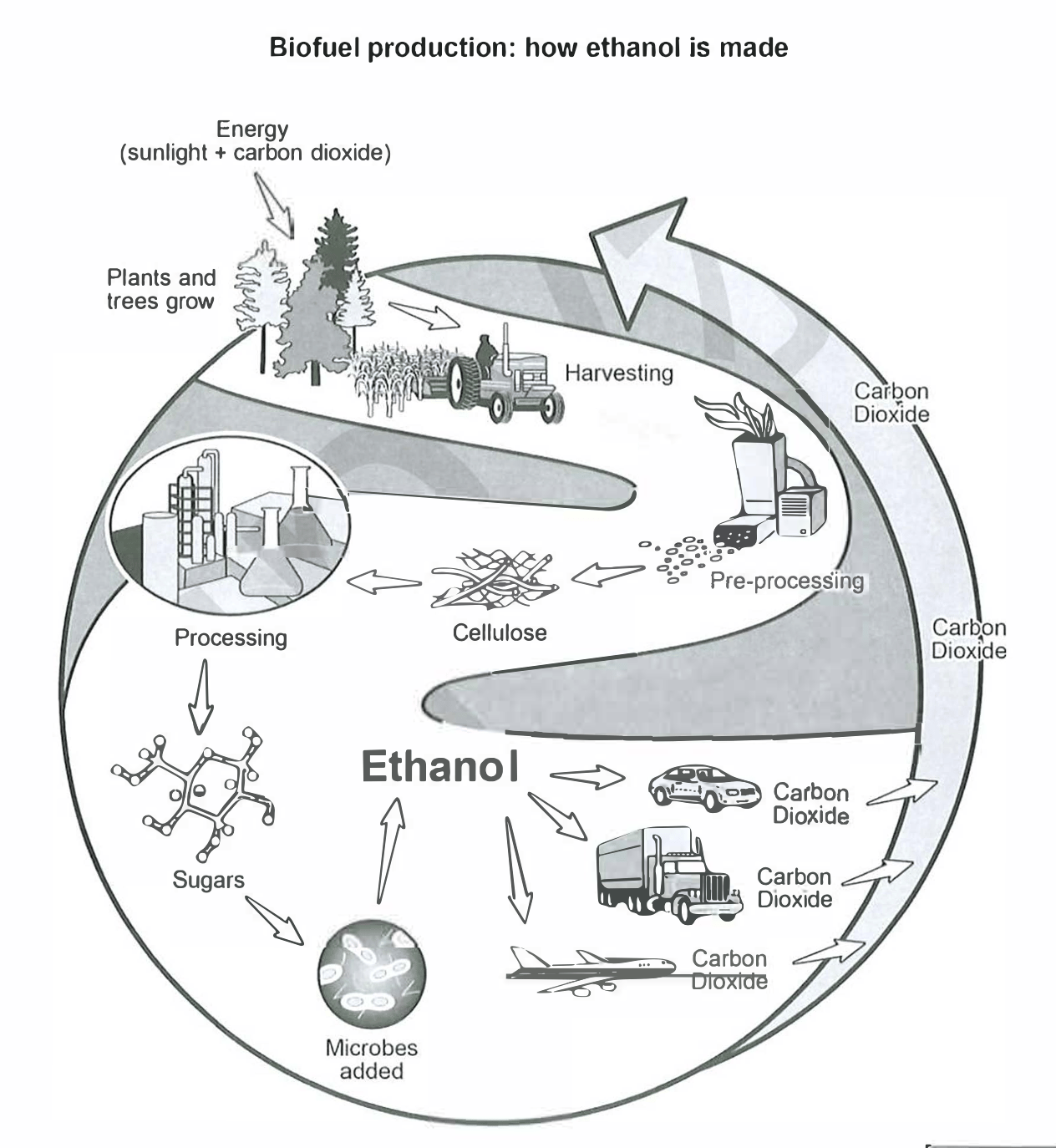
The diagram below shows how a biofuel called ethanol is produced.
Summarise the information by selecting and reporting the main features, and make comparisons where relevant.
Student answer (Band 6.0)
The diagram illustrates the production of biofuel called ethanol. Overall, it is a cyclical process consisting of 9 main stages. Commencing with vegetation making their energy from sunlight and carbon dioxide and ending with automotives emission of carbon dioxide to be absorbed by plants and trees again to make energy.
Firstly, plants and trees make use of sunlight and carbon dioxide to produce energy for their growth through the process of photosynthesis. After maturity, they are harvested and taken to a processing plant using tractors. In the firm, they are reduced into small pieces and pre-processed to produce cellulose. Next, the cellulose undergo further processing in a laboratory to produce sugars.
Sugars produced afrer laboratory test is added microbes. Subsequently, microbes assists in conversion of sugars to ethanol. Finally the ethanol is ready to be used by different automotives such as planes, lorries and small vehicles. Then the emitte
AI examiner evaluation
| Criterion | Band |
|---|---|
| Task Achievement / Task Response | 5.5 |
| Coherence and Cohesion | 6.0 |
| Lexical Resource | 6.0 |
| Grammatical Range and Accuracy | 5.5 |
| Overall | 6.0 |
Task Achievement / Task Response: Band 5.5
You identify the diagram as a cyclical process and describe the main progression from plant growth through harvesting, cellulose, sugars and ethanol. You also mention the return of carbon dioxide from transport to plants, which is central to the cycle. However, the response is incomplete: it ends abruptly at “Then the emitte” and does not explain the carbon-dioxide return in full. Some details are also unsupported or inaccurate, such as saying the material is taken to a processing plant “using tractors” and that cellulose is processed “in a laboratory”; the diagram shows a tractor at harvesting and a factory for processing, but does not specify a laboratory. The overview’s count of nine stages is not clearly aligned with the diagram’s sequence. The response is also one word below the required minimum. Develop the final stage and report only details shown.
Coherence and Cohesion: Band 6.0
The response has a generally understandable order, moving from the overview to the early production stages and then to ethanol use. Paragraphing helps separate the overview from the process details, and transitions such as “Firstly,” “Next,” and “Finally” guide the reader through the sequence. However, cohesion becomes less secure near the end: “Sugars produced afrer laboratory test is added microbes” is difficult to connect to the preceding sentence, and the final fragment, “Then the emitte,” leaves the account unfinished. Some references are also unclear, including “In the firm,” which appears to refer to a processing facility. To improve progression, use complete sentences, make each stage’s relationship explicit, and finish with a clear account of carbon dioxide returning to the plants.
Lexical Resource: Band 6.0
You use a reasonable range of process vocabulary, including “harvested,” “pre-processed,” “cellulose,” “conversion,” and “emission,” which helps communicate the stages. There are also attempts at more specific terms, such as “automotives” and “laboratory,” although these are not always appropriate to the diagram or natural in context. Several word-choice and spelling problems reduce precision: “make their energy” is less accurate than describing plants as using sunlight and carbon dioxide, “small vehicles” is vague, and “afrer” is misspelled. “Automotives” is also an awkward label for the car, truck and aeroplane. Aim for precise process language and check spelling and collocations; this will make the description clearer without requiring unnecessarily technical vocabulary.
Grammatical Range and Accuracy: Band 5.5
You attempt both simple and more complex forms, including the opening overview and the sequence of clauses beginning “After maturity” and “Finally.” Meaning is usually recoverable, but some grammatical errors affect clarity. For example, “vegetation making their energy” has an incomplete construction and unclear agreement, while “the cellulose undergo further processing” needs a singular verb. In “Sugars produced … is added microbes,” the subject–verb relationship and sentence structure are faulty; “microbes assists” also has incorrect agreement. The opening sentence beginning “Commencing with” is a fragment rather than a complete sentence, and the final sentence is cut off. Use complete clauses, check singular/plural agreement, and proofread verb forms and punctuation.
See this exact question answered at other band scores. The same prompt compared across bands.
Browse more IELTS Writing model answers or get your own writing scored by the same AI examiner.