Band 5.5 IELTS Writing Task 1 Model Answer
Overall Band Score: 5.5 · Cambridge IELTS 19 · 2026-11-12
IELTS Writing Task 1 question
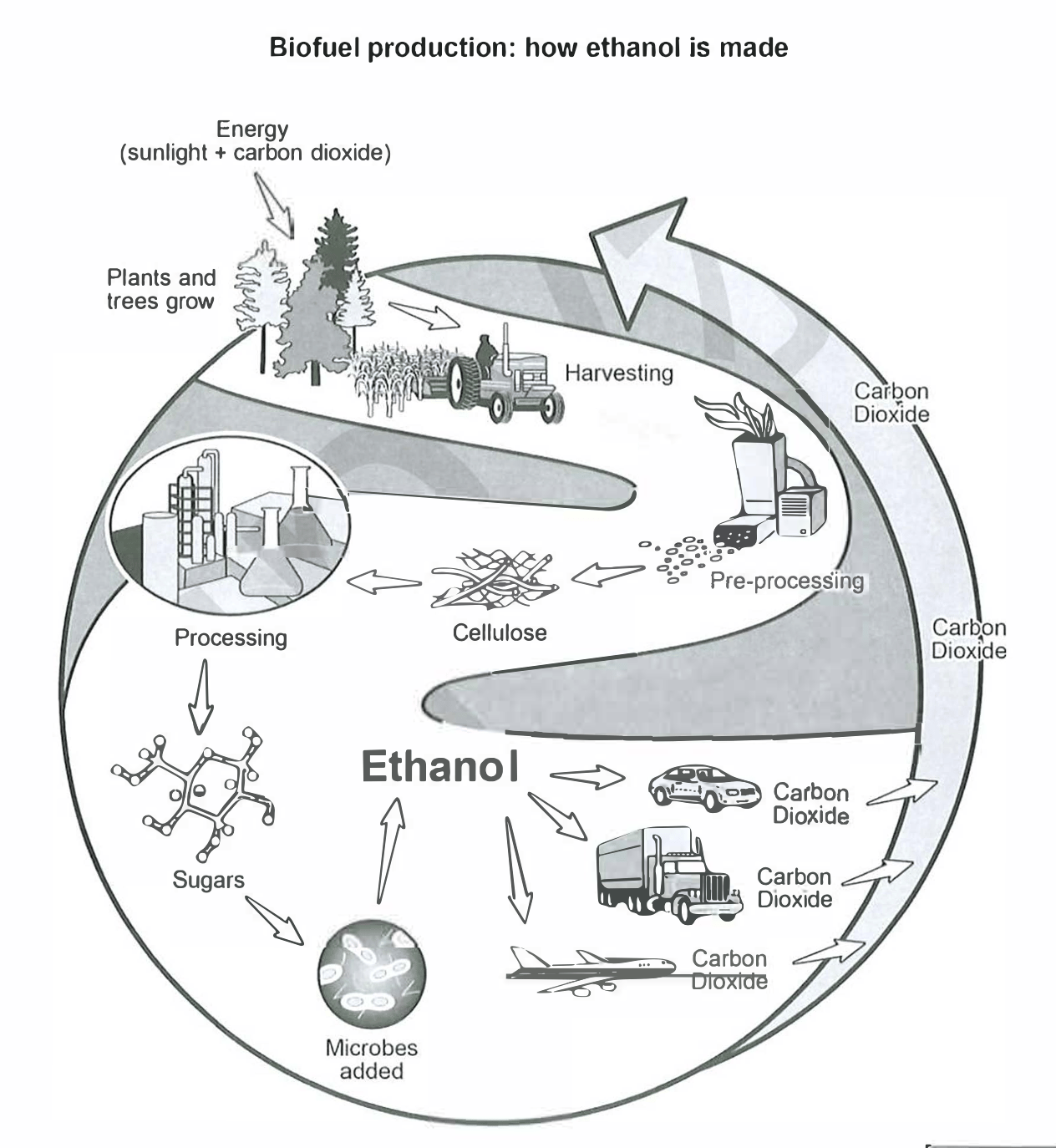
The diagram below shows how a biofuel called ethanol is produced.
Summarise the information by selecting and reporting the main features, and make comparisons where relevant.
Student answer (Band 5.5)
The illustration gives information about the process of how ethanol is produced. Overall, in production of biofuel, there are eight different steps are involved that we must follow then biofuel is ready for use of gasoline in vehicles.
It is quite evident from the diagram that sunlight and carbon dioxide help the growth of plants and trees. After that it is harvested by tractors and passing it from the pre-processing phase whre grains are made. In addition, passing from the pre-processing, cellulose was produced which is sent to the laboratory for processing.
Furthermore, following sugar crystals are made. Subsequently, microbes are added in sugars. Finallly, ethanol is ready to use. Ethanol are worked as a fuel in vehicles such as cars, trunks and aeroplanes which helps them to movement. When the traffic moved it discharges different types of radiation and cardon dioxide which is further use in plants and then this process is again followed.
AI examiner evaluation
| Criterion | Band |
|---|---|
| Task Achievement / Task Response | 6.0 |
| Coherence and Cohesion | 6.0 |
| Lexical Resource | 5.5 |
| Grammatical Range and Accuracy | 5.0 |
| Overall | 5.5 |
Task Achievement / Task Response: Band 6.0
You identify the main stages, from plant growth and harvesting through processing, the addition of microbes, and the use of ethanol in transport. You also recognise the central cycle by noting that carbon dioxide returns to support plant growth. However, some details are inaccurate or unclear: the diagram does not show grains being made, nor does it specify a laboratory, and it shows sugars rather than “sugar crystals.” The overview says there are eight steps, although the process includes more stages, and the description could better distinguish the production stages from the later transport and carbon-dioxide cycle. To strengthen the response, report the labelled stages precisely and give a clearer overview of the complete cycle.
Coherence and Cohesion: Band 6.0
The response has a recognisable structure: an introduction and overview are followed by stages in roughly chronological order, with a final account of ethanol use and carbon-dioxide return. Linking expressions such as “After that,” “Furthermore,” and “Subsequently” help signal progression. However, some connections are mechanical or unclear. For example, “After that it is harvested by tractors and passing it from the pre-processing phase” combines stages awkwardly, while “which is further use in plants” leaves the reference and process unclear. The paragraphing also groups several distinct stages together. Use one paragraph for the overview and organise the process into clearer stages, with precise references to what each arrow leads to.
Lexical Resource: Band 5.5
You use relevant process vocabulary, including “pre-processing,” “cellulose,” “microbes,” and “ethanol,” and the reader can generally follow the topic. However, several word choices and collocations are inaccurate or imprecise: “grains are made,” “sugar crystals,” “worked as a fuel,” and “helps them to movement” do not describe the diagram naturally. There are also spelling errors such as “whre,” “Finallly,” “trunks,” and “cardon.” Aim for precise process language and check spelling carefully; for example, describe sugars as being produced and ethanol as being used as fuel. Avoid adding technical details that are not shown, such as “radiation.”
Grammatical Range and Accuracy: Band 5.0
You attempt both simple and more complex sentences, including a relative clause in “which is sent to the laboratory for processing” and a time sequence using “Subsequently.” However, errors in sentence structure, verb forms, and agreement occur across the response and sometimes make relationships difficult to follow. For example, “there are eight different steps are involved” contains two competing verb structures, and “Ethanol are worked as a fuel” has incorrect agreement and verb construction. “When the traffic moved it discharges” also shifts tense inconsistently. Practise building complete clauses with one main verb, maintaining consistent present tense for a process, and checking subject–verb agreement. These corrections would make your sequence much clearer.
See this exact question answered at other band scores. The same prompt compared across bands.
Browse more IELTS Writing model answers or get your own writing scored by the same AI examiner.