Band 4.5 IELTS Writing Task 1 Model Answer
Overall Band Score: 4.5 · Cambridge IELTS 19 · 2026-11-13
IELTS Writing Task 1 question
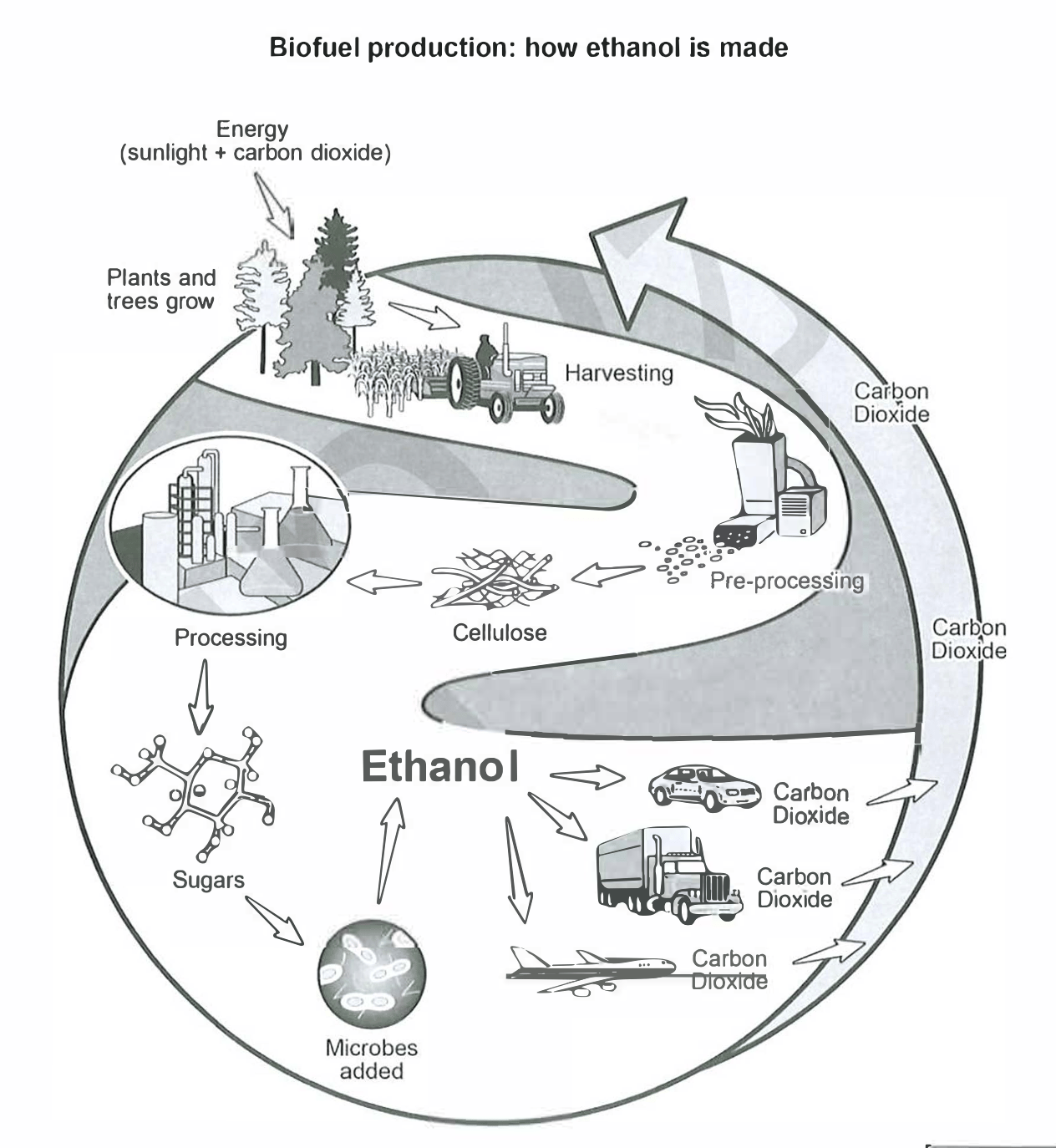
The diagram below shows how a biofuel called ethanol is produced.
Summarise the information by selecting and reporting the main features, and make comparisons where relevant.
Student answer (Band 4.5)
The diagram shows the how a biofuel called ethaonal is produced. This is have eight steps to produce biofual called ethaonal. Now describe the full process of this diagram.
First the energy (sunlight and carbon dioxide) pass to the trees and the energy comes in the trees and the second process is plants and trees are grow the third part is harvesting. Now, the fourth phase is pre processing and the fifth part is cellulose and the sixth process is processing. Now this becomes a sugars in the seventh part. The last one part is microbes which called ethanol. Moreover, every process is completed now in planes, trucks and cars load the ethanol and become to convert a carbon dioxide. This process is always repeating. Everytime a day start and this process will start to first position and energy (sunlight and carbon dioxide) pass the energy and complete the whole process.
AI examiner evaluation
| Criterion | Band |
|---|---|
| Task Achievement / Task Response | 4.5 |
| Coherence and Cohesion | 5.0 |
| Lexical Resource | 4.5 |
| Grammatical Range and Accuracy | 4.5 |
| Overall | 4.5 |
Task Achievement / Task Response: Band 4.5
You identify the subject as ethanol production and include several stages, from plant growth and harvesting through pre-processing, cellulose, processing, sugars and microbes. You also recognise that carbon dioxide returns to the start of the cycle. However, the account only minimally reports the diagram’s main features: it says there are eight steps, although the process includes more stages, and it does not clearly explain that microbes are added to sugars to produce ethanol. The transport stage is also unclear, and the diagram’s three transport modes are cars, trucks and an aeroplane, not “planes, trucks and cars load” the fuel. Give a concise overview of the cycle, then describe the stages accurately and in sequence.
Coherence and Cohesion: Band 5.0
The response follows a broadly chronological order, and sequencing expressions such as “First,” “the third part,” and “the fourth phase” help the reader track the process. The final reference to the process repeating also gives the account a sense of closure. However, the progression is weakened by repetitive “Now” and “part/process” phrasing, and the stages are crowded into one paragraph rather than grouped into a clear introduction, overview and process description. Some links are difficult to follow, especially “The last one part is microbes which called ethanol” and the sentence about transport and carbon dioxide. Use paragraphing and clearer links to show how each stage leads to the next.
Lexical Resource: Band 4.5
You use some relevant process vocabulary, including “harvesting,” “pre processing,” “cellulose,” “sugars” and “carbon dioxide,” so the topic is generally recognisable. However, the range is basic and repetitive, with frequent reliance on “part,” “process” and “becomes.” Several spelling and word-choice errors reduce precision, including “ethaonal,” “biofual” and “planes.” Some phrases are also unnatural, such as “the energy comes in the trees” and “load the ethanol.” Choose accurate terms for the diagram and use verbs that describe the transformations clearly. For example, explain that plants absorb energy, sugars are converted into ethanol, and transport produces carbon dioxide.
Grammatical Range and Accuracy: Band 4.5
You attempt to connect stages in longer sentences, and the reader can usually infer the intended sequence. However, the range of sentence structures is very limited, and frequent errors sometimes make relationships between stages unclear. Examples include “This is have eight steps,” “the energy … pass,” “plants and trees are grow,” and “which called ethanol”; these show problems with verb forms, agreement and missing auxiliary verbs. Articles and sentence construction are also unreliable in phrases such as “a sugars” and “the last one part.” Practise writing accurate simple process sentences first, then combine them with clauses such as “After the material is processed, sugars are produced.” Check each sentence for a clear subject and correctly formed verb.
See this exact question answered at other band scores. The same prompt compared across bands.
Browse more IELTS Writing model answers or get your own writing scored by the same AI examiner.