Band 6.0 IELTS Writing Task 1 Model Answer
Overall Band Score: 6.0 · Cambridge IELTS 19 · 2026-11-13
IELTS Writing Task 1 question
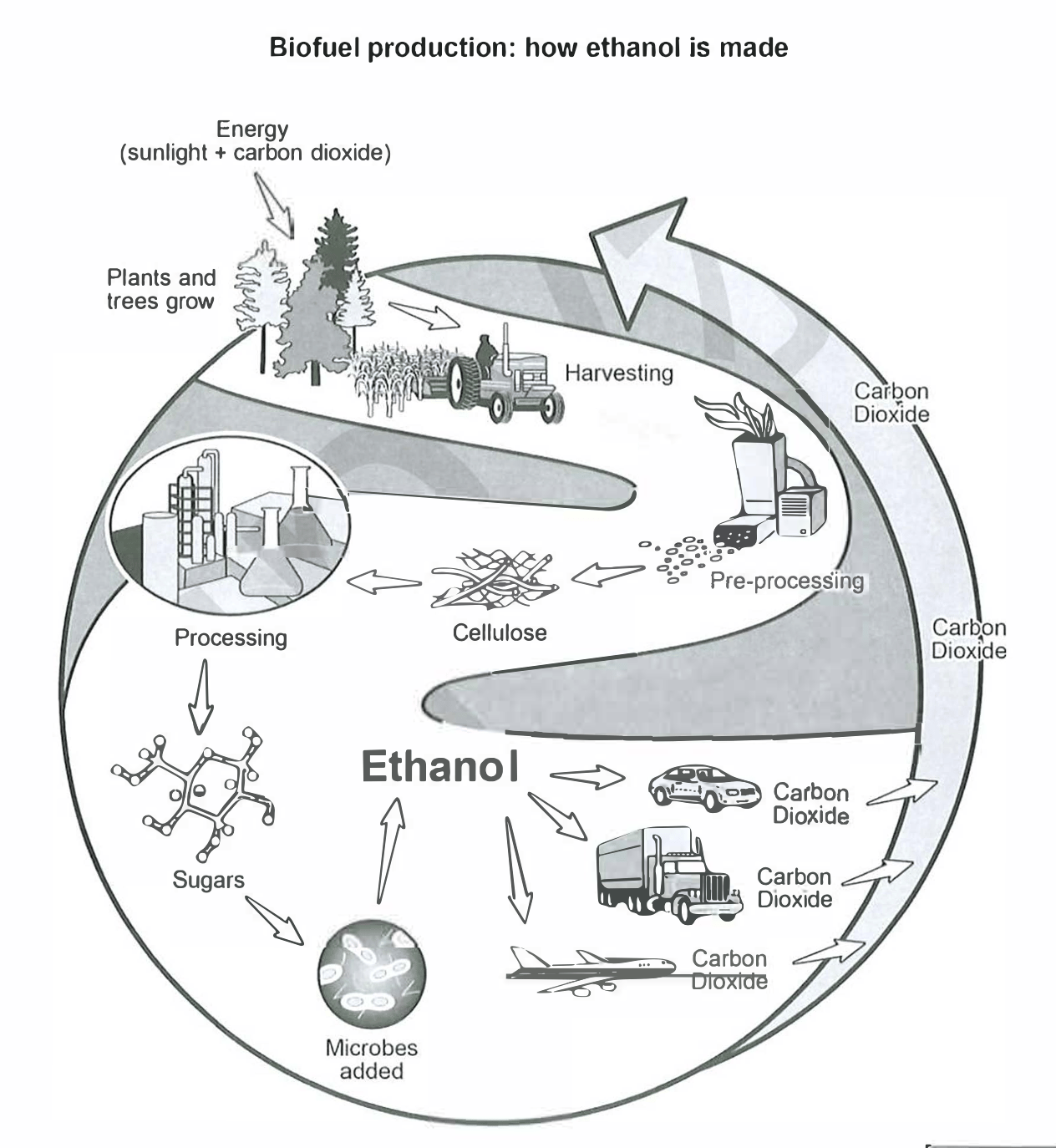
The diagram below shows how a biofuel called ethanol is produced.
Summarise the information by selecting and reporting the main features, and make comparisons where relevant.
Student answer (Band 6.0)
The diagram below illustrates the stages involved in processing a biofuel known as ethanol in an industry.
Overall, several steps take place during the production of ethanol, ranging from growing the plants and trees,which is the longest stage, to harvesting and processing before the final product is being utilized by motor vehicles and planes while releasing Carbon Dioxide in the atmosphere, which is later used by plants and trees.
The initial step begins with plants and tree planting which is the longest stage as it requires time. When the plants and trees mature, they are harvested and transported to the factory where they are pre-processed producing Cellulose, which is fibre dense.The cellulose is then processed into simple Sugars, in liquid form, Microbes are then added and the end product called ethanol is produced.
This end product, ethanol is then ready to use as Biofuel in vehicles and planes. As it is used, Carbon dioxide is released in the atmosphere and reabsorbed by the plants and trees.
AI examiner evaluation
| Criterion | Band |
|---|---|
| Task Achievement / Task Response | 6.5 |
| Coherence and Cohesion | 6.0 |
| Lexical Resource | 6.0 |
| Grammatical Range and Accuracy | 6.0 |
| Overall | 6.0 |
Task Achievement / Task Response: Band 6.5
The response covers the main stages and gives a clear overview of the cycle, including plant growth, conversion through cellulose and sugars, ethanol use, and carbon dioxide returning to the plants. This captures the diagram’s central process and is a strong feature. Some details, however, are not fully accurate or developed: the diagram shows plants and trees growing with sunlight and carbon dioxide, rather than being planted, and it does not indicate that growth is the longest stage or that harvested material is transported to a factory. The account also omits the three transport modes and the addition of microbes as a distinct stage, although microbes are mentioned. To strengthen the summary further, report the diagram’s stages precisely and avoid unsupported claims.
Coherence and Cohesion: Band 6.0
The response is arranged in a sensible sequence: an introduction and overview are followed by the production stages and then the fuel’s use and carbon cycle. This makes the process easy to follow overall. Sequencing expressions such as “The initial step,” “When,” and “then” help guide the reader, and the paragraphing is appropriate. However, some links between stages are compressed, particularly the transition from harvesting through pre-processing to cellulose, and the final paragraph repeats information already included in the overview. A few long sentences also carry several stages at once, making the progression less smooth. Use clearer stage-by-stage transitions and reduce repetition so that cohesion feels less mechanical.
Lexical Resource: Band 6.0
There is an adequate range of process vocabulary, including “pre-processed,” “Cellulose,” “simple Sugars,” “Microbes,” “end product,” and “reabsorbed.” These terms help communicate the production cycle, and the meaning remains clear. Some word choices and collocations are imprecise, however: “plants and tree planting” does not accurately describe the diagram’s natural growth stage, while “utilized by motor vehicles and planes” is awkward and does not mention the truck shown. “Fibre dense” is also an unnatural description of cellulose, and capitalisation of common process terms such as “carbon dioxide” and “sugars” is inconsistent. Aim for precise, natural process language and use the diagram’s labels where appropriate.
Grammatical Range and Accuracy: Band 6.0
The response uses a mix of simple and complex structures, including a relative clause in “which is later used by plants and trees” and a time clause beginning “When the plants and trees mature.” Most sentences communicate the process clearly. Some grammatical and punctuation errors remain. In “plants and trees,which,” a space is missing after the comma; “the end product called ethanol is produced” would be clearer with commas around “called ethanol.” The phrase “This end product, ethanol is then ready” also needs punctuation around the appositive. In addition, “before the final product is being utilized” is an awkward tense construction for a general process; use the simple present, “is used.” More consistent sentence control and proofreading would improve accuracy.
See this exact question answered at other band scores. The same prompt compared across bands.
Browse more IELTS Writing model answers or get your own writing scored by the same AI examiner.