Band 6.0 IELTS Writing Task 1 Model Answer
Overall Band Score: 6.0 · Cambridge IELTS 19 · 2026-11-13
IELTS Writing Task 1 question
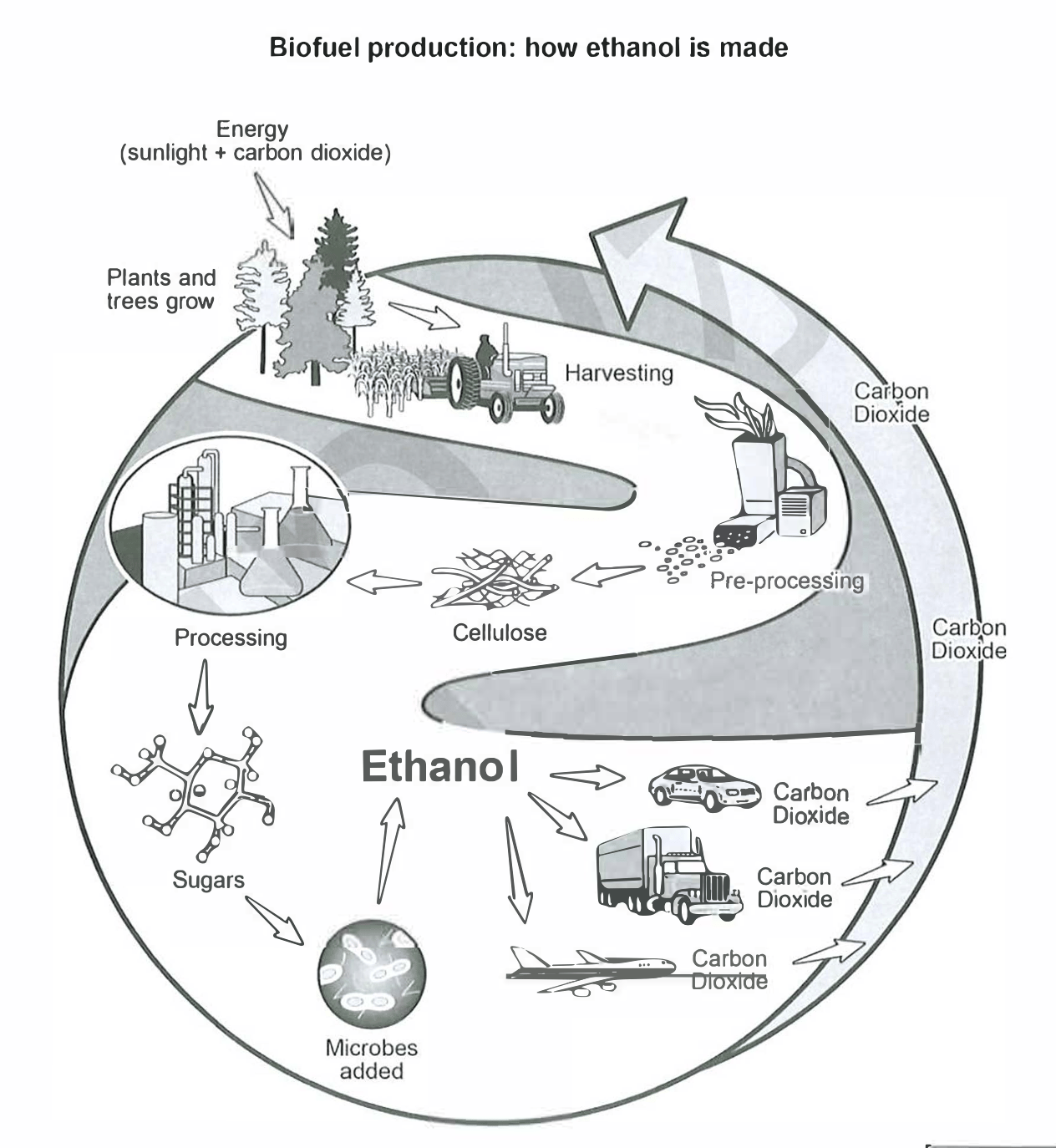
The diagram below shows how a biofuel called ethanol is produced.
Summarise the information by selecting and reporting the main features, and make comparisons where relevant.
Student answer (Band 6.0)
The diagram depicts the production of a biofuel called ethanol.
Overall, the process of making ethanol consists of ten different stages and a number of different tools and infrastructures, beginning with growing the plants and trees to releasing Carbon Dioxide into environment.
At the begininig of the process, the plants and trees grow by consuming the energy from sun and carbon dioxide from environment and these plants were harvested through a tructor by humans. After that, cultivated plants went through a pre-processing machine to produce cellulose. These cellulose then taken to chemical lab for processing.
In the next stage, after the processing, sugers, the raw ingrediant of making ethanol, were created. Afterwards, microbes were added to the refined sugers that creates ethanol. This ethanol then used to cars, trucks, planes as a fuel to their engine to produce power. Meanwhile carbon dioxide was also created while ethanol was breaking in the engine. These carbon dioxide then released to the atmosphere for the plants to grow them again.
AI examiner evaluation
| Criterion | Band |
|---|---|
| Task Achievement / Task Response | 6.0 |
| Coherence and Cohesion | 6.0 |
| Lexical Resource | 5.5 |
| Grammatical Range and Accuracy | 5.5 |
| Overall | 6.0 |
Task Achievement / Task Response: Band 6.0
You cover the main stages from plant growth through processing and transport use, and you identify the important cycle in which carbon dioxide returns to support further growth. The overview also gives the reader a useful sense of the process as a whole. However, some details are imprecise or unsupported: the diagram shows pre-processing and processing, but not a “pre-processing machine” or “chemical lab,” and it does not specify that the plants are harvested “by humans.” The description of carbon dioxide being produced as ethanol is “breaking in the engine” is also less precise than saying it is released by the vehicles. Develop the overview more clearly by highlighting the conversion from cellulose to sugars and then ethanol, alongside the recycling of carbon dioxide.
Coherence and Cohesion: Band 6.0
The response is arranged in a clear sequence, with an introduction, an overview, and two paragraphs that follow the stages of the diagram. Linking phrases such as “At the beginning,” “After that,” and “In the next stage” help readers follow the process. This gives the account coherent overall progression. Some connections and references are less clear, however: “These cellulose” and “These carbon dioxide” do not refer smoothly to their preceding nouns, and “Meanwhile” suggests a contrast or simultaneous event that is not fully explained. The overview also repeats the endpoint of carbon dioxide release without clearly previewing the central conversion stages. Use more precise referencing and vary the links by showing cause and sequence explicitly.
Lexical Resource: Band 5.5
You use relevant process vocabulary, including “harvested,” “pre-processing,” “cellulose,” “microbes,” and “ethanol,” so the reader can understand the main stages. There are also attempts at more specific wording, such as “raw ingredient” and “refined sugars.” However, several spelling errors—“begininig,” “tructor,” “sugers,” and “ingrediant”—reduce accuracy, while phrases such as “chemical lab” and “breaking in the engine” are not precise descriptions of the diagram. “Tools and infrastructures” is also an awkward choice for the equipment and facilities shown. Aim for accurate spelling and natural process collocations, and use neutral terms such as “processing facility” rather than adding a specific setting not shown.
Grammatical Range and Accuracy: Band 5.5
You attempt a mix of simple and complex sentences, including a longer explanation of how plants grow and a sequence of stages linked with “After that” and “Afterwards.” The overall meaning is generally understandable, but some grammatical errors remain. For example, “These cellulose then taken” is missing a verb form, and “microbes were added … that creates ethanol” has an unclear relative clause and inconsistent tense. There are also problems with articles and prepositions in “released to the atmosphere” and “used to cars.” Keep the process consistently in the present simple or passive present, and check subject–verb agreement and complete verb phrases. Shortening a few long sentences would also help you control the grammar more reliably.
See this exact question answered at other band scores. The same prompt compared across bands.
Browse more IELTS Writing model answers or get your own writing scored by the same AI examiner.