Band 6.5 IELTS Writing Task 1 Model Answer
Overall Band Score: 6.5 · Cambridge IELTS 19 · 2026-11-14
IELTS Writing Task 1 question
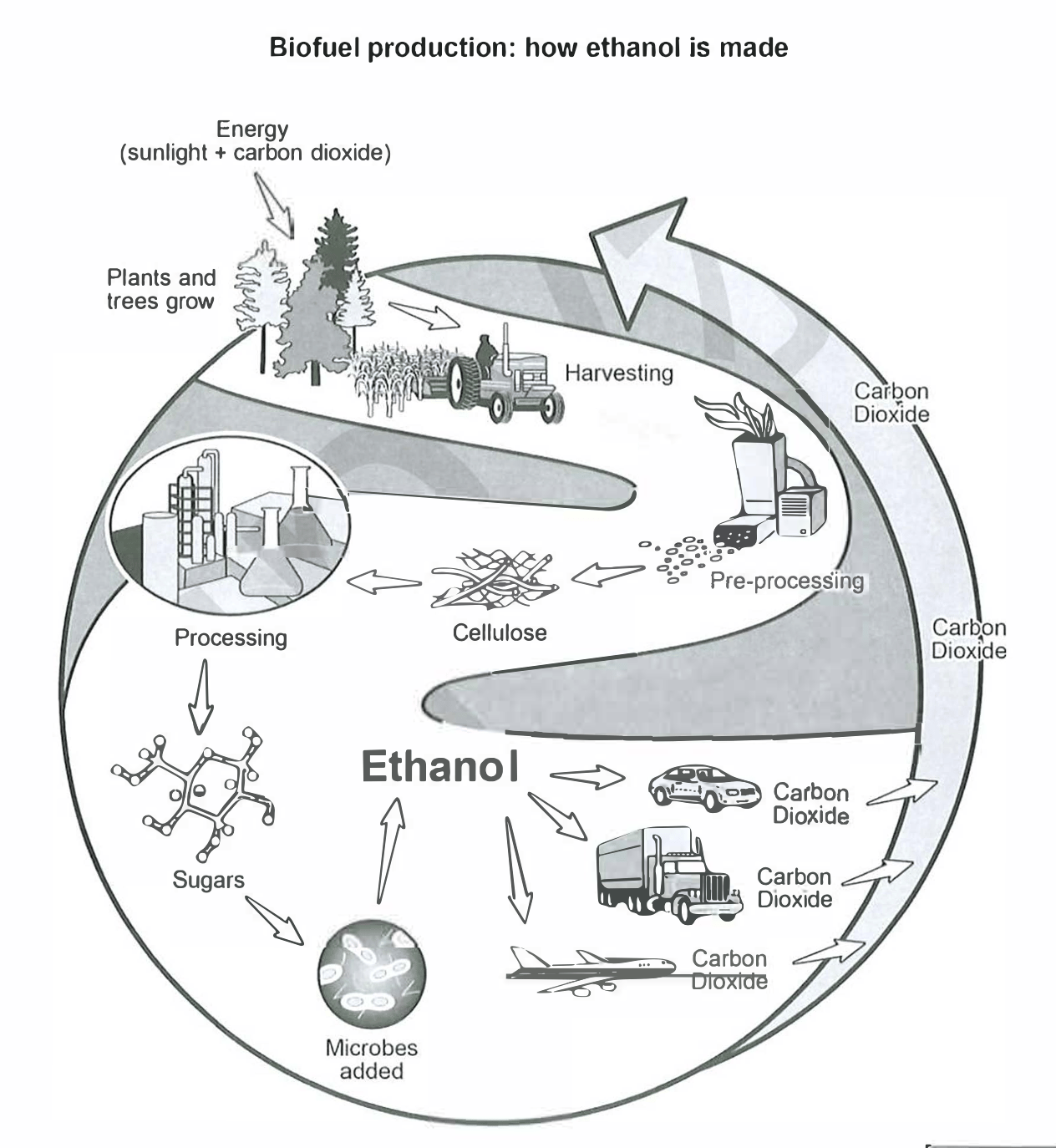
The diagram below shows how a biofuel called ethanol is produced.
Summarise the information by selecting and reporting the main features, and make comparisons where relevant.
Student answer (Band 6.5)
The diagram illustrates the cycle of biofuel production which is called ethanol.
Overall, the cycle shows how from the environment , carbon dioxide is used to make the biofuel and how it is recirculated again in the atmosphere , helping to make a sustainble energy source.
According to the diagram, energy coming from the sunlight and atmospheric carbon dioxide helps plant and tree to grow and after the farmer harvesting those trees and plants they goes through a pre-processing process where it is compressed to make cellulose. Then, the cellulose is processed through some chemical reactions where sugar is extracted from that product.
Subsequently, after extracting sugar from cellulose microbes are added to the sugar so that it can make ethanol which is later called bio-fuel. Lasltly, this bio fuel is used in every transportation system such as car, truck , aeroplane etc. From the emission of these vehicles , carbon dioxide releases in the atmosphere again and helps to grow plants and trees again making a wonderful example of renewable energy.
AI examiner evaluation
| Criterion | Band |
|---|---|
| Task Achievement / Task Response | 7.0 |
| Coherence and Cohesion | 7.0 |
| Lexical Resource | 6.0 |
| Grammatical Range and Accuracy | 5.5 |
| Overall | 6.5 |
Task Achievement / Task Response: Band 7.0
You cover the main stages in a clear sequence, from sunlight and carbon dioxide supporting plant growth through harvesting, processing, the addition of microbes, and ethanol use in transport. Your overview also identifies the central feature of the diagram: carbon dioxide returns to the atmosphere and supports further plant growth, making the process cyclical. This gives the response a clear focus and addresses the task well. Some details, however, go beyond what the diagram shows: it does not state that the material is compressed, that chemical reactions extract the sugars, or that ethanol is used in “every” transport system. For stronger coverage, report only visible information and describe the three transport modes without generalising beyond them.
Coherence and Cohesion: Band 7.0
The response is organised into an introduction, an overview, and two paragraphs describing the stages, with a logical progression through the cycle. Sequencing expressions such as “According to the diagram,” “Then,” “Subsequently,” and “Lastly” help the reader follow the process. The final reference to carbon dioxide returning to the atmosphere also connects the end of the description to the cycle introduced in the overview. Cohesion is generally effective, although some links are repetitive or make the sequence sound more causal than the diagram establishes, as in “so that it can make ethanol.” Use precise stage-to-stage links and clear references to the materials at each point to make the progression even smoother.
Lexical Resource: Band 6.0
You use a suitable range of process vocabulary, including “pre-processing,” “cellulose,” “extracted,” “emission,” and “renewable energy,” which helps explain the diagram. Some word choices and collocations are imprecise, however: “the farmer harvesting those trees” is not a natural description of the labelled harvesting stage, and “bio-fuel” is unnecessarily varied from “biofuel.” There are also spelling errors, notably “sustainble” and “Lasltly,” and “sugar” should be plural to match the diagram’s “Sugars.” These do not prevent understanding, but they limit precision. Aim for consistent technical terms and check spelling and collocations during revision.
Grammatical Range and Accuracy: Band 5.5
You attempt a mix of simple and complex sentences, including a relative clause in “which is later called bio-fuel” and time links such as “after extracting sugar.” The overall meaning remains understandable, but some grammatical errors recur. For example, “plant and tree … helps” has number-agreement problems, while “they goes through” mismatches the plural subject and verb. The opening phrase “how from the environment” is also awkwardly structured, and several long sentences would benefit from clearer clause boundaries and punctuation. Work on subject–verb agreement, articles and plurals, and sentence control; accurate versions of these patterns would make your process description easier to read.
See this exact question answered at other band scores. The same prompt compared across bands.
Browse more IELTS Writing model answers or get your own writing scored by the same AI examiner.