Band 6.0 IELTS Writing Task 1 Model Answer
Overall Band Score: 6.0 · Cambridge IELTS 19 · 2026-11-14
IELTS Writing Task 1 question
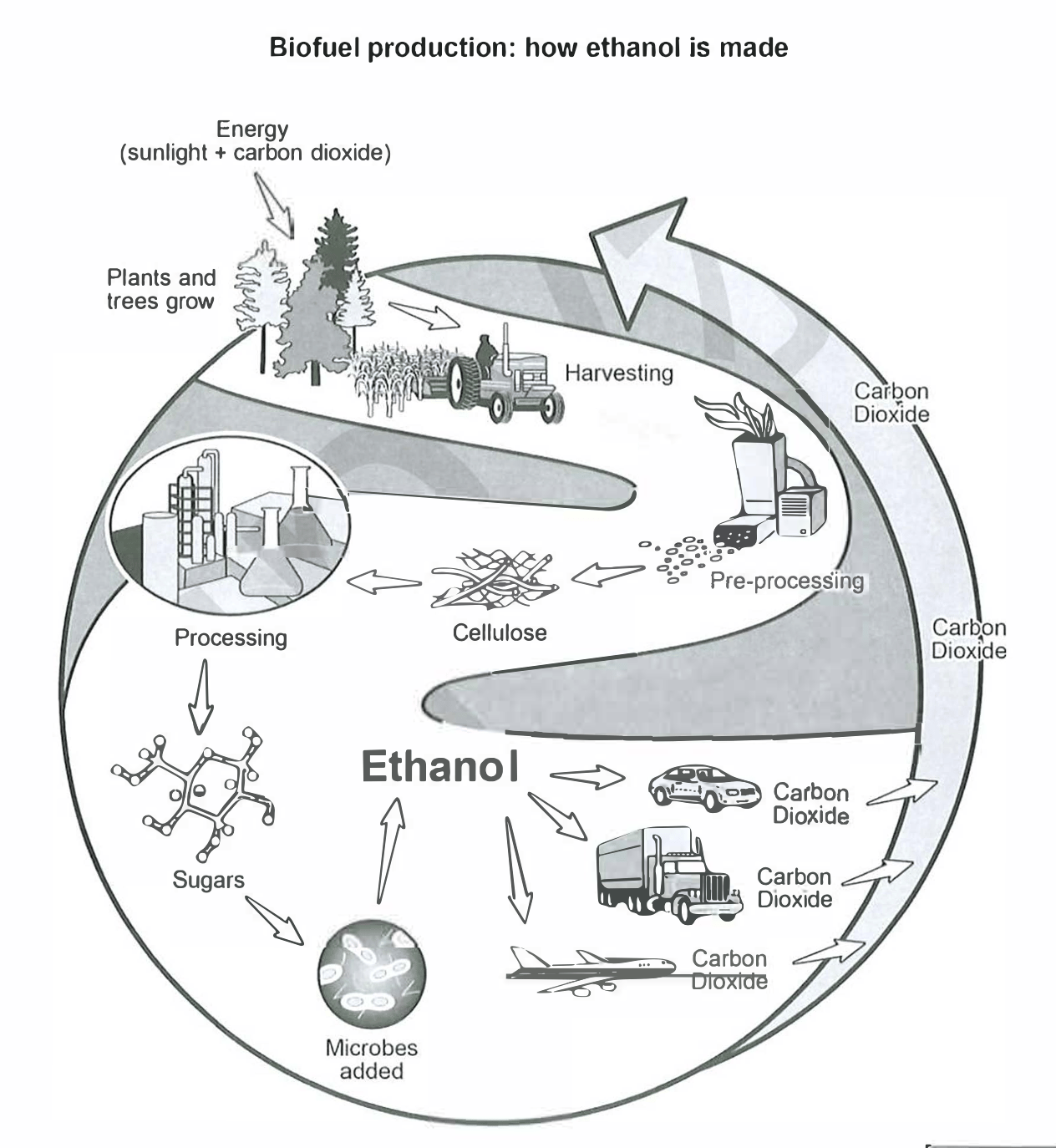
The diagram below shows how a biofuel called ethanol is produced.
Summarise the information by selecting and reporting the main features, and make comparisons where relevant.
Student answer (Band 6.0)
The given diagram provides information about how erhanol formed from different steps.
Overall, there are seven steps for making biofuel, however carbon dioxide is the major source for making ethanol and the main think is that whole process is recycling process.
The production of ethanol starts from plants and trees, as plants use sunlight and carbon dioxide they grow. Secondly, these plants harvested before putting them to pre-processing machiens. After undergoing some process in pre-processing machiens these plants are converted into cellulose, which is the fourth process of ethanols' production. In the fifth step the cellulose sent to liboratory where different camicals used for further changings.
Furthermore, after some testing in liboratory cellulose is converted into sugars, which is the second last step of this process. In the last step microbes are added to sugars and finally ethanol is ready. When ethanol made it used in cars, trucks and airplans which release carbon dioxide which again use in growing plants.
AI examiner evaluation
| Criterion | Band |
|---|---|
| Task Achievement / Task Response | 6.5 |
| Coherence and Cohesion | 6.5 |
| Lexical Resource | 5.0 |
| Grammatical Range and Accuracy | 5.5 |
| Overall | 6.0 |
Task Achievement / Task Response: Band 6.5
You identify the diagram as a production cycle and cover the main sequence from plant growth through harvesting, processing, sugar production and the addition of microbes. You also include the use of ethanol in transport and the return of carbon dioxide to plant growth, which supports a relevant overview. This shows good coverage of the task. However, some details are inaccurate or unclear: the diagram does not specify seven steps, and it does not show laboratory testing or chemicals; it shows processing that converts cellulose into sugars. The overview also calls carbon dioxide the “major source,” which is not quite accurate because sunlight is also shown as an energy input. More precise reporting of the stages and inputs would make the account more complete and accurate.
Coherence and Cohesion: Band 6.5
The response has a clear overall arrangement: an introduction and overview are followed by a chronological account of the process. Sequencing expressions such as “Overall,” “Secondly,” “Furthermore” and “In the last step” help readers follow the stages, and the final sentence returns to the cycle’s carbon-dioxide link. This is a coherent structure. At times, however, the linking is mechanical, and the sequence becomes confusing when the text calls cellulose the “fourth process” and then describes the next stage as laboratory work. Some references, such as “these plants” and “which is the second last step,” could be clearer. Grouping the stages into two connected phases and using more precise transitions would improve progression.
Lexical Resource: Band 5.0
You use relevant process vocabulary, including “harvested,” “pre-processing,” “cellulose,” “sugars” and “microbes,” so the reader can recognise the subject and many stages. There is also an attempt to use more formal wording, such as “undergoing” and “converted into.” However, spelling and word-choice problems are noticeable and sometimes make the description less precise: “erhanol,” “machiens,” “liboratory” and “camicals” are misspelled, while “different changings” is not a natural expression. “Testing” and “laboratory” also introduce details not shown in the diagram. Build accuracy with standard process collocations and check spelling carefully; for example, describe material as being “processed” or “converted,” rather than undergoing “changings.”
Grammatical Range and Accuracy: Band 5.5
You attempt a mixture of simple and complex sentences, including a time clause in “as plants use sunlight and carbon dioxide they grow” and a relative clause in “which is the second last step.” The overall meaning is generally recoverable, but some grammatical errors remain. Examples include missing auxiliaries or passive forms in “plants harvested,” “the cellulose sent,” and “When ethanol made it used”; these should be “plants are harvested,” “cellulose is sent,” and “when ethanol is made, it is used.” There are also article and agreement issues, such as “the main think is that whole process is recycling process.” More consistent use of the passive voice, articles and complete verb phrases would improve accuracy while retaining your sentence variety.
See this exact question answered at other band scores. The same prompt compared across bands.
Browse more IELTS Writing model answers or get your own writing scored by the same AI examiner.