Band 5.5 IELTS Writing Task 1 Model Answer
Overall Band Score: 5.5 · Cambridge IELTS 19 · 2026-11-14
IELTS Writing Task 1 question
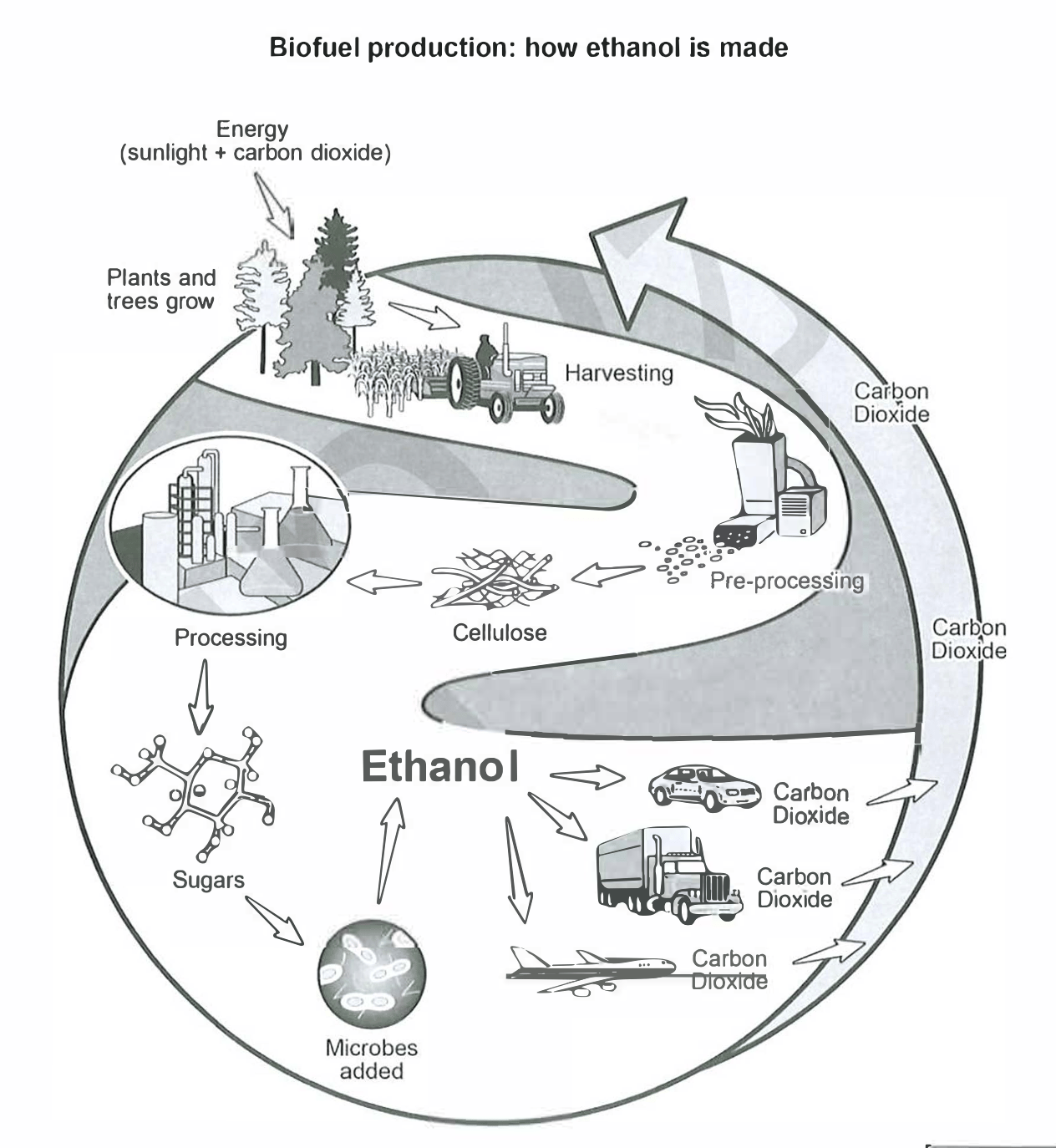
The diagram below shows how a biofuel called ethanol is produced.
Summarise the information by selecting and reporting the main features, and make comparisons where relevant.
Student answer (Band 5.5)
The process diagram illustrates information about the biofuel recycling and making by using different steps.
Overall, it is evident that biofuel produced with seven steps, while main step was ethanol converted into carbon dioxide. To began with, tree grew and end with ethanol fuel consumption. Notably, this process have seven steps and every steps related to other ones, this process was a recycling process.
The production of ethanol started with first step plants and trees grew after that harvesting was the next phase. Furthermore, the third step was most essential to convert raw material into cellulose form with the help of pre-processing machines.
At the end ending phase, cellulose converted into sugars formulation and added microbes to changed the condition of sugars into Ethanol. However, ethanol used in different vehicle which indicated in second last step. The last but more crucial step was ethanol changed into carbon dioxide and again react with sunlight, this process helps to trees would grow again by using energy.
AI examiner evaluation
| Criterion | Band |
|---|---|
| Task Achievement / Task Response | 5.5 |
| Coherence and Cohesion | 5.5 |
| Lexical Resource | 5.5 |
| Grammatical Range and Accuracy | 5.0 |
| Overall | 5.5 |
Task Achievement / Task Response: Band 5.5
You identify the diagram as a production cycle and mention several central stages, including plant growth, harvesting, pre-processing, cellulose, sugars, microbes and ethanol. You also recognise that ethanol is used by vehicles and that carbon dioxide returns to support further plant growth. However, the account is only partly accurate: it says there are seven steps, although the diagram shows a longer sequence, and it places the conversion to sugars after cellulose without clearly describing the separate processing stage. The overview also incorrectly suggests ethanol itself is converted directly into carbon dioxide, rather than explaining that transport use releases carbon dioxide. To improve, give a precise overview of the cycle and report the stages in order, including the processing stage and the three transport types.
Coherence and Cohesion: Band 5.5
The response has a basic paragraph structure, moving from an introduction and overview to descriptions of the early and later stages. Sequencing expressions such as “To began with,” “after that,” and “At the end” help signal progression. However, the progression is not consistently clear: the overview says the process has seven steps, while later paragraphs refer to a “third step” and a “second last step,” making the sequence difficult to follow. Some linking phrases are awkward or do not show the intended relationship, and “At the end ending phase” is repetitive. Organise the stages in a straightforward chronological sequence and use a small range of accurate connectors, such as “Next,” “Following this,” and “Finally.”
Lexical Resource: Band 5.5
You use some relevant process vocabulary, including “harvesting,” “pre-processing,” “cellulose,” “microbes,” and “carbon dioxide,” so the reader can identify the main subject and several stages. However, the range is limited and several word choices or combinations are inaccurate, sometimes making the process unclear. For example, “biofuel recycling and making” is an imprecise description, “cellulose form” and “sugars formulation” are unnatural, and “ethanol fuel consumption” does not clearly describe its use in transport. “Most essential” is also an unsupported evaluation rather than a precise process description. Aim for standard process language and accurate collocations, such as “ethanol production,” “cellulose is processed into sugars,” and “ethanol is used as a fuel in vehicles.”
Grammatical Range and Accuracy: Band 5.0
You attempt both simple and longer sentences, and the overall meaning is usually recoverable. However, errors occur frequently in verb forms, agreement, articles and sentence construction. Examples include “biofuel produced with seven steps” (missing a finite verb and incorrect preposition), “To began with,” “tree grew,” and “this process have seven steps.” The sentence “added microbes to changed the condition” also has faulty verb patterns, while “this process helps to trees would grow again” combines incompatible structures. These errors sometimes make relationships between stages difficult to understand. Practise forming accurate present-simple passive sentences for processes, for example, “The cellulose is processed into sugars, and microbes are then added,” and check subject–verb agreement and verb forms.
See this exact question answered at other band scores. The same prompt compared across bands.
Browse more IELTS Writing model answers or get your own writing scored by the same AI examiner.