Band 6.0 IELTS Writing Task 1 Model Answer
Overall Band Score: 6.0 · Cambridge IELTS 19 · 2026-11-14
IELTS Writing Task 1 question
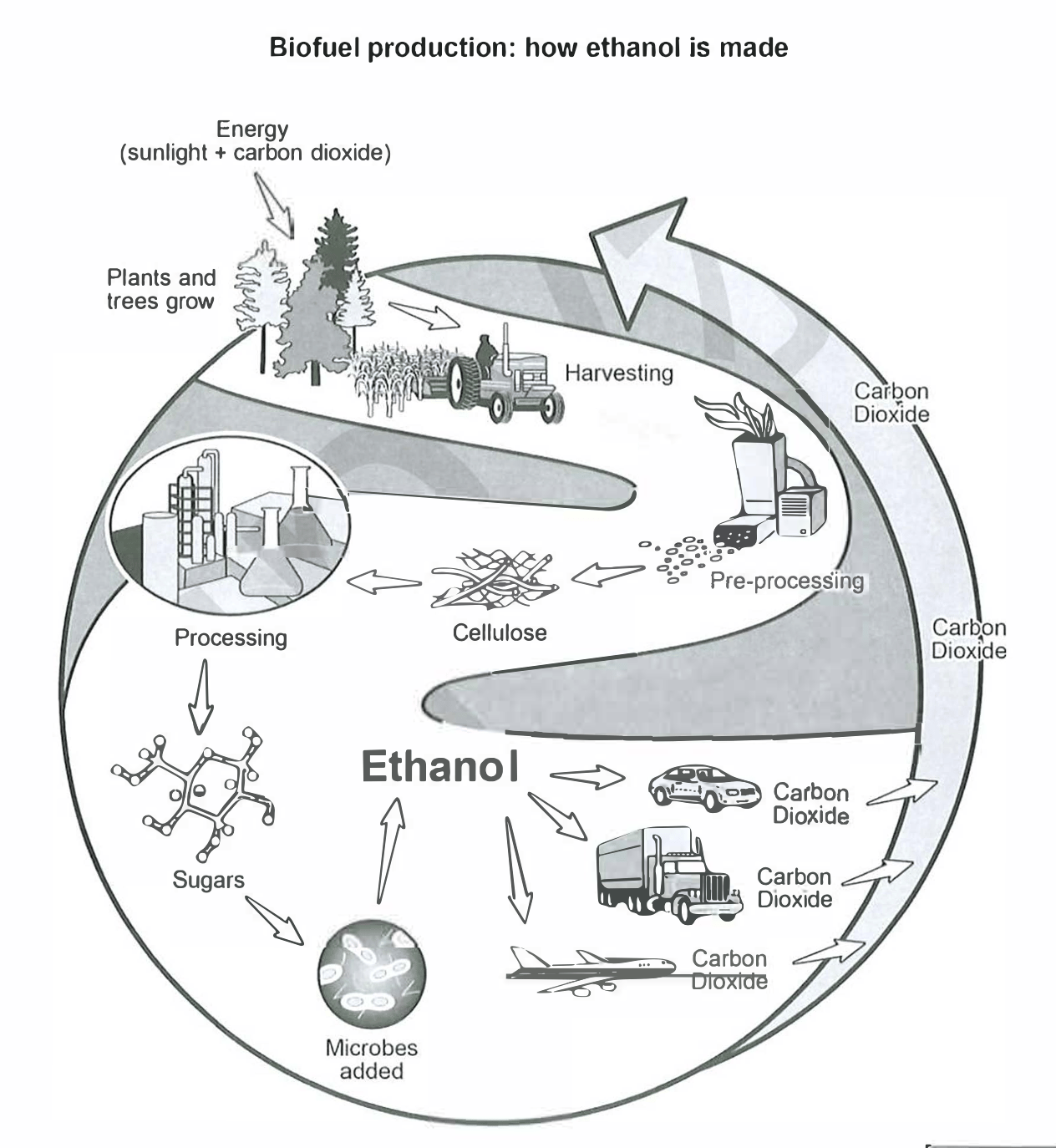
The diagram below shows how a biofuel called ethanol is produced.
Summarise the information by selecting and reporting the main features, and make comparisons where relevant.
Student answer (Band 6.0)
The diagram illustrates, the procedure for ethanol production. Overall, the procedure for its production consists of various stages. The process began with growth of plants and trees by absorbing sunlight and carbon dioxide. This is a recycle, agriculture and industrial mixed process.
It starts with the growth of plants and trees. These plants and trees absorb carbon dioxide and sun light. In the second step, trees and plants are harvested. Then, in the 3rd stage, plants and trees goes throw pre-processing, and cut down into little pieces by a cutter machine. In the 4th stage, the material turned into cellulose. Afterwards, this cellulose goes throw a processing on a large scale.
In the 6th stage, the cellulose after the processing, turned into sugars particles. Later, the microbes are added into sugar material, in the 7th step. Afterwards, the mixture of microbes and sugar became ethanol. This ethanol used as a fuel in cars, trucks and aeroplanes. As a result, carbon dioxide spreaded into the atmosphere, and later again absorb by the trees and plants.
AI examiner evaluation
| Criterion | Band |
|---|---|
| Task Achievement / Task Response | 6.5 |
| Coherence and Cohesion | 6.0 |
| Lexical Resource | 5.5 |
| Grammatical Range and Accuracy | 5.0 |
| Overall | 6.0 |
Task Achievement / Task Response: Band 6.5
You cover the main stages from plant growth through processing, sugar production, fermentation and fuel use, and you identify the cycle linking carbon dioxide from transport back to plant growth. The overview also recognises that this is a combined agricultural and industrial process. Some details, however, are not supported by the diagram: it does not show a cutter or say that the material is cut into small pieces, and it does not specify that carbon dioxide is released into the atmosphere. The stage numbering is also inconsistent: microbes are added after sugars, but the response calls this the seventh step after describing processing as the fourth. To strengthen the response, report the sequence more precisely and avoid adding unshown details; the main features are present, but not all are fully accurate or clearly developed.
Coherence and Cohesion: Band 6.0
The response has a recognisable overall structure: an opening and overview are followed by a description of the process, with stages generally presented in sequence. Connectors such as “Then,” “Afterwards” and “Later” help guide the reader. However, the progression is sometimes mechanical, and the numbering creates confusion: processing is called the fourth stage, while sugars and microbes are later assigned the sixth and seventh steps. The opening also repeats plant growth in the next paragraph, and “This is a recycle, agriculture and industrial mixed process” is not smoothly connected to the overview. Grouping the stages into clearer phases and using accurate references such as “the next stage” would make the sequence easier to follow.
Lexical Resource: Band 5.5
You use relevant process vocabulary, including “harvested,” “cellulose,” “microbes,” “ethanol” and “fuel,” which allows the reader to understand the subject. There is also some attempt to describe technical stages rather than relying only on general words. However, several choices are inaccurate or unnatural, such as “a recycle,” “sugars particles,” “spreaded” and “goes throw.” “Sun light” is also conventionally written as one word, “sunlight.” These errors make the vocabulary less precise and sometimes distract from the process. Aim for standard collocations and accurate word forms, for example “a cyclical process,” “sugar,” and “is released,” while retaining the useful technical terms already used.
Grammatical Range and Accuracy: Band 5.0
You attempt both simple sentences and longer structures, and the sequence is usually understandable. However, control of verb forms and sentence construction is inconsistent. Examples include “plants and trees goes,” “the material turned into cellulose,” “This ethanol used as a fuel,” and “later again absorb by the trees,” where agreement, tense or passive forms are missing or incorrect. The opening comma in “The diagram illustrates, the procedure” is also unnecessary. These errors occur across the response and sometimes make relationships between stages less clear, which limits grammatical accuracy. Practise forming consistent present-simple passives for process descriptions, such as “the material is processed” and “carbon dioxide is absorbed,” and check subject–verb agreement in each sentence.
See this exact question answered at other band scores. The same prompt compared across bands.
Browse more IELTS Writing model answers or get your own writing scored by the same AI examiner.