Band 6.0 IELTS Writing Task 1 Model Answer
Overall Band Score: 6.0 · Cambridge IELTS 19 · 2026-11-14
IELTS Writing Task 1 question
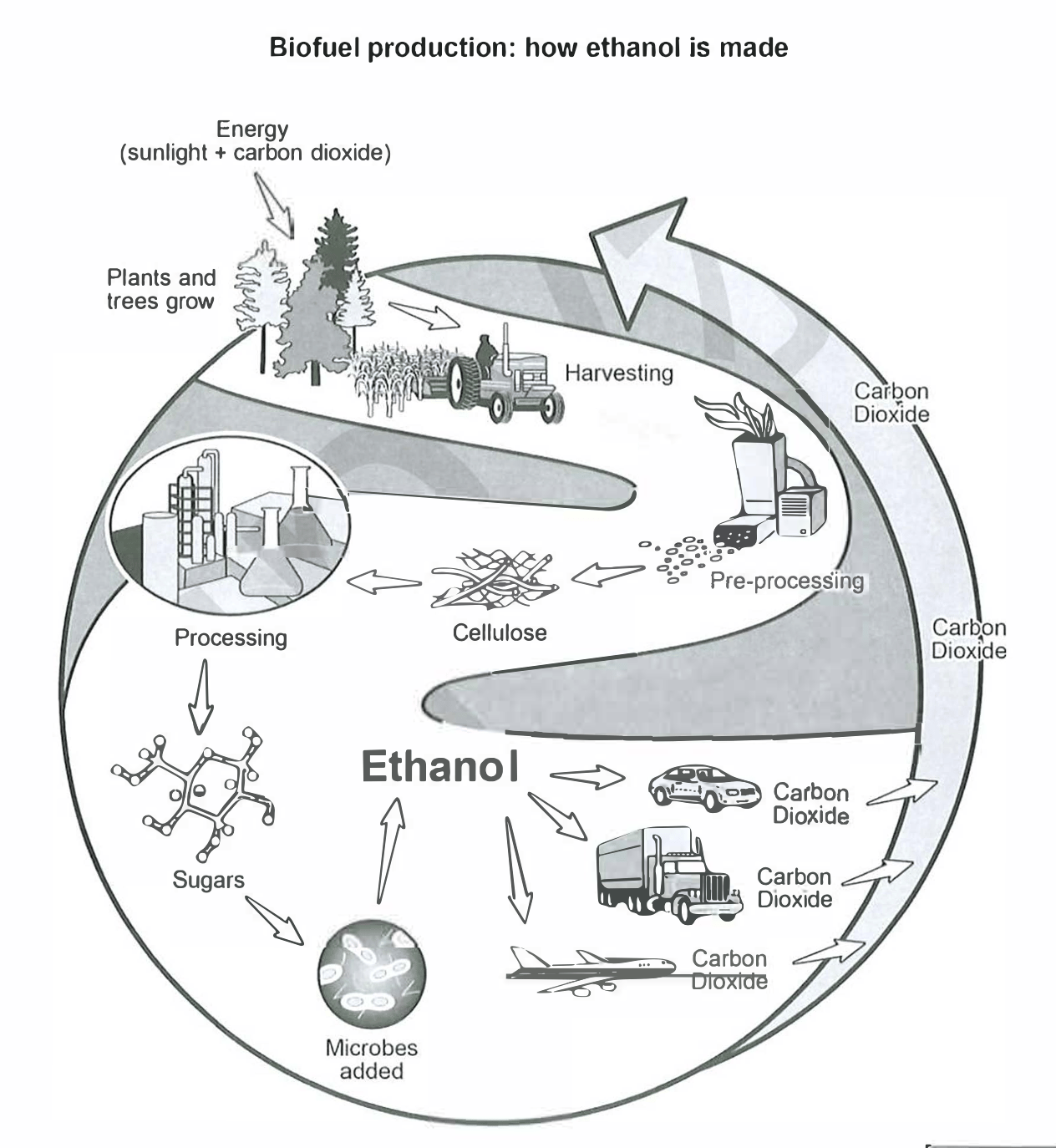
The diagram below shows how a biofuel called ethanol is produced.
Summarise the information by selecting and reporting the main features, and make comparisons where relevant.
Student answer (Band 6.0)
The provided diagram illustrates the process of ethanol production from natural sources. Overall, carbon dioxide is considered the base of this process followed by a lot of steps to produce ethanol.
Firstly, many transportation methods such as cars, vehicles and planes send carbon dioxide as their exhaust, this gas will be absorbed by trees with the sunlight as energy source, plants and trees grow and became ready for harvesting. After harvesting these trees and plants will be transported then pre-processing step occure, the end result of this pre-processing step is the formation of cellulose, some processings will be happened to convert cellulose into sugars, these complicated Sugars just need some microbes to be added to it.The mixing of sugar with microbes is considered the final step of producing ethanol. After the production of ethanol it can be used as a biofuel to operate cars and other transportaions which will send carbon dioxide again and the cicle of the production could start in the same pattern.
AI examiner evaluation
| Criterion | Band |
|---|---|
| Task Achievement / Task Response | 6.5 |
| Coherence and Cohesion | 6.5 |
| Lexical Resource | 6.0 |
| Grammatical Range and Accuracy | 5.5 |
| Overall | 6.0 |
Task Achievement / Task Response: Band 6.5
You cover the main cycle and give an overview that recognises the link between carbon dioxide, plant growth and ethanol use. The sequence from harvesting through pre-processing, cellulose, sugars and the addition of microbes is also reported, so the response addresses the central stages. However, some details are unclear or inaccurate: the diagram shows sunlight and carbon dioxide supporting plant growth, rather than carbon dioxide being the “base” of the process, and it does not show harvested material being transported. The final stage is also described as mixing sugar and microbes, whereas the diagram indicates microbes are added before ethanol is produced. To strengthen the summary, describe the stages more precisely and include the three transport modes shown, while keeping the overview focused on the circular nature of the process.
Coherence and Cohesion: Band 6.5
The response has a clear overall progression: it begins with an overview, follows the production stages, and returns to the carbon-dioxide cycle at the end. Sequencing words such as “Firstly,” “After harvesting,” and “After the production of ethanol” help the reader follow the process. This gives the account a coherent arrangement, but most of the stages are compressed into one long paragraph and sentence, making relationships between steps harder to track. Some links are also imprecise, particularly the transition from microbes to ethanol and the return from transport to plant growth. Use separate paragraphs for the overview and process details, and divide the sequence into shorter sentences with clear references to each stage.
Lexical Resource: Band 6.0
You use a suitable range of process vocabulary, including “harvesting,” “pre-processing,” “cellulose,” “sugars,” and “biofuel,” which helps communicate the diagram’s subject. There are also attempts at more specific phrasing, such as “exhaust” and “formation of cellulose.” However, several choices are inaccurate or awkward for this process: “carbon dioxide is considered the base” is imprecise, “complicated Sugars” is not supported by the diagram, and “mixing of sugar with microbes” does not describe the labelled stage as clearly as “microbes are added.” Spelling errors such as “occure,” “cicle,” and “transportaions” also reduce control. Aim for precise process collocations and check spelling and capitalization.
Grammatical Range and Accuracy: Band 5.5
You attempt both simple and complex sentence forms, including a relative clause in “which will send carbon dioxide again” and a sequence of linked process clauses. The overall meaning is generally recoverable, but some grammatical errors make the long central sentence difficult to follow. For example, “plants and trees grow and became ready” shifts tense, while “some processings will be happened” has an incorrect passive construction. The sentence beginning “Firstly” also joins several independent ideas with commas, and “it can be used … which will send” leaves the reference of “which” unclear. Use consistent present simple for a process diagram, form passives accurately where needed, and break long sequences into shorter, correctly punctuated sentences.
See this exact question answered at other band scores. The same prompt compared across bands.
Browse more IELTS Writing model answers or get your own writing scored by the same AI examiner.