Band 6.5 IELTS Writing Task 1 Model Answer
Overall Band Score: 6.5 · Cambridge IELTS 19 · 2026-11-14
IELTS Writing Task 1 question
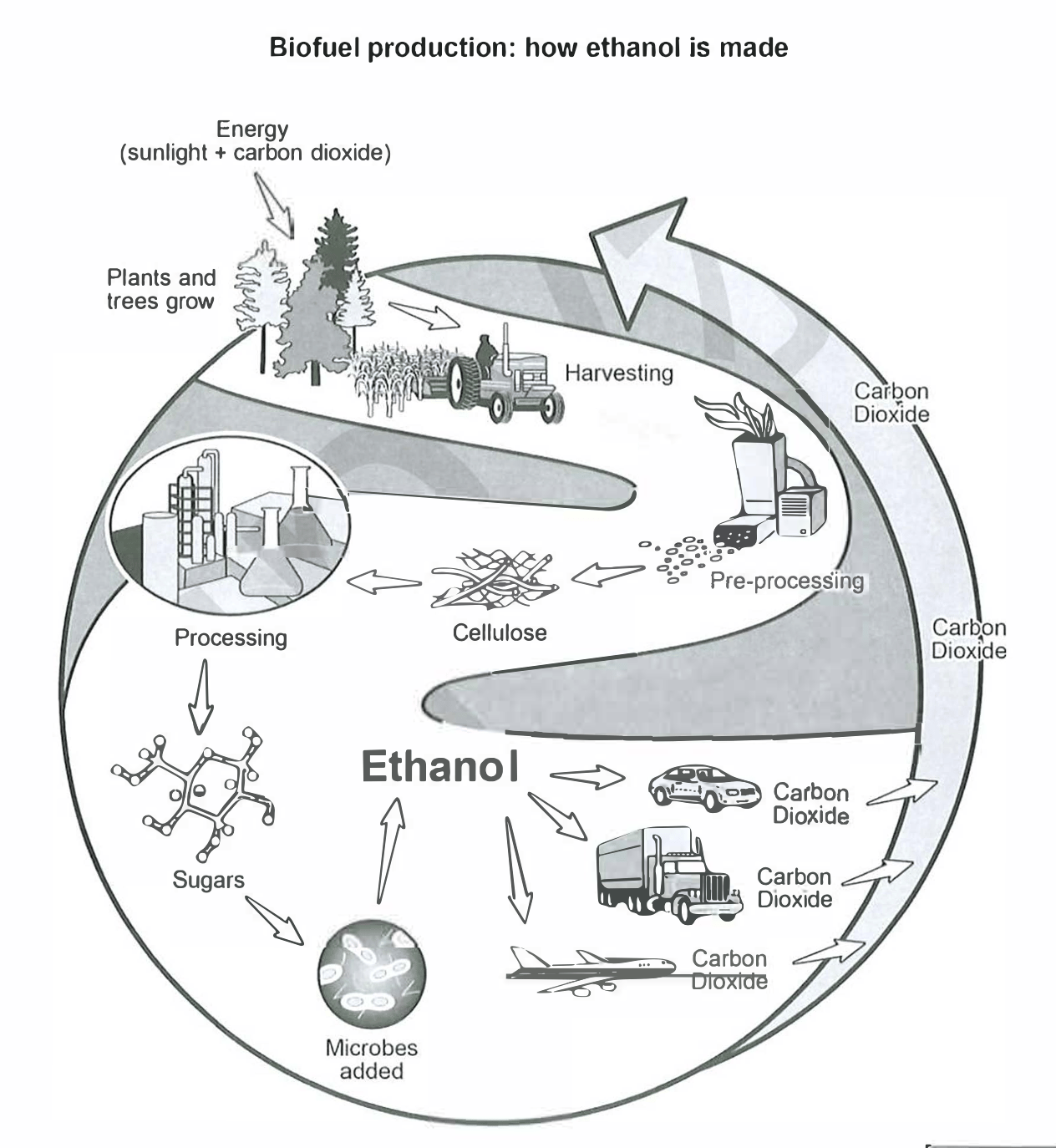
The diagram below shows how a biofuel called ethanol is produced.
Summarise the information by selecting and reporting the main features, and make comparisons where relevant.
Student answer (Band 6.5)
The diagram below illustrates how a biofuel names ethanol is manufactured.
Overall, it comes from energy ( sunlight + carbon dioxide ) which is taken by the trees and goes through several steps to produce ethanol which can be used in various types of vehicles.
Firstly, the process begins with the plants and trees consuming energy ( sunlight + carbon dioxide ) and growing. After that the trees are taken for harvesting which is goes for the pre-processing and makes cellulose. Secondly, the cellulose goes to the processing factory begin processed to make sugars, which is a important substance to make ethanol. Thirdly, sugars and microbes are added altogether to manufacture ethanol. Lastly, the ethanol is ready it is then used by the cars, trucks and even in airplanes. Then, the vehicles uses it and releases carbon dioxide which is then taken by the plants again. Moreover, this is a cycle which starts from the beginning and follows all the steps all over again.
AI examiner evaluation
| Criterion | Band |
|---|---|
| Task Achievement / Task Response | 7.0 |
| Coherence and Cohesion | 6.5 |
| Lexical Resource | 6.0 |
| Grammatical Range and Accuracy | 5.5 |
| Overall | 6.5 |
Task Achievement / Task Response: Band 7.0
You give a clear overview of the cycle and identify its main stages, from plants growing with sunlight and carbon dioxide through processing to ethanol, followed by its use in transport and the return of carbon dioxide to plants. The sequence of harvesting, pre-processing, cellulose, processing, sugars and microbes is also broadly represented, and the account stays focused on the diagram. This coverage and the overall summary are strong. Some details could be more precise: the diagram shows microbes being added to sugars before ethanol is produced, rather than sugars and microbes simply being added “altogether”; it also shows ethanol going to three transport types. Clarifying these relationships would make the process description more exact and fully developed.
Coherence and Cohesion: Band 6.5
The response has a coherent overall arrangement: an overview is followed by the stages in sequence, and the final sentences return to the cycle. Sequencing expressions such as “Firstly,” “Secondly,” “Thirdly” and “Lastly” help the reader follow the process. The progression is generally clear, but the repeated ordinal markers make the linking somewhat mechanical, and “After that the trees are taken for harvesting which is goes for the pre-processing” combines several stages in a confusing way. The final “Moreover” also adds little because the cycle has already been described. To strengthen cohesion, group related stages into paragraphs and use more precise links, such as “The harvested material is then pre-processed” and “The resulting sugars are fermented after microbes are added.”
Lexical Resource: Band 6.0
You use an adequate range of process vocabulary, including “harvesting,” “pre-processing,” “cellulose,” “processing,” “manufacture” and “releases carbon dioxide.” These terms help convey the diagram’s stages, and the meaning is generally understandable. However, some word choices and collocations are inaccurate or imprecise: “a biofuel names ethanol” should be “a biofuel called ethanol,” while “the trees are taken for harvesting” and “sugars and microbes are added altogether” do not describe the process naturally. “Important substance” is also vague where a more specific description of sugars’ role would help. Aim for precise process verbs and natural collocations, for example “the harvested plants are pre-processed” and “microbes are added to the sugars.”
Grammatical Range and Accuracy: Band 5.5
You attempt a mixture of simple and longer sentences, including a clear overview and a sequence of stages. Some clauses communicate the process effectively, such as “the ethanol is ready it is then used by the cars, trucks and even in airplanes,” although this sentence needs clearer punctuation or a linking word. Errors in verb forms, agreement and sentence construction recur: “which is goes for the pre-processing,” “the processing factory begin processed,” and “the vehicles uses it” are examples. Articles and sentence boundaries also need attention, as in “a important substance” and the run-on “the ethanol is ready it is then used.” These errors do not prevent the reader from following the main cycle, but they limit control. Practise accurate passive forms and check each sentence for a complete, correctly linked clause.
See this exact question answered at other band scores. The same prompt compared across bands.
Browse more IELTS Writing model answers or get your own writing scored by the same AI examiner.