Band 4.0 IELTS Writing Task 1 Model Answer
Overall Band Score: 4.0 · Cambridge IELTS 19 · 2026-11-15
IELTS Writing Task 1 question
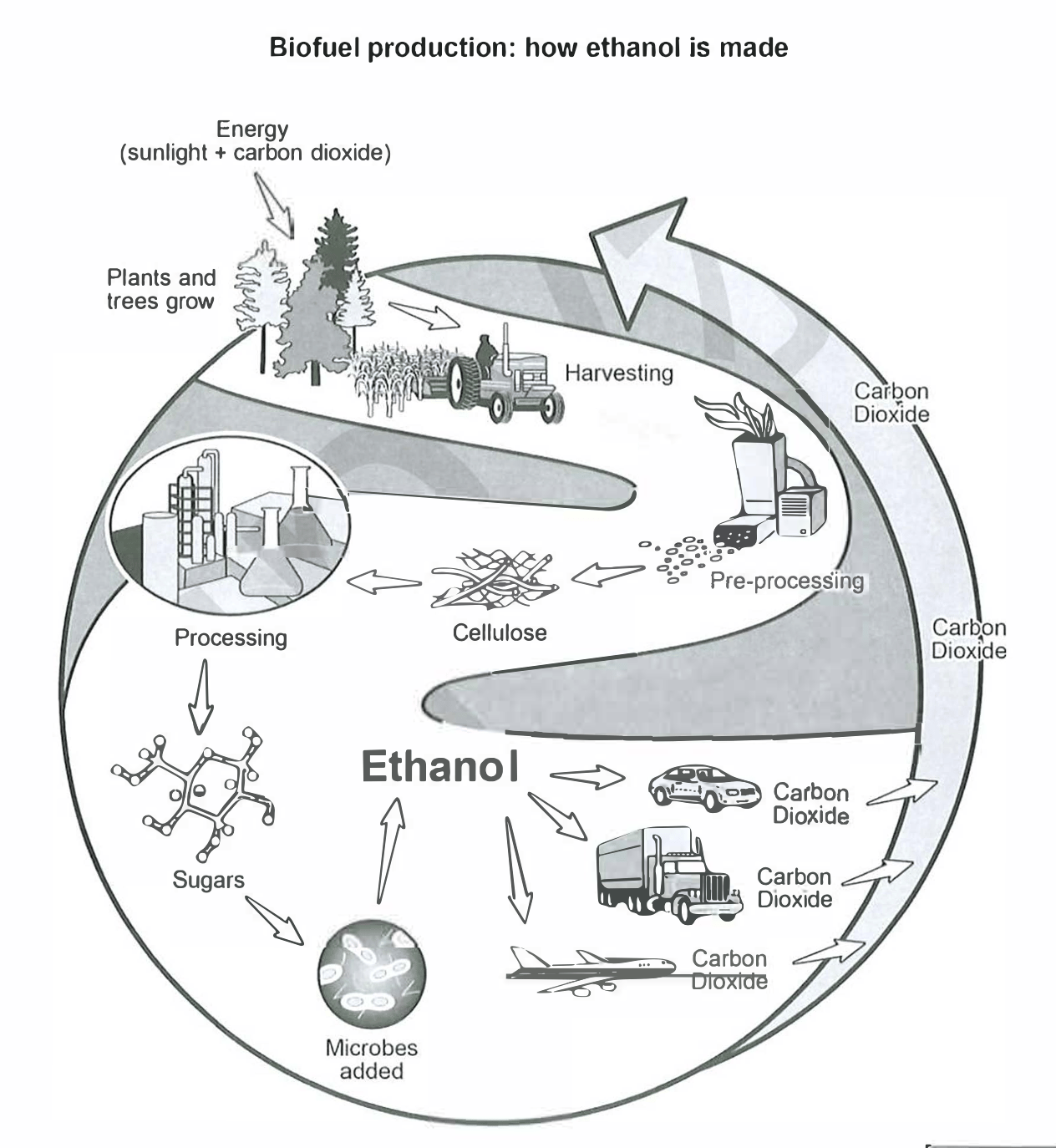
The diagram below shows how a biofuel called ethanol is produced.
Summarise the information by selecting and reporting the main features, and make comparisons where relevant.
Student answer (Band 4.0)
The circular diagram illustrates the production of ethanol, one of the biofuel.
Overall, it is a circular ongoing combined natural and man made process, begins with plants observing carbondioxide from the atmosphere for growth and ending up realising air back towards atmosphere through utilizing as energy to run different mode of tranportations.
People
AI examiner evaluation
| Criterion | Band |
|---|---|
| Task Achievement / Task Response | 3.0 |
| Coherence and Cohesion | 4.5 |
| Lexical Resource | 4.5 |
| Grammatical Range and Accuracy | 4.5 |
| Overall | 4.0 |
Task Achievement / Task Response: Band 3.0
The response identifies the diagram as a circular process and mentions plant growth, carbon dioxide, ethanol, and transport, so it captures a few central elements. However, it does not summarise the main stages: harvesting, pre-processing, cellulose, processing, sugars, and the addition of microbes are all omitted. The overview also inaccurately says the process ends with carbon dioxide being released, whereas the diagram shows this gas returning to support plant growth and complete the cycle. The final word, “People,” is unfinished and does not add relevant information. The response is substantially below the required 150 words, leaving too little detail to report the process adequately. To improve, describe the stages in sequence and explain how transport-related emissions feed back into plant growth.
Coherence and Cohesion: Band 4.5
There is a basic attempt to organise the response: an opening identifies the diagram, followed by an overview beginning with “Overall.” The phrase “begins with … and ending up …” also signals a sequence. However, the response stops after this overview and provides no developed account of the stages, so progression is very limited. The isolated word “People” forms an incomplete final paragraph and disrupts the flow. The overview sentence is also difficult to follow because several ideas are compressed into one long construction. Use separate paragraphs for the overview and the process details, then connect stages with clear sequencing expressions such as “next,” “after this,” and “finally.”
Lexical Resource: Band 4.5
The response uses some relevant process vocabulary, including “circular,” “production,” “plants,” “carbon dioxide,” and “ethanol,” which makes the general topic recognisable. However, the range is too narrow to describe the diagram’s stages, and several word choices or forms are inaccurate: “observing carbon dioxide” does not express plants taking it in, while “realising air” is not an appropriate description of emissions. “Different mode of tranportations” is also awkward and contains a spelling error. The phrase “one of the biofuel” has an incorrect singular form. Build a more precise vocabulary set for the process, including terms such as “absorb,” “harvest,” “convert,” “release,” and “vehicles,” and check spelling and collocations.
Grammatical Range and Accuracy: Band 4.5
The response attempts a complex overview sentence using “begins with … and ending up …,” but the verb forms do not form a parallel structure, and the sentence is difficult to parse. The opening also has an article and number error in “one of the biofuel”; the intended construction requires a plural noun after “one of.” The phrase “plants … for growth” is attached to the sentence in a way that leaves the relationship between the ideas unclear. There is little evidence of a range of sentence structures because the response contains only one developed sentence and an incomplete final fragment, “People.” Aim first for accurate, complete simple sentences, then add controlled complex sentences to explain the sequence and cycle.
See this exact question answered at other band scores. The same prompt compared across bands.
Browse more IELTS Writing model answers or get your own writing scored by the same AI examiner.