Band 5.0 IELTS Writing Task 1 Model Answer
Overall Band Score: 5.0 · Cambridge IELTS 19 · 2026-11-15
IELTS Writing Task 1 question
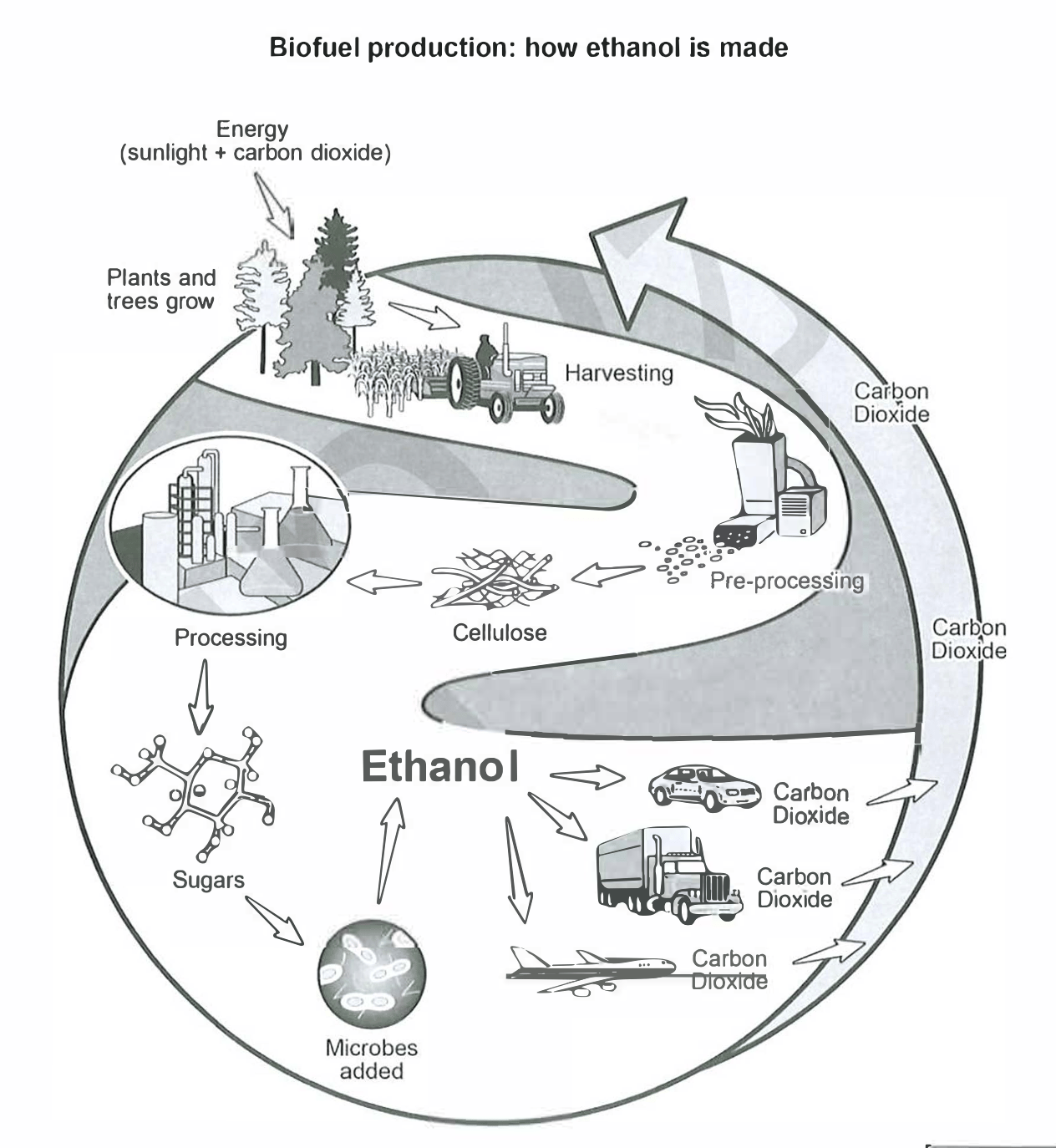
The diagram below shows how a biofuel called ethanol is produced.
Summarise the information by selecting and reporting the main features, and make comparisons where relevant.
Student answer (Band 5.0)
ethanol is one of the biofuel that his production passes from numerous steps.To start with , ethanol is initialy taken from the plants ,Indeed farmers have to provide energy for the plants in order to make them grow .After ensure their full growth , workers harvest them .Then, the pills pass through a machine to turn them into tiny pieces which called pre-proccessing.and respectively we get celluloses .After that ,we move to processing in which the cellulose transform into sugars.finally, we get the finaly product which is ethanol by adding microbes to sugars.This biofuel will be consummed by various vehicels such as trucks cars and planes.and hopefully these stuffs release carbon dioxide which provide energy for plans .hence, we this mecanism will be repeated that s why we can considere ethanol as a renewable energy
AI examiner evaluation
| Criterion | Band |
|---|---|
| Task Achievement / Task Response | 5.5 |
| Coherence and Cohesion | 5.0 |
| Lexical Resource | 5.0 |
| Grammatical Range and Accuracy | 5.0 |
| Overall | 5.0 |
Task Achievement / Task Response: Band 5.5
You describe the main sequence from plant growth and harvesting through pre-processing, cellulose, processing, sugars and the addition of microbes to produce ethanol. You also include the transport uses and the return of carbon dioxide, so the account is relevant and captures the diagram’s cyclical feature. However, the opening is unclear about the source of the plants’ energy: sunlight and carbon dioxide are shown, rather than farmers providing energy. The overview is also only implied in the final sentence, and several stages are briefly or inaccurately described, such as calling the harvested material “pills.” The response is below the required 150 words, which limits how fully you can report the process. A clearer overview and more precise coverage of the cycle would strengthen the response.
Coherence and Cohesion: Band 5.0
The stages are presented mostly in the correct order, and sequencing expressions such as “To start with,” “Then,” “After that” and “finally” help the reader follow the process. The response also moves from production to transport and carbon dioxide, giving it a basic overall structure. However, it is written as one continuous block, and the connectors sometimes make the progression feel mechanical. The relationship between carbon dioxide and plant growth is compressed into “which provide energy for plans,” so the cycle is not clearly explained. Some transitions are awkward or incomplete, particularly “hence, we this mecanism will be repeated.” Organise the account into a short overview and logically grouped stages, and use clearer links between the production cycle and its final return to plant growth.
Lexical Resource: Band 5.0
You use some relevant process vocabulary, including “harvest,” “pre-processing,” “cellulose,” “processing,” “sugars” and “microbes,” which allows the reader to identify several key stages. There is also an attempt to describe the cycle as “renewable energy.” However, the range is limited and several spelling and word-choice errors make the account less clear, including “initialy,” “proccessing,” “consummed,” “vehicels” and “mecanism.” Some expressions are imprecise or unnatural: “the pills” does not accurately name the plant material, and “these stuffs” is unsuitable for the vehicles. Aim for accurate process terms and natural collocations, such as “plant material is broken into smaller pieces” and “vehicles release carbon dioxide.”
Grammatical Range and Accuracy: Band 5.0
The response attempts to connect stages in longer sentences, for example, “After that, we move to processing in which the cellulose transform into sugars,” but complex structures are often faulty. Errors in agreement and verb forms occur in “the cellulose transform” and “which provide energy,” while “After ensure their full growth” lacks a correctly formed clause. Articles, plurals and sentence boundaries are also inconsistent, as in “one of the biofuel” and the run-on sequence beginning “This biofuel will be consummed.” These frequent errors sometimes make relationships between ideas difficult to follow. Practise forming accurate simple sentences first, then combine them with controlled clauses—for example, “After the plants have grown, they are harvested” and “Microbes are added to the sugars to produce ethanol.”
See this exact question answered at other band scores. The same prompt compared across bands.
Browse more IELTS Writing model answers or get your own writing scored by the same AI examiner.