Band 6.0 IELTS Writing Task 1 Model Answer
Overall Band Score: 6.0 · Cambridge IELTS 19 · 2026-11-15
IELTS Writing Task 1 question
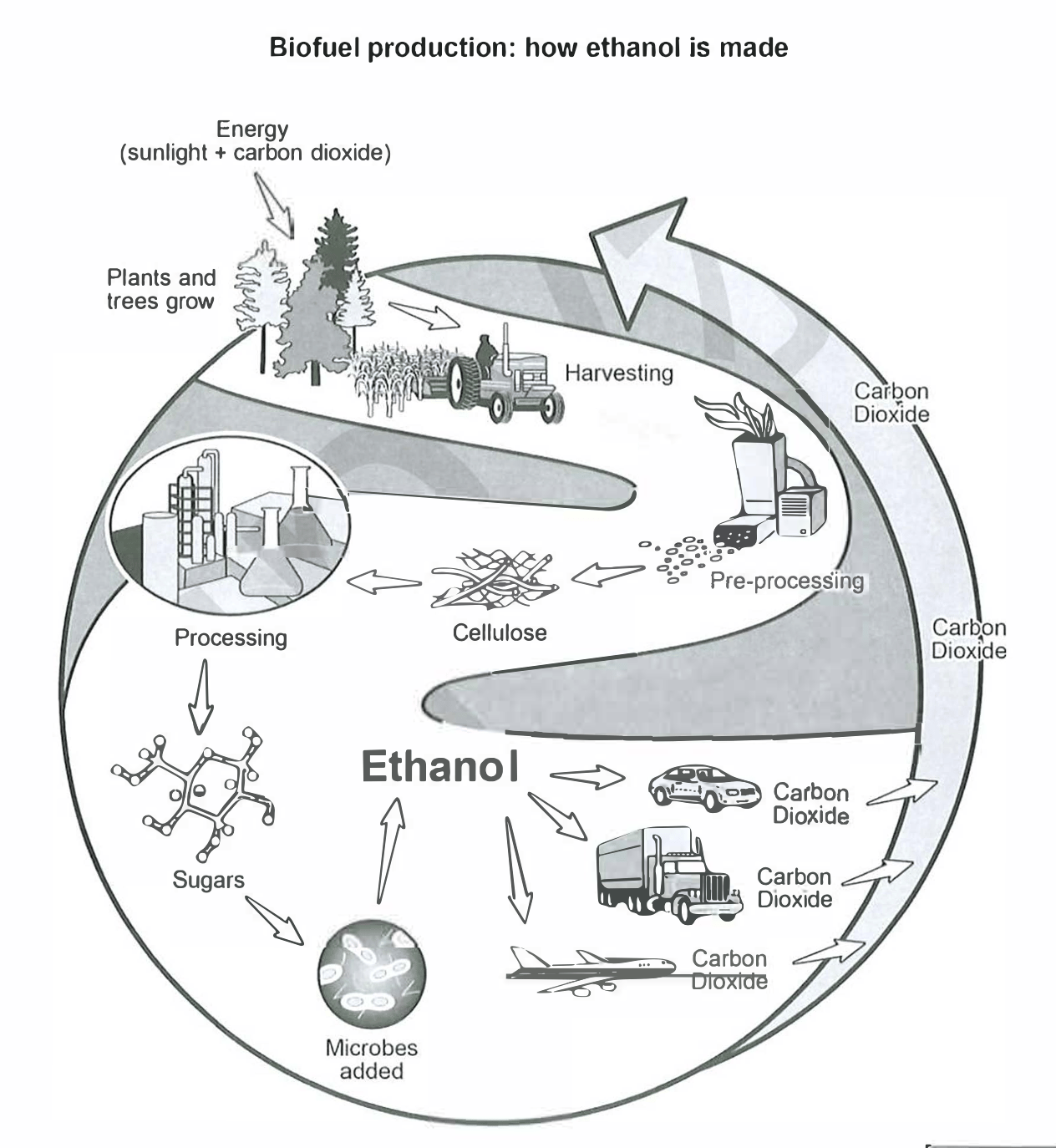
The diagram below shows how a biofuel called ethanol is produced.
Summarise the information by selecting and reporting the main features, and make comparisons where relevant.
Student answer (Band 6.0)
The diagram illustrates the steps involve in the production of biofuel called ethanol.
As a whole, the biofuel production include seven steps starting from the conversion of sunlight and carbon dioxide into energy form and terminating in the production of ethanol by combining sugars with microbes. The most notable feature of the diagram is that its a cycle mean the end product carbon dioxide will be again utilized in the cycle.
In the begning, photosysthesis process take place in which sunlight and carbon dioxide combine to form glucose which used by plants and trees for their growth. In the next step, harvesting of these plantation take place and further pre-processed in the factory to convert it into cellilose which undergo further processing to change it into sugars. In the final stage, microbes are mixed with sugars that eventually produce ethanol. Ethanol is a form of biofuel that used as fuel by different vehicals such as cars, trucks and aeroplane and release carbon dioxide into the atmosphere and the cycle again begin when it mixes with sunlight.
AI examiner evaluation
| Criterion | Band |
|---|---|
| Task Achievement / Task Response | 6.5 |
| Coherence and Cohesion | 6.5 |
| Lexical Resource | 6.0 |
| Grammatical Range and Accuracy | 5.5 |
| Overall | 6.0 |
Task Achievement / Task Response: Band 6.5
You identify the process as a cycle and describe its main stages, from plant growth and harvesting through processing, sugar production, and the use of microbes to make ethanol. You also include the transport uses and the return of carbon dioxide, so the response covers the key parts of the diagram. The overview is useful, although “seven steps” does not accurately represent the sequence shown, and the opening description of sunlight and carbon dioxide being converted into energy is unclear. Some details are also inferred rather than shown: the diagram does not label glucose or explicitly show photosynthesis, and carbon dioxide returns to the plants rather than simply mixing with sunlight. More precise reporting of the diagram would strengthen an otherwise relevant account.
Coherence and Cohesion: Band 6.5
The response has a clear overall progression: an introduction and overview are followed by a description of the stages in sequence. Phrases such as “In the next step” and “In the final stage” help guide the reader, and the cycle is brought back at the end. However, the account is presented as one continuous paragraph, so the overview and detailed stages are not visually distinguished. Some links are also imprecise: “further pre-processed in the factory” makes the relationship between harvesting and pre-processing difficult to follow, while “the cycle again begin when it mixes with sunlight” leaves the reference of “it” unclear. Clearer paragraphing and more precise links between stages would make the progression smoother.
Lexical Resource: Band 6.0
You use a relevant range of process vocabulary, including “harvesting,” “pre-processed,” “cellulose,” “microbes,” and “eventually produce,” which helps explain the diagram. There are also attempts at more formal phrasing, such as “The most notable feature.” However, several word-choice and spelling problems reduce precision: “plantation” is not the natural term for the plants and trees shown, “cellilose” is misspelled, and “vehicals” is also misspelled. Phrases such as “steps involve” and “energy form” are awkward or unclear. Aim for accurate process collocations and check spelling carefully; this would make the vocabulary more flexible and precise.
Grammatical Range and Accuracy: Band 5.5
You attempt both simple and complex sentences, including a relative clause in “which eventually produce ethanol” and a longer sequence describing the stages. The main meaning is generally understandable, but some grammatical errors recur. For example, “steps involve” needs a passive form (“steps involved”), “production include” has a subject–verb agreement error, and “its a cycle” needs an apostrophe. There are also missing articles and verb forms in “which used by plants” and “that used as fuel,” while “the cycle again begin” has incorrect agreement. These errors do not usually prevent understanding, but more consistent control of agreement, articles, and passive constructions would improve accuracy.
See this exact question answered at other band scores. The same prompt compared across bands.
Browse more IELTS Writing model answers or get your own writing scored by the same AI examiner.