Band 4.5 IELTS Writing Task 1 Model Answer
Overall Band Score: 4.5 · Cambridge IELTS 19 · 2026-11-16
IELTS Writing Task 1 question
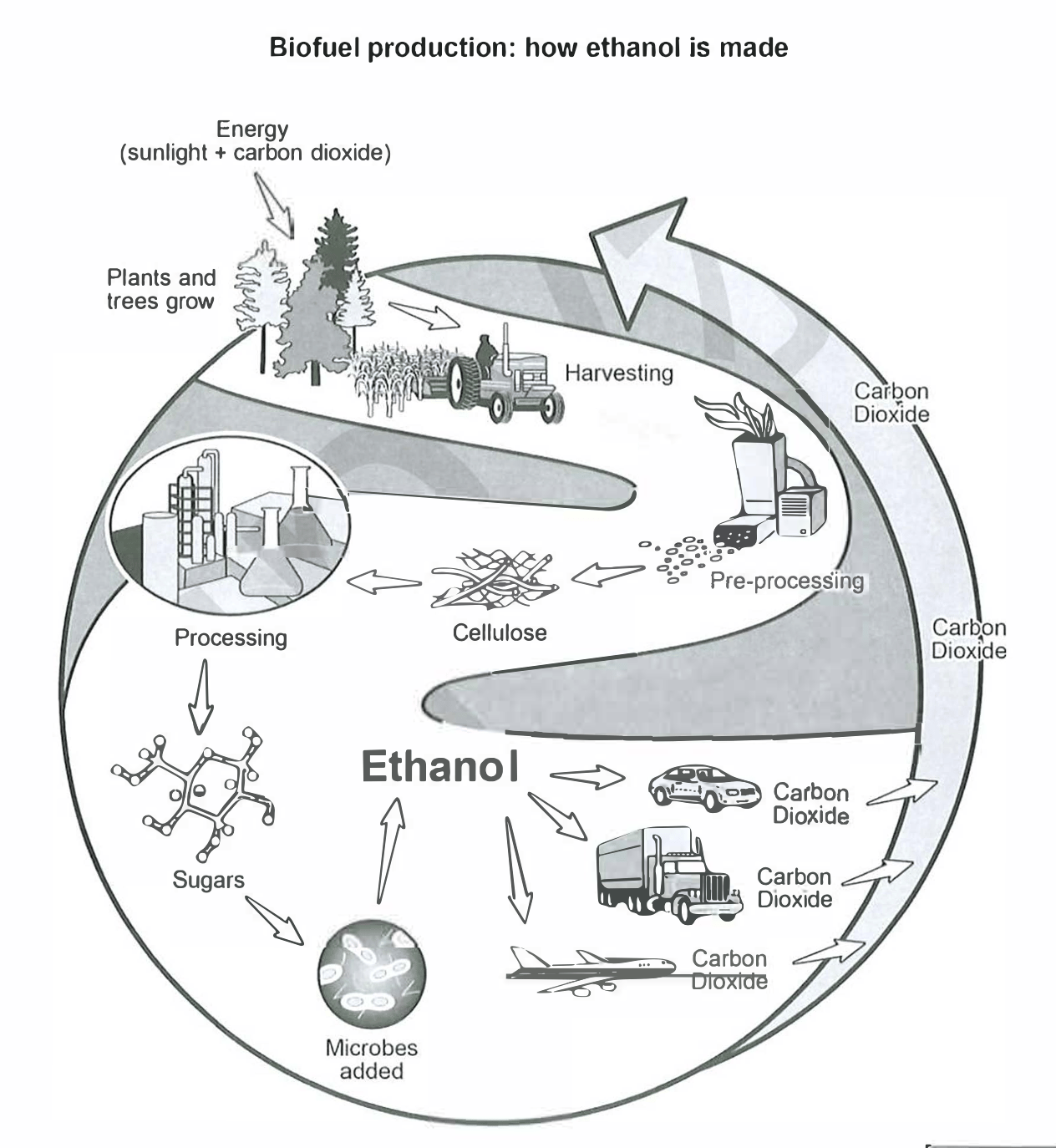
The diagram below shows how a biofuel called ethanol is produced.
Summarise the information by selecting and reporting the main features, and make comparisons where relevant.
Student answer (Band 4.5)
The diagram illustrates the biofuel production how ethanol is made.
Overall, it is clear that the diagram are eight stages for the process of enthanol produced.first plants and trees reduce the energy [sunlight+carbon dioxide] and grow. Second step is harvesting man use a tractor harvesting then step pre processing all crops move the pre processing mechine then made the cellulose and move the next step is processing.After that processing is complete and made sugars.Sugars deliver to microbes added and made the Ethanol
AI examiner evaluation
| Criterion | Band |
|---|---|
| Task Achievement / Task Response | 4.0 |
| Coherence and Cohesion | 5.0 |
| Lexical Resource | 5.0 |
| Grammatical Range and Accuracy | 4.5 |
| Overall | 4.5 |
Task Achievement / Task Response: Band 4.0
You identify the topic and describe several early stages, including plant growth, harvesting, pre-processing, cellulose, processing, sugars and microbes. However, the report is only a minimal response to the diagram: it stops at ethanol and omits its use in cars, trucks and aircraft, the carbon dioxide released, and the cycle returning to plant growth. The overview also says there are eight stages, which does not accurately summarise the full process shown. The response is 82 words, below the required 150, so important features are left unreported. To improve, give a concise overview of the complete cycle, then describe all key stages and the transport-and-carbon-dioxide loop.
Coherence and Cohesion: Band 5.0
There is a basic sequence in the response: plants grow, harvesting takes place, and the material proceeds through processing to ethanol. Words such as “Second step,” “then,” and “After that” help signal order. However, the writing is presented as one long, crowded paragraph, and the progression becomes difficult to follow in the sentence beginning “Second step is harvesting.” Several stages are joined together without clear sentence boundaries, while “Overall” introduces details rather than a concise overview. Use separate overview and process paragraphs, and connect each stage with clear, consistent transitions such as “Next,” “Following this,” and “Finally.” This would make the sequence easier to track.
Lexical Resource: Band 5.0
The response uses some relevant process vocabulary, including “harvesting,” “cellulose,” “processing,” “sugars,” and “microbes,” so the reader can recognise the general subject. However, the range is limited and some phrases are inaccurate or unclear, such as “the biofuel production how ethanol is made,” “reduce the energy,” and “made the cellulose.” There are also spelling errors, including “enthanol” and “mechine,” which reduce precision. Aim for accurate process collocations and avoid repeating “made”: for example, say that plants “absorb sunlight and carbon dioxide,” crops are “pre-processed,” and cellulose is “converted into sugars.” These choices would make the description more natural and precise.
Grammatical Range and Accuracy: Band 4.5
You attempt to describe the process in sequence, and the opening sentence gives the reader a basic introduction. However, sentence structures are very limited, and frequent errors in sentence formation and verb forms make parts difficult to understand. For example, “the diagram are eight stages” has incorrect agreement and structure, while “plants and trees reduce the energy … and grow” does not clearly express the intended relationship. The long sequence beginning “Second step is harvesting” also lacks reliable sentence boundaries and grammatical links between stages. Practise writing short, complete sentences with a consistent present simple passive where appropriate, such as “The crops are harvested and then pre-processed.” Check agreement, articles, and punctuation before finishing.
See this exact question answered at other band scores. The same prompt compared across bands.
Browse more IELTS Writing model answers or get your own writing scored by the same AI examiner.