Band 5.0 IELTS Writing Task 1 Model Answer
Overall Band Score: 5.0 · Cambridge IELTS 19 · 2026-11-16
IELTS Writing Task 1 question
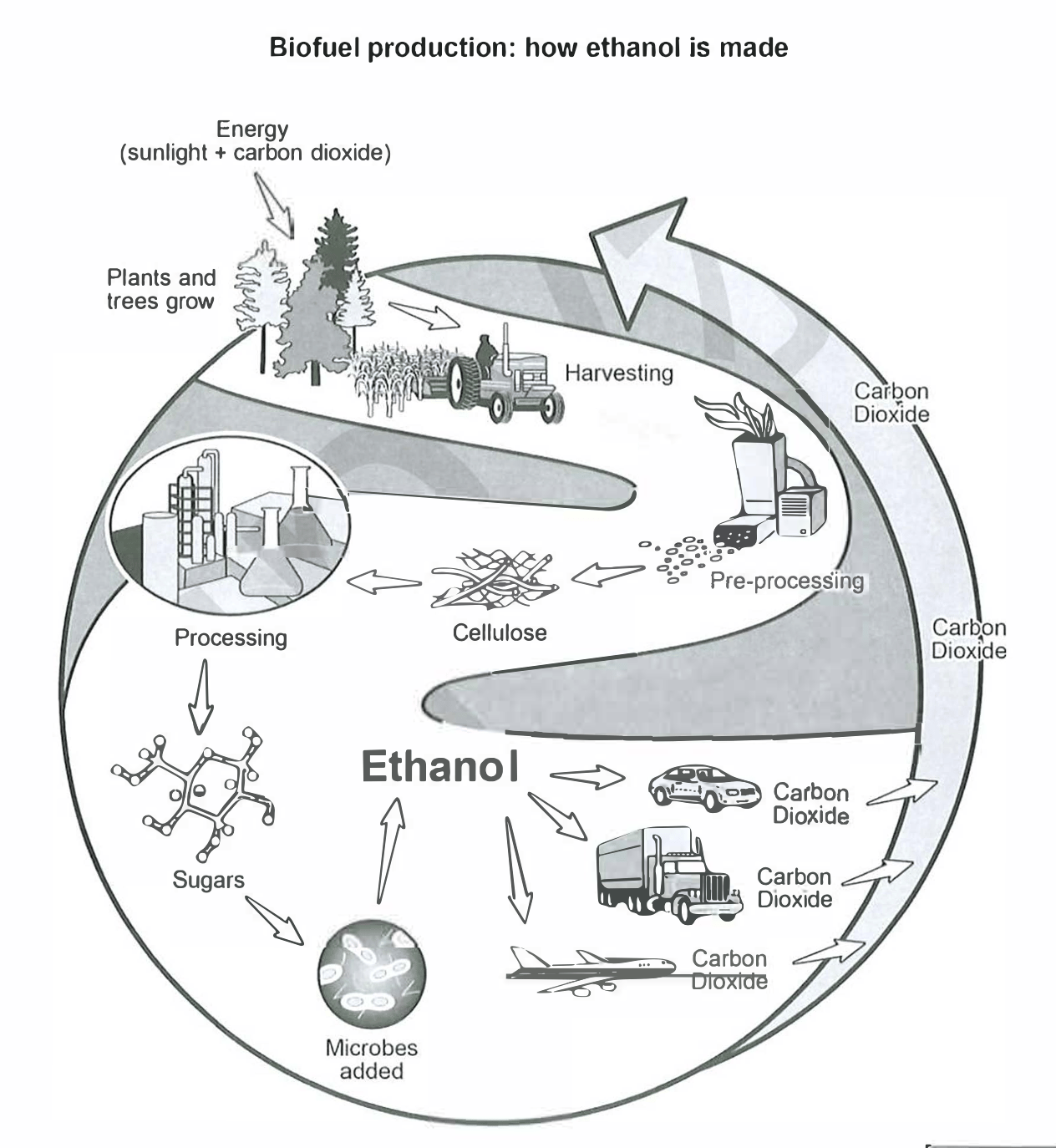
The diagram below shows how a biofuel called ethanol is produced.
Summarise the information by selecting and reporting the main features, and make comparisons where relevant.
Student answer (Band 5.0)
The process diagram illustrates how ethanol is produced from seven different steps. Overall, it is crystal clear that the biofuel production uses different stages, starting with growing plammts and trees using energy provided by sunlight and carbon dioxide and ending with vehicles releasing carbon dioxide to the atmosphere, which helps this process to continue.
Firstly, sunlight and carbon dioxide were used to produce energy. From that energy plants and trees have grew. Once they are fully grown, they are sent to be harvested. Finally, it is used in vehicles such as planes, cars, truchs and releases carbon dioxide into the atmosphere which allows the cycle to start again.
AI examiner evaluation
| Criterion | Band |
|---|---|
| Task Achievement / Task Response | 3.5 |
| Coherence and Cohesion | 5.5 |
| Lexical Resource | 5.5 |
| Grammatical Range and Accuracy | 5.5 |
| Overall | 5.0 |
Task Achievement / Task Response: Band 3.5
The response identifies the diagram as a cycle and gives a broadly relevant start and end point: plant growth uses sunlight and carbon dioxide, while transport releases carbon dioxide. However, it omits most of the process that the task asks you to summarise, including harvesting’s subsequent stages of pre-processing, cellulose, processing, sugars and the addition of microbes before ethanol is produced. The claim that there are “seven different steps” is also not supported by the diagram, and the overview does not explain how the fuel is made. The response is 108 words, below the required 150. To improve, describe the intermediate stages in order and include the conversion of ethanol into a fuel used by vehicles as part of the cycle.
Coherence and Cohesion: Band 5.5
There is a basic overall structure: an introductory overview is followed by a paragraph beginning “Firstly,” and the sequence moves from plant growth towards harvesting and vehicle use. This gives the reader some sense of progression. However, the second paragraph jumps from harvesting directly to vehicles, leaving the central stages unexplained, and “Finally” makes the process sound linear rather than cyclical. The link “From that energy” is also unclear because the diagram shows sunlight and carbon dioxide supporting plant growth, rather than energy being produced as a separate stage. Use a fuller sequence of stages and connect the final carbon-dioxide release back to plant growth to make the cycle’s progression clear.
Lexical Resource: Band 5.5
The response uses some relevant process vocabulary, including “harvested,” “biofuel production,” “vehicles” and “carbon dioxide,” and the meaning is generally understandable. However, the range is limited, with repeated reliance on general wording such as “used” and “produce,” and several choices are inaccurate or informal for describing a diagram. “Crystal clear” is conversational and does not add useful precision, while “sent to be harvested” is an awkward description of the process. There are also spelling errors in “plammts” and “truchs.” Aim for precise process terms such as “undergoes pre-processing,” “is converted into sugars” and “microbes are added,” and check spelling carefully.
Grammatical Range and Accuracy: Band 5.5
You use a mixture of simple sentences and some longer structures, including the overview’s participle phrase “starting with … and ending with …” and the clause “which allows the cycle to start again.” The main ideas remain understandable, but there are some errors in verb forms and sentence construction. In “plants and trees have grew,” the past participle should follow “have”; “were used” also shifts to the past passive while the rest of the description uses present forms. The sentence beginning “Finally, it is used…” has an unclear subject, and its singular “it” does not clearly refer to the plural plants and trees. Use the present simple consistently for a process and make each sentence’s subject explicit.
See this exact question answered at other band scores. The same prompt compared across bands.
Browse more IELTS Writing model answers or get your own writing scored by the same AI examiner.