Band 4.5 IELTS Writing Task 1 Model Answer
Overall Band Score: 4.5 · Cambridge IELTS 19 · 2026-11-16
IELTS Writing Task 1 question
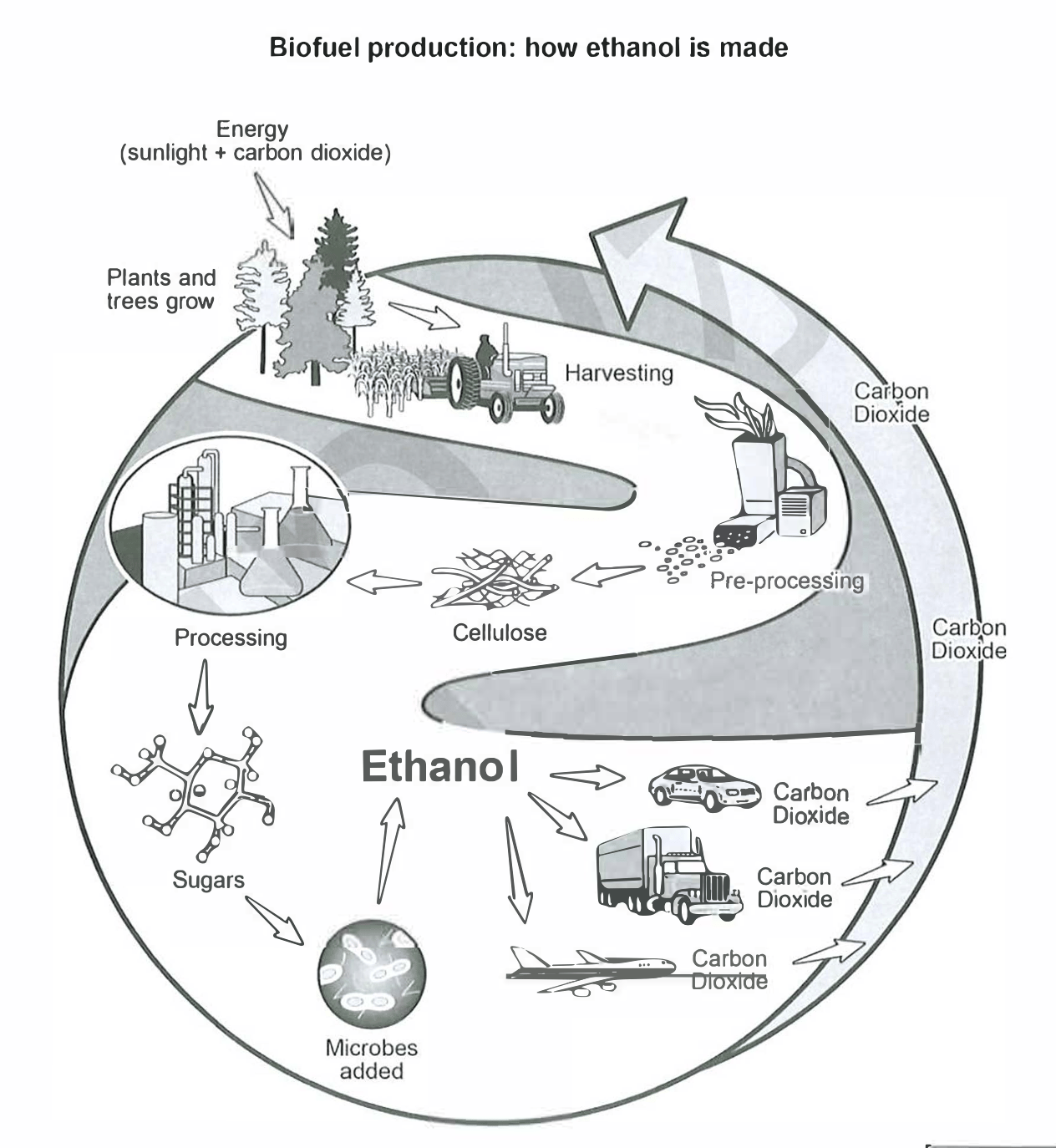
The diagram below shows how a biofuel called ethanol is produced.
Summarise the information by selecting and reporting the main features, and make comparisons where relevant.
Student answer (Band 4.5)
The given concept diagram elucidates the mass manufacturing of Biofuel production . This process is a joint venture of humans and machines which work together for a single final product . Over all it can b seen that the mass production of biofuel production is carried out by following more than ten distinctive steps . Additionally, the process starts from sunglight + carbon dioxide and ends at Ethanol . Talking about first step is sunlight + carbon dioxide which is followed by plants and tree grow and harvesting , pre pre processing , cellulose and sugars , microbes added , Ethanol and then carbon dioxide . All these process complete almost half of the total procedure . pouring some light finalizing steps these final steps are very critical to gett the finished product . Hence a finished product is obtained by different phases of the mass manufacturing of biofuel production .
AI examiner evaluation
| Criterion | Band |
|---|---|
| Task Achievement / Task Response | 4.5 |
| Coherence and Cohesion | 4.0 |
| Lexical Resource | 5.0 |
| Grammatical Range and Accuracy | 5.0 |
| Overall | 4.5 |
Task Achievement / Task Response: Band 4.5
The response recognises that the diagram shows a production process and mentions several relevant stages, including plant growth, harvesting, cellulose, microbes and ethanol. However, it reports the sequence inaccurately: it says the process “ends at Ethanol,” although carbon dioxide is also shown and returns to the plants, making the diagram a cycle. It also omits key transitions, especially processing into sugars and the use of ethanol in cars, trucks and aircraft. The overview is vague and repeats “mass production” rather than identifying the cycle and its main stages. To improve, describe the full sequence accurately and highlight how carbon dioxide released during transport is reused as plants grow.
Coherence and Cohesion: Band 4.0
There is an attempt to move from an introduction to a sequence of stages and then a concluding statement, and some linking words such as “Additionally,” “Hence” and “which is followed by” are used. However, the ideas are not arranged into clear, distinct stages, and the sequence becomes difficult to follow in the long middle sentence. The phrase “All these process complete almost half of the total procedure” does not clarify which stages are being grouped, while “pouring some light finalizing steps” disrupts the progression. Repetition of “mass manufacturing of biofuel production” also weakens cohesion. Organise the response into a brief overview and a clearly ordered account of the cycle, using precise links between each stage.
Lexical Resource: Band 5.0
The response attempts some task-related vocabulary, including “cellulose,” “microbes,” “distinctive steps” and “final product,” so the topic is generally recognisable. However, the range is limited and several choices are inaccurate or unnatural, such as “joint venture of humans and machines,” “mass manufacturing of biofuel production” and “pouring some light finalizing steps.” These expressions do not describe the diagram clearly and sometimes make the meaning difficult to interpret. There are also spelling errors, including “sunglight,” “get t” and “b,” and inconsistent capitalisation of “Biofuel” and “Ethanol.” Use standard process vocabulary and accurate stage names, and check spelling and collocations before submitting.
Grammatical Range and Accuracy: Band 5.0
The response includes a few attempts at longer structures, for example, “which is followed by plants and tree grow and harvesting,” but control is uneven. Errors in sentence construction and verb forms occur in phrases such as “plants and tree grow,” “All these process complete” and “a finished product is obtained by different phases.” The opening also contains awkward sentence boundaries and spacing around full stops, while the sequence sentence joins many stages without clear grammatical structure. These problems sometimes make relationships between stages unclear. Build a more reliable base with accurate simple sentences, then add controlled clauses to show sequence and cause. Check subject–verb agreement, plural forms and punctuation when revising.
See this exact question answered at other band scores. The same prompt compared across bands.
Browse more IELTS Writing model answers or get your own writing scored by the same AI examiner.