Band 6.0 IELTS Writing Task 1 Model Answer
Overall Band Score: 6.0 · Cambridge IELTS 19 · 2026-11-16
IELTS Writing Task 1 question
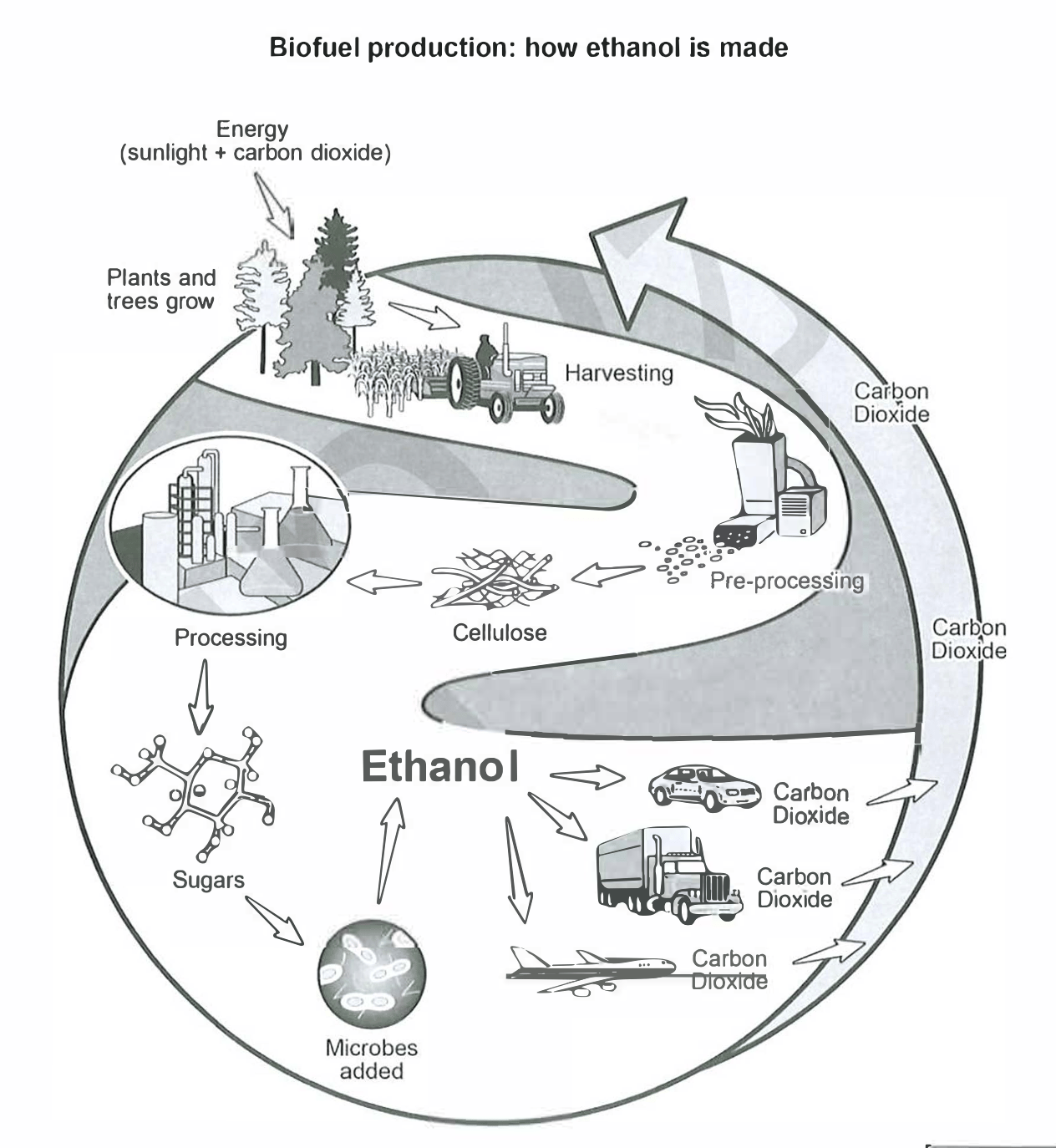
The diagram below shows how a biofuel called ethanol is produced.
Summarise the information by selecting and reporting the main features, and make comparisons where relevant.
Student answer (Band 6.0)
Above diagram represents the production of ethanol. Carbon Dioxide, emitted from automobiles i.e airplanes, trucks and cars, enters into our atmosphere. Plants utilizes carbon dioxide in the pressence of sunlight to produce glucose. Glucose undergoes various processes and stored in the plant body in the form of cellulose.
Cellulose is extracted from the trees after harvesting by a procedure called a pre-processing. Pre-processing results in cellulose and this cellulose goes into the processing. During processing cellulose is broken down into sugars that are the builing blocks for cellulose.
These sugar molecules are converetd into ethanol by the addition of microbes. The microorganisms oxidize the sugars and transform them into ethanol. Ethanol is a vital source of fuel for the automobiles. This ethanol is combusted in the engines of the automobiles and resultantly carbon dioxide is released in the air. In this way this cycle contunies to the production of ethanol.
AI examiner evaluation
| Criterion | Band |
|---|---|
| Task Achievement / Task Response | 6.0 |
| Coherence and Cohesion | 6.5 |
| Lexical Resource | 5.5 |
| Grammatical Range and Accuracy | 5.5 |
| Overall | 6.0 |
Task Achievement / Task Response: Band 6.0
You cover the main stages, from plant growth and harvesting through cellulose processing, sugar conversion, and ethanol use in transport, and you recognise the cycle linking carbon dioxide back to plant growth. However, some details are inaccurate or unclear: plants use sunlight and carbon dioxide to grow, but the diagram does not say they produce glucose; nor does it show sugars as building blocks for cellulose. The claim that microbes “oxidize” sugars is also not supported. A clearer overview identifying the circular nature of the process and its main transformation stages would strengthen the response. Keep explanations closely tied to the labels and arrows, especially when describing the chemical changes.
Coherence and Cohesion: Band 6.5
The response has a coherent overall sequence, moving from carbon dioxide and plant growth to processing, fuel use, and the return of carbon dioxide. The paragraph break also helps separate the early stages from conversion and use. Linking phrases such as “after harvesting,” “During processing,” and “In this way” guide the reader through the process. This meets the lower-band expectation of an organised account and shows some flexibility in sequencing. However, the progression is occasionally weakened by unclear references, particularly “These sugar molecules” after “This cellulose,” and by the abrupt shift from plant growth to glucose and cellulose. Grouping the stages more deliberately and using precise references would make the flow smoother and more consistently clear.
Lexical Resource: Band 5.5
You use a relevant range of process vocabulary, including “harvesting,” “pre-processing,” “cellulose,” “microorganisms,” and “combusted,” which helps convey the topic. There are also attempts at more technical wording, although some choices are inaccurate or unnatural: “oxidize” is not shown in the diagram, “building blocks for cellulose” misstates the relationship, and “resultantly” is awkward in this context. Spelling errors such as “pressence,” “builing,” and “contunies” are noticeable, as are forms such as “converetd.” These issues sometimes make the description less precise. Aim for accurate, natural collocations and check spelling carefully, particularly for technical terms.
Grammatical Range and Accuracy: Band 5.5
You use both simple sentences and some more developed structures, for example, “Cellulose is extracted from the trees after harvesting…” and “These sugar molecules are converted into ethanol by the addition of microbes.” The sequence is generally understandable, but some grammatical errors remain. In “Plants utilizes,” the subject and verb do not agree; “a procedure called a pre-processing” has an unnecessary article; and “carbon dioxide is released in the air” uses an awkward preposition within the sentence pattern. The sentence beginning “Ethanol is a vital source…” also shifts into “and resultantly carbon dioxide is released” without a clear grammatical connection. Review agreement, articles, and sentence construction, while retaining the range of structures you attempt.
See this exact question answered at other band scores. The same prompt compared across bands.
Browse more IELTS Writing model answers or get your own writing scored by the same AI examiner.