Band 5.0 IELTS Writing Task 1 Model Answer
Overall Band Score: 5.0 · Cambridge IELTS 19 · 2026-11-17
IELTS Writing Task 1 question
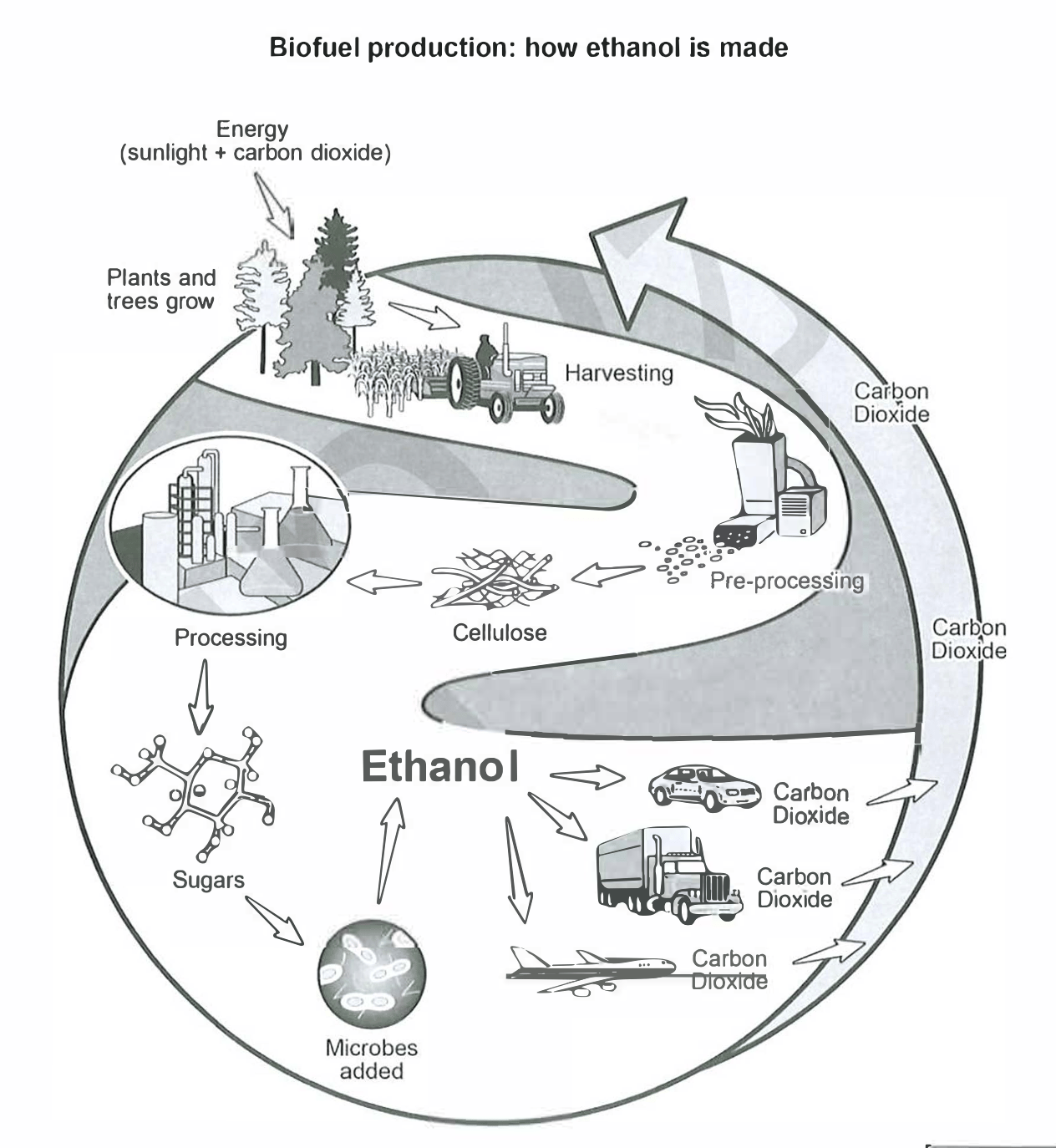
The diagram below shows how a biofuel called ethanol is produced.
Summarise the information by selecting and reporting the main features, and make comparisons where relevant.
Student answer (Band 5.0)
In today world ,moving from one place to another become very easy due to Vehicles.Hunderads of Kilometers can cover in hours.Most of Vehicles use ethanol as a fuel for moving one place to another. Ethanol is very important and it acts as a biofuel.In today era, All vehicles use ethanol to move from one place to another.let we explore how ethonal is build .
The lifecycle of ethanol is started as plants and trees consum corbon dioxide and the sunlight.with the passage of time,plants grow and become large.Then human do harvesting and store them.The stored meterial is preprocessed and converted into cellulose.cellulose is the type of protein that are present in the plants.Cellulose is further preprocessed and converted into sugars.
Microbes are the small organism that further decombose the suger and converted into the Ethanol. Ethanol is a biofuel.Cars ,trucks and plans used that ethanol as a fuel.Vehicles exhausts the corbon dieoxide and it goes to the air again
AI examiner evaluation
| Criterion | Band |
|---|---|
| Task Achievement / Task Response | 5.0 |
| Coherence and Cohesion | 5.5 |
| Lexical Resource | 5.0 |
| Grammatical Range and Accuracy | 5.0 |
| Overall | 5.0 |
Task Achievement / Task Response: Band 5.0
You identify the main stages from plant growth through harvesting, pre-processing, cellulose, sugars and microbial action to ethanol, and you mention its use in cars, trucks and planes. However, the account is only partial: it does not clearly describe the diagram’s overall circular nature or explain that carbon dioxide from transport returns to support plant growth. Some details are inaccurate or unsupported, such as calling cellulose “the type of protein” and saying vehicles “exhaust” carbon dioxide without linking this to the cycle. The opening claims that all vehicles use ethanol, which the diagram does not establish. To strengthen the response, focus on the process shown, give a clear overview of the cycle, and report each stage accurately.
Coherence and Cohesion: Band 5.5
The stages are presented in a broadly sensible order, and words such as “Then,” “further” and “again” help signal sequence. The response also moves from the production process to the fuel’s use. However, the opening discussion of travel and vehicle use delays the process description, and the response has no clear paragraphing or concise overview to guide the reader. Connections between stages are sometimes unclear: for example, “Cellulose is further preprocessed and converted into sugars” does not clearly distinguish processing from the earlier pre-processing stage. Organise the answer into a brief introduction and overview, followed by the production stages and the return of carbon dioxide, using linking phrases to make the cycle explicit.
Lexical Resource: Band 5.0
You use some relevant process vocabulary, including “harvesting,” “cellulose,” “microbes” and “ethanol,” so the reader can follow the general subject. However, the range is limited and several word-choice, spelling and collocation errors make parts difficult to understand, such as “ethonal is build,” “decombose the suger” and “store them.” The repeated use of “one place to another” and “vehicles” also takes space without describing the diagram precisely. Use accurate process terms and avoid unsupported explanations; for instance, describe microbes as being added rather than saying they “decompose” sugar unless the diagram supports that detail. Careful proofreading of spelling and word forms would make the vocabulary more reliable.
Grammatical Range and Accuracy: Band 5.0
The response includes both simple statements and attempts to link ideas, as in “The stored meterial is preprocessed and converted into cellulose.” However, sentence structures are mostly basic, and errors occur frequently in verb forms, agreement, articles, and sentence boundaries. Examples include “In today world,” “plants and trees consum,” “plants grow and become large,” and “Microbes are the small organism that … converted.” Several sentences also run together or begin with inconsistent capitalisation, which can make relationships between ideas harder to follow. Practise accurate present-simple forms for describing processes, including passive constructions such as “the material is processed” and “sugars are converted,” and check subject–verb agreement and punctuation when editing.
See this exact question answered at other band scores. The same prompt compared across bands.
Browse more IELTS Writing model answers or get your own writing scored by the same AI examiner.