Band 5.0 IELTS Writing Task 1 Model Answer
Overall Band Score: 5.0 · Cambridge IELTS 19 · 2026-11-17
IELTS Writing Task 1 question
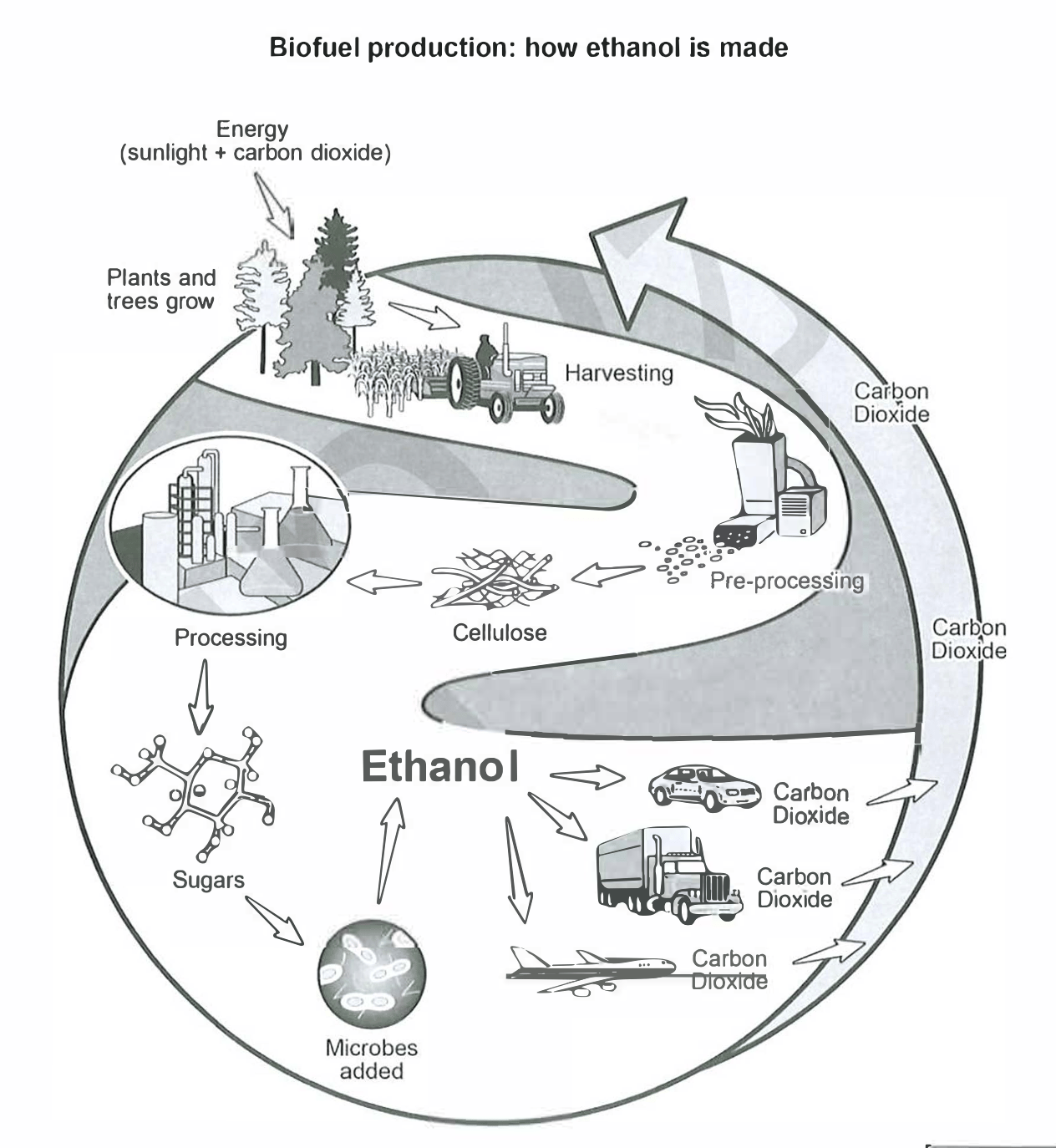
The diagram below shows how a biofuel called ethanol is produced.
Summarise the information by selecting and reporting the main features, and make comparisons where relevant.
Student answer (Band 5.0)
The chart bellow played the production processus of ethanol
Overall the ethanol produced by some of steps who start with the safetly step wich the energy make the plants grow and crossed by some others steps befor to have the ethanol
Firstly before the processus they are the plants and trees that grow with energy that include the sunlight with carbone dioxide who help theme to grow saftly and naturaly , then they will harvesting and transporting them and put theme in the pre-processing to do what they are necessar to them.
After the pre-processing and some editing in this stage we found the cellulose that will have some processing in the laboratary with some chemical product and aditive to transformate it at the sugars and this sugars will add to him the microbes a²dded and finnaly we got our product the ethanole
AI examiner evaluation
| Criterion | Band |
|---|---|
| Task Achievement / Task Response | 4.5 |
| Coherence and Cohesion | 5.5 |
| Lexical Resource | 5.0 |
| Grammatical Range and Accuracy | 5.0 |
| Overall | 5.0 |
Task Achievement / Task Response: Band 4.5
You identify the general subject and mention several early stages, including plant growth, harvesting, pre-processing, cellulose, sugars, microbes and ethanol. However, the response only minimally reports the process: it gives no clear account of ethanol being used by cars, trucks and aircraft, or of the carbon dioxide released returning to support plant growth, which is central to the cycle. The overview is also unclear, and some details are invented, such as transporting the plants and using chemical products in a laboratory. The response contains 143 words, below the required 150. To improve, give a concise overview of the complete cycle, then describe the stages accurately and include the transport and carbon-dioxide loop.
Coherence and Cohesion: Band 5.5
There is a basic sequence, signalled by “Firstly” and the movement from plant growth through processing to ethanol, so the reader can follow the broad direction of the process. However, the response is presented as one continuous block, and the opening overview is difficult to connect to the details that follow. Several long sentences join many stages with “and” or “then,” making relationships between steps unclear. For example, the sentence beginning “After the pre-processing” combines cellulose, processing, sugars, microbes and the final product without clear boundaries. Use separate paragraphs for the overview and stages, and divide the process into shorter sentences with precise links such as “next,” “after this,” and “finally.”
Lexical Resource: Band 5.0
You use some relevant process vocabulary, including “harvesting,” “pre-processing,” “cellulose,” “sugars” and “microbes,” which helps identify the main stages. However, the range is limited and several inaccurate or misspelled choices make the description harder to understand, such as “processus,” “saflty,” “laboratary” and “ethanole.” Some phrases are also unnatural or imprecise, including “the chart played the production” and “some editing.” Aim for accurate process language and standard spelling, and avoid adding unsupported technical terms such as “chemical product and additive.” More precise verbs such as “is converted into” and “is used to produce” would make the account clearer.
Grammatical Range and Accuracy: Band 5.0
You attempt to connect stages in longer sentences, but the response relies heavily on basic clauses joined together, and complex structures are often faulty. For example, “The chart bellow played the production processus” does not form a clear grammatical sentence, while “the plants and trees that grow with energy” has an unclear clause relationship. There are also problems with verb forms and sentence construction in “they will harvesting” and “this sugars will add to him the microbes.” These errors sometimes make the process difficult to follow. Practise forming clear present-simple passive sentences for process descriptions, such as “The plants are harvested” and “The cellulose is processed into sugars,” and check agreement, articles and punctuation.
See this exact question answered at other band scores. The same prompt compared across bands.
Browse more IELTS Writing model answers or get your own writing scored by the same AI examiner.