Band 5.0 IELTS Writing Task 1 Model Answer
Overall Band Score: 5.0 · Cambridge IELTS 19 · 2026-11-17
IELTS Writing Task 1 question
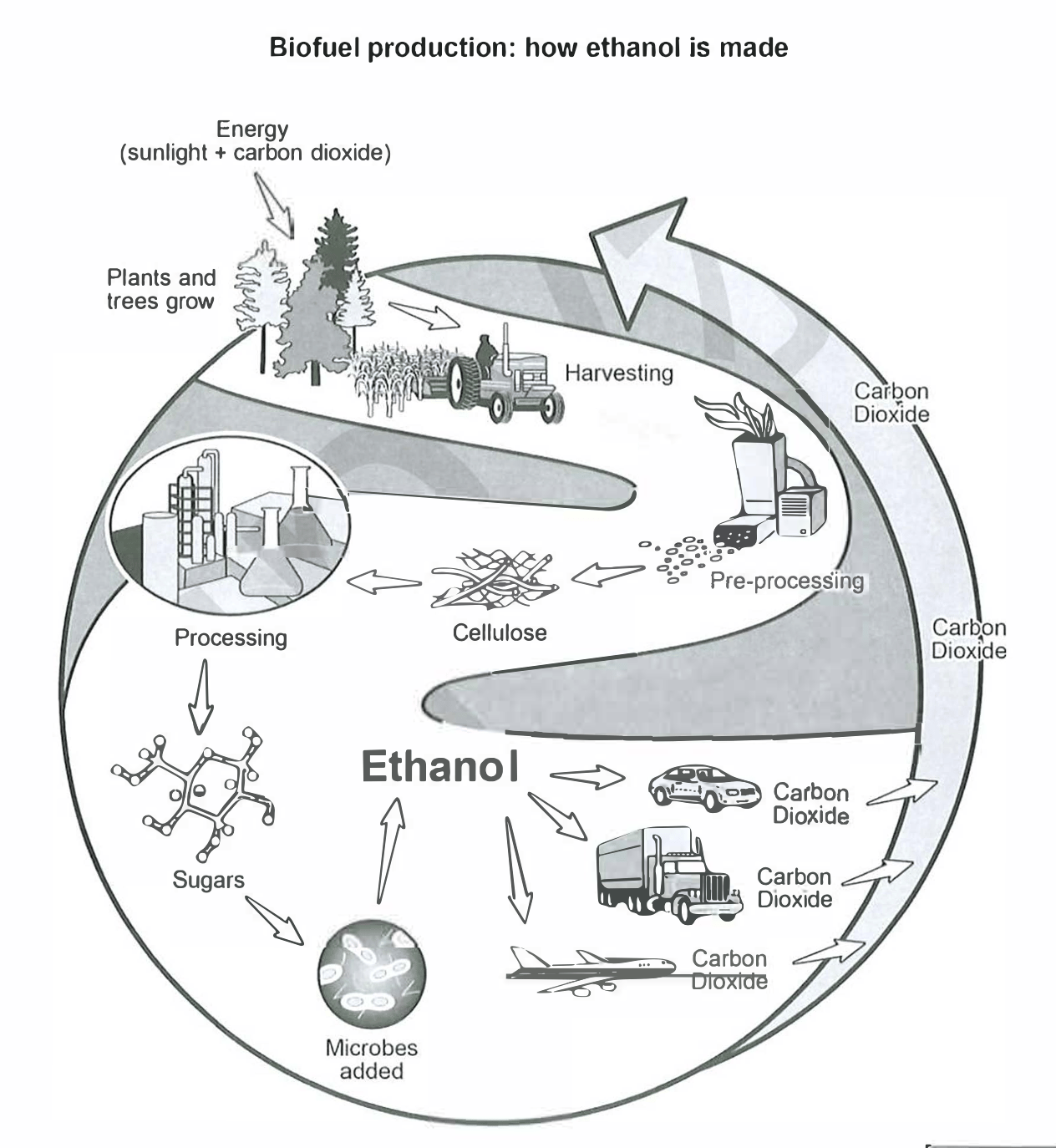
The diagram below shows how a biofuel called ethanol is produced.
Summarise the information by selecting and reporting the main features, and make comparisons where relevant.
Student answer (Band 5.0)
This diagram illustrate the formation of ethanol.
Initially , we grow plants and trees taking energy from sunlight and release carbon di oxide after we harvest the growing trees by using tractor .Than this harvesting material goes under pre-processing which separate cellulose from the rest of tree after this , cellulose goes under processing and suger is formed.
Finally we added microbes in to sugar and ethanol is formed. than we use this ethanol in to aeroplane, truck and cars. This use of ethanol is the excessive release of carbondi oxide which is not good for earth
AI examiner evaluation
| Criterion | Band |
|---|---|
| Task Achievement / Task Response | 4.5 |
| Coherence and Cohesion | 5.5 |
| Lexical Resource | 5.5 |
| Grammatical Range and Accuracy | 5.0 |
| Overall | 5.0 |
Task Achievement / Task Response: Band 4.5
You identify the main stages from plant growth and harvesting through processing, sugar production, the addition of microbes, and ethanol use in transport. However, the account is very brief and covers the diagram only partially: it does not clearly explain the cycle’s return of carbon dioxide to the plants, and it incorrectly says that plants release carbon dioxide during growth. The diagram shows sunlight and carbon dioxide supporting plant growth, while carbon dioxide from transport returns to the plants. The explanation that pre-processing separates cellulose is also not explicitly shown. The response is 53 words below the required minimum, which limits the detail and coverage possible. To improve, give a clear overview of the cycle and accurately describe each key stage and the carbon-dioxide loop.
Coherence and Cohesion: Band 5.5
The stages are presented in a broadly chronological order, and words such as “Initially” and “Finally” help signal movement through the process. This gives the response some organisation. However, the account is compressed into two paragraphs with little development, and the progression becomes difficult to follow in places, particularly in “after we harvest the growing trees by using tractor” and the transition from ethanol use to carbon dioxide. “Than” is also used where a sequence marker is intended, and the links between stages are often joined in long, loosely punctuated sentences. Use separate sentences or paragraphs for plant growth and processing, then ethanol use and the return cycle, with clear connectors such as “Next” and “As a result.”
Lexical Resource: Band 5.5
You use several relevant process terms, including “pre-processing,” “cellulose,” “processing,” “microbes,” and “ethanol,” so the reader can recognise the subject and many of the stages. However, the vocabulary range is limited, and some word choices or forms make the description less clear or less suitable for an academic process report. For example, “formation” is less precise than “production,” while “use of ethanol is the excessive release” does not clearly express the relationship shown. There are also noticeable spelling errors, including “suger” and “carbondi oxide.” Aim for accurate process vocabulary and concise collocations, such as “is converted into,” “is then used as fuel,” and “carbon dioxide is released.”
Grammatical Range and Accuracy: Band 5.0
The response attempts to connect stages using clauses, as in “which separate cellulose from the rest of tree,” but most sentences rely on simple structures or long chains joined by “after this.” Errors in verb forms, agreement, articles, and sentence boundaries are frequent enough to make some relationships unclear. For example, “This diagram illustrate” needs subject–verb agreement, and “Finally we added microbes” shifts into the past tense even though the process is described generally. The sentence beginning “Initially” also combines several stages without clear punctuation, making the sequence hard to parse. Use the present simple consistently for process descriptions, check singular and plural agreement, and divide each stage into a complete, clearly punctuated sentence.
See this exact question answered at other band scores. The same prompt compared across bands.
Browse more IELTS Writing model answers or get your own writing scored by the same AI examiner.