Band 6.0 IELTS Writing Task 1 Model Answer
Overall Band Score: 6.0 · Cambridge IELTS 19 · 2026-11-19
IELTS Writing Task 1 question
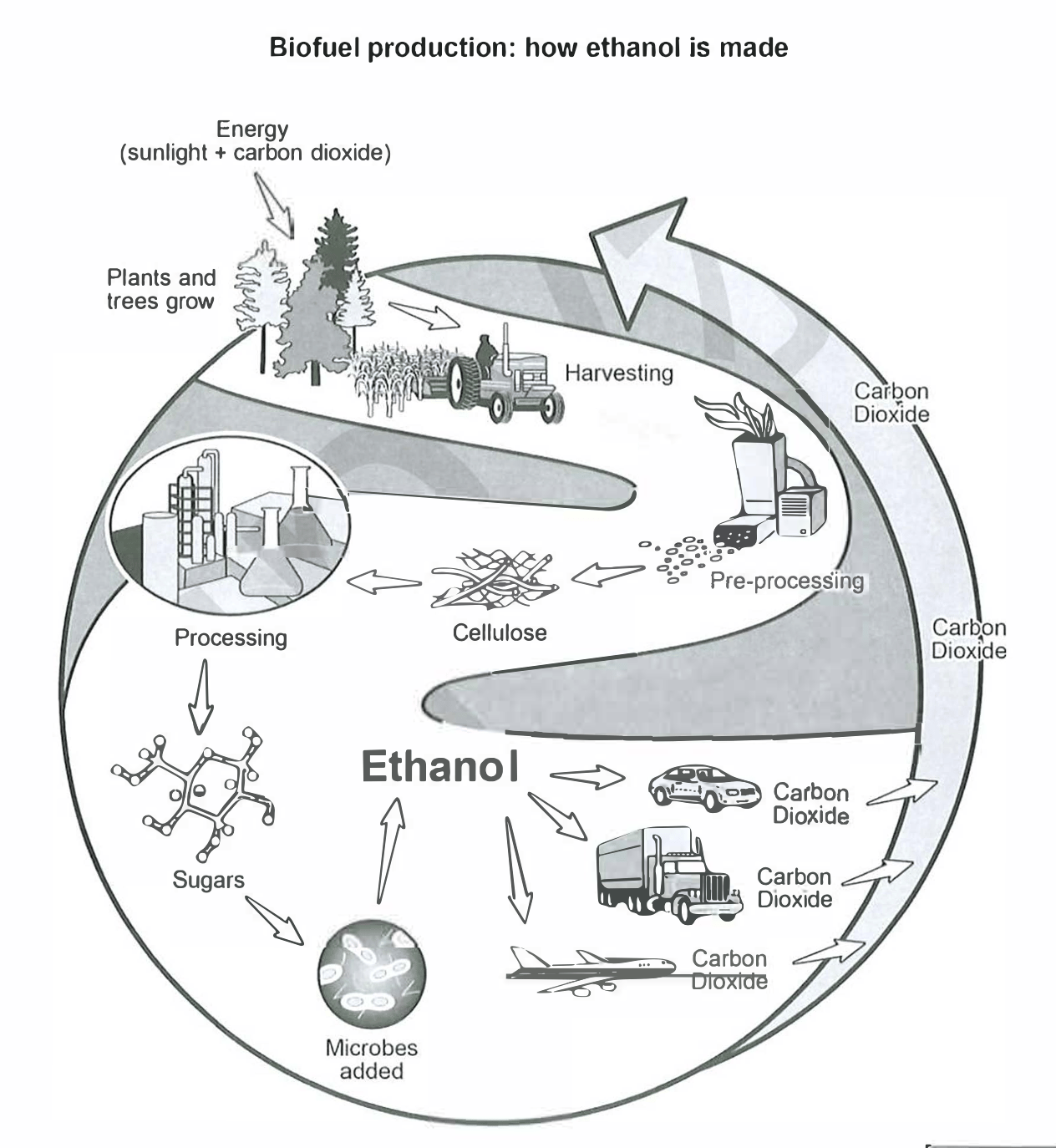
The diagram below shows how a biofuel called ethanol is produced.
Summarise the information by selecting and reporting the main features, and make comparisons where relevant.
Student answer (Band 6.0)
The diagram illustrates the production of biofuel which is called ethanol.
Overall, the process is cyclic. It starts with the sunlight and the carbon dioxide. From plants people make cellulose that helps to produce ethanol. When the ethanol produces, it emits the carbon dioxide after usage in different places.
The process has started with evergy which is combined with sunlight and carbon dioxide. Later, the plants and trees grow, and people collect them as harvests. Additionally, after harvesting they do pre-processing to make cellulose. After making cellulose, the processing of making sugars has started.
Once sugars are ready, the production of ethanol is nearly done. In the sugars people add micorbes and it becomes a form with circle shape. That micorbes addition in sugars make the ethanol. The ethanol use in different forms in different vehicles, such as cars, trucks, and even in airplanes. However, after using ethanol as fuel, the vehicles emit carbon dioxide. Furthermore, the carbon dioxide and the sunlight become the form of energy, and in this way the first step starts again.
AI examiner evaluation
| Criterion | Band |
|---|---|
| Task Achievement / Task Response | 6.5 |
| Coherence and Cohesion | 6.5 |
| Lexical Resource | 5.5 |
| Grammatical Range and Accuracy | 5.5 |
| Overall | 6.0 |
Task Achievement / Task Response: Band 6.5
You cover the main stages and give a relevant overview by identifying the process as cyclic, from plant growth through ethanol use and back to carbon dioxide. The account also includes the key stages of harvesting, pre-processing, cellulose, processing, sugars and microbes, as well as the three vehicle types. This is a solid response to the diagram, but some details are unclear or inaccurate: for example, “the sunlight and the carbon dioxide” are described as starting the process, whereas the diagram shows sunlight and carbon dioxide providing energy for plant growth. The statement that the sugars become “a form with circle shape” is not supported by the diagram and obscures the microbes-to-ethanol stage. More precise reporting of these relationships would make the overview and stage descriptions more complete.
Coherence and Cohesion: Band 6.5
The response is arranged in a clear sequence: an introduction and overview are followed by the early production stages and then ethanol use and the return of carbon dioxide. This progression helps the reader follow the cycle, and linking expressions such as “Additionally,” “Once,” and “Furthermore” show an effort to connect ideas. However, some links are mechanical or do not express the relationship accurately. “However” does not signal a contrast between ethanol use and carbon dioxide emissions, while “In this way the first step starts again” repeats the cycle idea without clarifying the final link. References such as “it” and “that microbes addition” are also not always clear. Use more precise transitions and make each sentence’s subject explicit to strengthen cohesion.
Lexical Resource: Band 5.5
You use relevant process vocabulary, including “harvesting,” “pre-processing,” “cellulose,” “sugars,” and “carbon dioxide,” and you identify the transport examples accurately. This gives the response enough topic-specific language to communicate the general process. However, several word choices and collocations are noticeably inaccurate or awkward, such as “the ethanol produces,” “make cellulose,” and “the ethanol use in different forms.” There are also spelling errors in “evergy” and “micorbes,” and “form with circle shape” is unclear. These issues sometimes make the intended meaning harder to follow. Aim for precise process verbs and natural combinations, such as “is produced,” “is converted into,” and “is used as fuel,” while checking spelling carefully.
Grammatical Range and Accuracy: Band 5.5
You attempt both simple and more complex sentence forms, including clauses linked with “which,” “after,” and “once.” Most of the process remains understandable, but some errors in verb forms and sentence construction reduce accuracy. For example, “When the ethanol produces” needs a passive form, and “The process has started” is an awkward tense choice for describing a diagram that presents a general process. In “That microbes addition in sugars make the ethanol,” the subject–verb agreement and sentence structure are faulty. There are also unclear constructions such as “the sunlight and the carbon dioxide become the form of energy.” Use the present simple and passive consistently for process descriptions, and check agreement and clause structure when combining stages.
See this exact question answered at other band scores. The same prompt compared across bands.
Browse more IELTS Writing model answers or get your own writing scored by the same AI examiner.