Band 6.0 IELTS Writing Task 1 Model Answer
Overall Band Score: 6.0 · Cambridge IELTS 19 · 2026-11-19
IELTS Writing Task 1 question
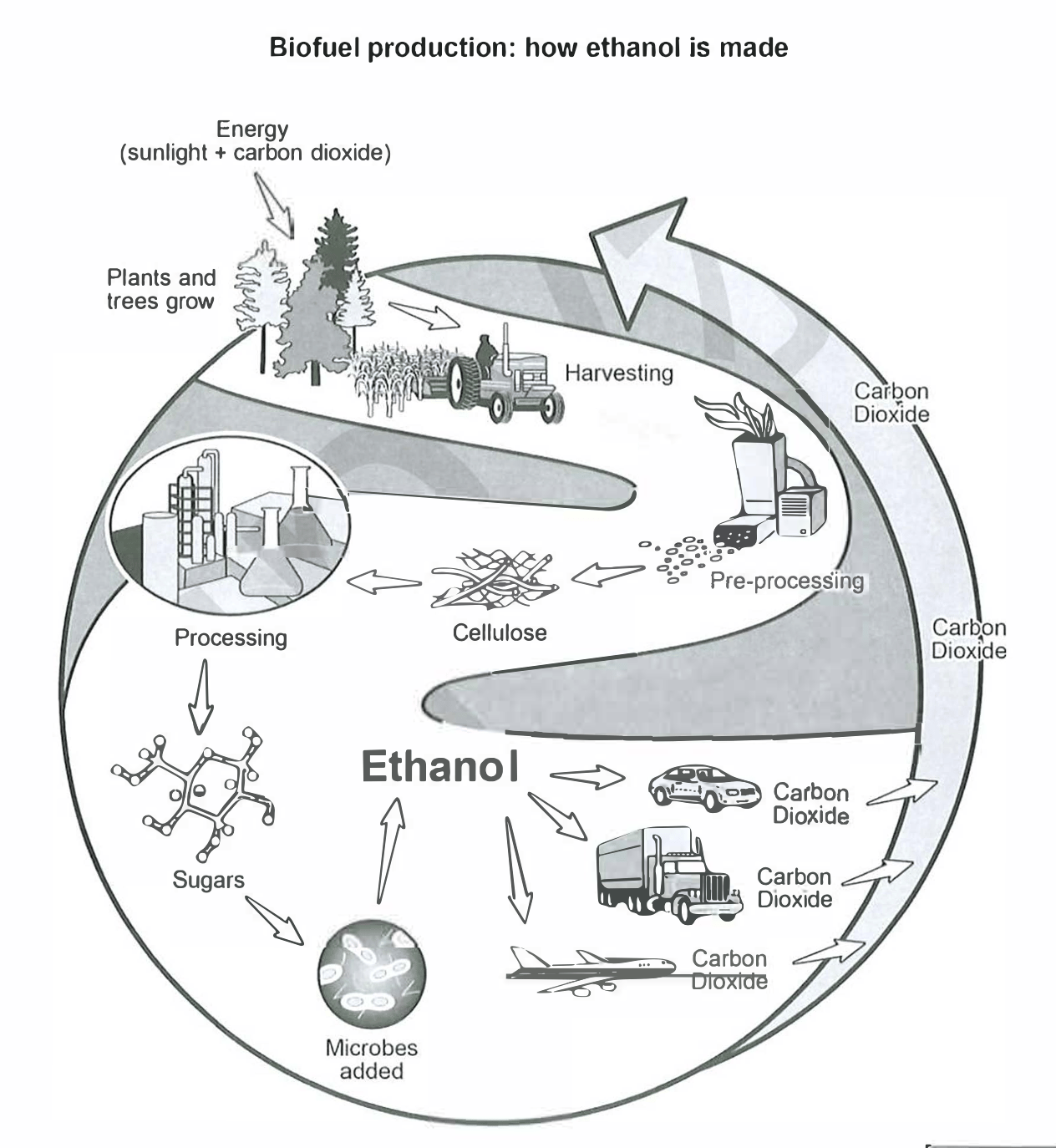
The diagram below shows how a biofuel called ethanol is produced.
Summarise the information by selecting and reporting the main features, and make comparisons where relevant.
Student answer (Band 6.0)
The given image illustrates the overall process of ethanol production which is also known as biofuel.
Overall, what stands out from the diagram is, the production of ethanol undergoes several steps untill ethanol is finally made and used in vehicles. Intitialization of this whole process starts by growing plants and trees which is then harvested to make a form which could be sent for processing. The last step includes adding of the microbes to finally form an ethanol.
Looking into the details, the first step includes growing plants and trees. When they turned out to be mature, they are then harvested by a machinery. After cutting of the plants, they are sent for pre-processing which results in the formation of Cellulose. After forming a Cellulose, processing is done in the laboratories which results in sugars. The last process is adding microbes in the sugary form which results in the final prodcued form of useable ethanol.
AI examiner evaluation
| Criterion | Band |
|---|---|
| Task Achievement / Task Response | 5.5 |
| Coherence and Cohesion | 6.5 |
| Lexical Resource | 5.5 |
| Grammatical Range and Accuracy | 5.5 |
| Overall | 6.0 |
Task Achievement / Task Response: Band 5.5
You identify the diagram as a process and describe several central stages, including harvesting, pre-processing, cellulose, processing, sugars and the addition of microbes. However, the account is only partial: it omits the cycle’s key inputs and outputs—sunlight and carbon dioxide supporting plant growth, ethanol being used by cars, trucks and aircraft, and carbon dioxide returning to the plants. The overview also says the final step is ethanol formation, without capturing the subsequent transport use and carbon cycle. Some details are not supported by the diagram, such as processing “in the laboratories.” To strengthen the response, summarise the complete cycle in the overview and report the transport and carbon-dioxide stages accurately.
Coherence and Cohesion: Band 6.5
The response has a clear paragraph structure: an introduction, an overview and a more detailed account of the production stages. The sequence from harvesting through to ethanol is generally easy to follow, and phrases such as “After cutting” and “After forming” help signal progression. This coherent organisation supports the reader, although the overview repeats information that is then given in the detail paragraph, while the later stages of the diagram are absent. Some linking is also awkward or mechanical, as in “The last process is adding microbes.” For stronger progression, organise the details to cover the whole cycle in order and use concise links that clarify how each stage leads to the next.
Lexical Resource: Band 5.5
You use relevant process vocabulary, including “harvested,” “pre-processing,” “cellulose,” “sugars” and “microbes,” so the main stages can be understood. However, the range is limited and several choices or collocations are unnatural: “the overall process of ethanol production which is also known as biofuel” confuses the fuel with the process, and “a form which could be sent for processing” is vague. There are also noticeable spelling errors, including “untill,” “Intitialization” and “prodcued,” which reduce accuracy. Aim for precise process language such as “ethanol, a biofuel,” “the harvested plant material,” and “the resulting ethanol,” and check spelling carefully.
Grammatical Range and Accuracy: Band 5.5
You attempt both simple and complex sentences, including a relative clause in “which results in the formation of Cellulose” and a time clause beginning “When they turned out to be mature.” However, control is uneven, and some sentence patterns are faulty or awkward. For example, “Overall, what stands out from the diagram is, the production…” has incorrect punctuation and clause structure; “plants and trees which is then harvested” has a subject–verb agreement error; and “After forming a Cellulose, processing is done” uses an unclear construction. The response also relies heavily on repeated “which results” clauses. Use direct, controlled sentences, check agreement and articles, and vary the structures used to describe stages and outcomes.
See this exact question answered at other band scores. The same prompt compared across bands.
Browse more IELTS Writing model answers or get your own writing scored by the same AI examiner.