Band 6.5 IELTS Writing Task 1 Model Answer
Overall Band Score: 6.5 · Cambridge IELTS 19 · 2026-11-19
IELTS Writing Task 1 question
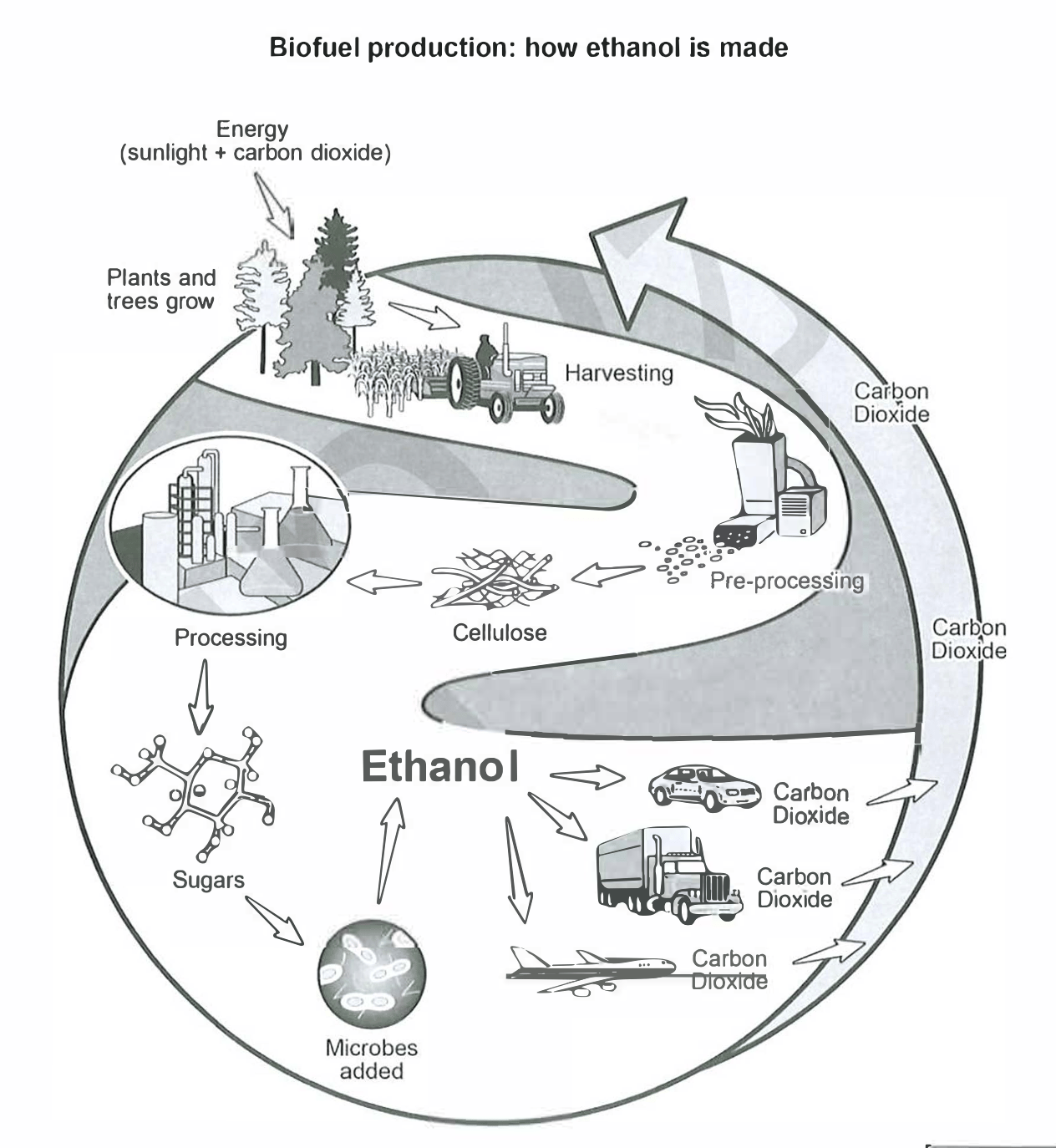
The diagram below shows how a biofuel called ethanol is produced.
Summarise the information by selecting and reporting the main features, and make comparisons where relevant.
Student answer (Band 6.5)
The diagram explains the whole process/cycle of the production of biofuel: Ethanol, from source to sink.
The cycle explains the source of raw material, its utilization and harvesting of it, processing of the product and recycling of that product back into the environment.
The process starts with the capture of energy in the form of sunlight and carbon dioxide by plants and trees for growth purpose. These plants and trees are then harvested and send for pre-processing. Pre-processing extracts the sugar cellulose from them, and send it to laboratory for further processing.
In the laboratory, the sugar is mixed with microbes, which ferment the sugar and convert it into ethanol. The ethanol is then used as a biofuel in autombiles, heavy vehicles and aeroplanes. The recycling process goes on its own. It involves release of carbon dioxide from those locomotives that use ethanol as a fuel. The carbon dioxide then goes back to the enviroment where it again become the part of it.
AI examiner evaluation
| Criterion | Band |
|---|---|
| Task Achievement / Task Response | 6.5 |
| Coherence and Cohesion | 6.5 |
| Lexical Resource | 6.0 |
| Grammatical Range and Accuracy | 6.0 |
| Overall | 6.5 |
Task Achievement / Task Response: Band 6.5
You cover the main stages and give a clear overview of the cycle, from plant growth and harvesting through conversion to ethanol and the return of carbon dioxide. The sequence is generally recognisable, and you correctly identify transport as a use for the fuel. Some details, however, are unclear or not fully supported by the diagram: pre-processing produces cellulose, rather than extracting “sugar cellulose,” and the diagram shows processing producing sugars before microbes are added. Calling the processing site a “laboratory” is also an interpretation rather than a labelled feature. The final recycling stage is mentioned but could be explained more precisely as carbon dioxide from the vehicles returning to support plant growth. This covers the task well overall, but some stages need more accurate development.
Coherence and Cohesion: Band 6.5
The response has a sensible overall progression: an introduction and overview are followed by the plant-processing stages and then fuel use and carbon recycling. Sequencing phrases such as “The process starts,” “then,” and “In the laboratory” help the reader follow the cycle. However, the first two paragraphs overlap in describing the cycle, while the later stages are compressed into a single paragraph. Some connections are also imprecise: “it” in “send it to laboratory” does not clearly identify whether cellulose or another material is being sent, and “The recycling process goes on its own” does not explain the relationship between vehicle emissions and plant growth. More consistent paragraphing and clearer references would make the progression smoother and less dependent on basic sequencing.
Lexical Resource: Band 6.0
You use a relevant range of process vocabulary, including “harvested,” “pre-processing,” “ferment,” “biofuel,” and “carbon dioxide,” which allows you to describe the main stages. There are also attempts at more formal phrasing, such as “source of raw material” and “utilization.” Some word choices and collocations are inaccurate or unnatural, however: “source to sink,” “for growth purpose,” and “goes on its own” do not express the process clearly. “Locomotives” is not an appropriate general term for cars, trucks, and aeroplanes, and “autombiles” and “enviroment” contain spelling errors. Aim for precise process terms and natural collocations rather than abstract or overly broad wording.
Grammatical Range and Accuracy: Band 6.0
You use a mix of simple and complex forms, including the relative clause “which ferment the sugar and convert it into ethanol” and the passive construction “are then harvested.” Most of the process remains understandable, but some grammatical errors persist. For example, “are then harvested and send” needs a consistent passive form (“sent”), and “it again become” needs subject–verb agreement (“it again becomes”). The phrase “send it to laboratory” also needs an article, and “for growth purpose” would require a plural or a different construction. These errors do not prevent the reader from following the main sequence, but more reliable control of verb forms, agreement, and articles would improve accuracy. Continue using complex sentences while checking each clause.
See this exact question answered at other band scores. The same prompt compared across bands.
Browse more IELTS Writing model answers or get your own writing scored by the same AI examiner.