Band 6.5 IELTS Writing Task 1 Model Answer
Overall Band Score: 6.5 · Cambridge IELTS 19 · 2026-11-19
IELTS Writing Task 1 question
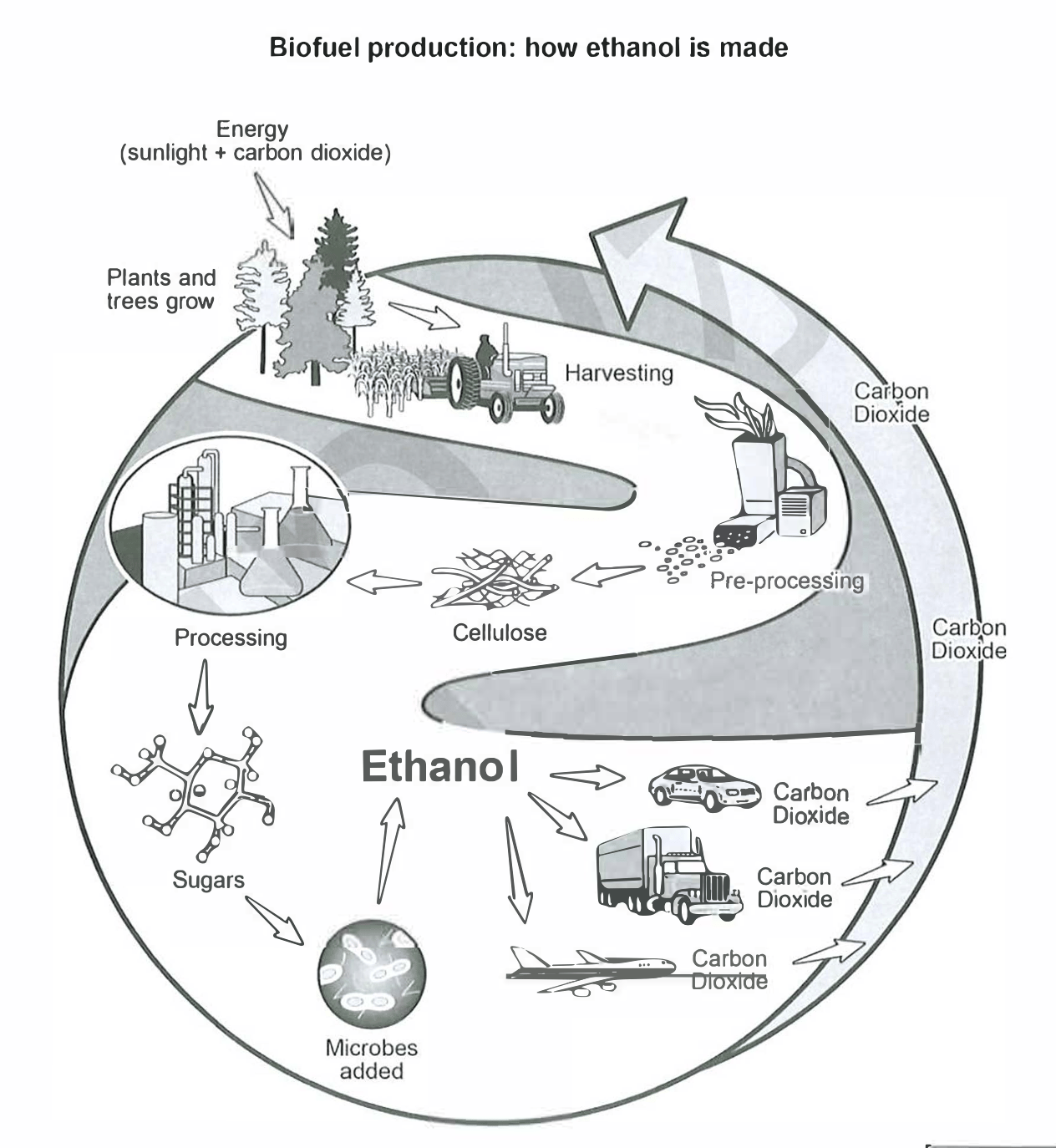
The diagram below shows how a biofuel called ethanol is produced.
Summarise the information by selecting and reporting the main features, and make comparisons where relevant.
Student answer (Band 6.5)
The diagram illustrates the complete cycle of how a biofuel called ethanol is produced.
Overall, the process can be divided into 5 major stages. This produced ethanol is then used in various automobiles and aircrafts.
To produce ethanol the significant ingredient is cellulose, in order to produce cellulose we begin with planting trees and letting them grow. Second stage is when these trees are harvested and made ready to be pre-processed in the following step. With the help of the third stage "pre-processing" the cellulose is extracted from the trees. This cellulose is then processed in beakers at the lab that creates the formation of sugars in it. During this stage microbes are added to this mixture, microbes react with the sugar present in the processed cellulose and forms a colourless alchohol namely ethanol.
This volatile alcohol can be used in tranportation sector, it is widely used as fuel in automobiles and aircrafts. These vehicles and aircrafts then release carbondioxide in the air that is consumed by the plants and the trees for creating their own food and hence the cycle continues.
AI examiner evaluation
| Criterion | Band |
|---|---|
| Task Achievement / Task Response | 7.0 |
| Coherence and Cohesion | 7.0 |
| Lexical Resource | 6.0 |
| Grammatical Range and Accuracy | 6.0 |
| Overall | 6.5 |
Task Achievement / Task Response: Band 7.0
You give a clear account of the main production sequence, from plant growth and harvesting through cellulose, sugars, microbes and ethanol, and you also describe the fuel’s use and the return of carbon dioxide to plants. This covers the cycle’s central features and provides a relevant overview. Some details, however, are not supported by the diagram: it shows processing in a factory, not “in beakers at the lab,” and it does not specify that the alcohol is colourless or volatile. The overview’s division into “5 major stages” is also not explained and does not clearly reflect the diagram’s sequence. To strengthen the report, describe the stages more precisely and avoid adding properties or equipment that are not shown.
Coherence and Cohesion: Band 7.0
The response is organised into a brief introduction and overview followed by a chronological account, with the final paragraph completing the cycle. This gives the reader a clear progression from plant growth to fuel use and carbon-dioxide return. Sequencing expressions such as “Second stage,” “following step,” and “then” help connect the stages, while “This cellulose” and “These vehicles” provide useful reference. However, the overview’s “5 major stages” is not carried through or clarified in the body, and the long production paragraph packs several steps and explanations together. Grouping the production stages more deliberately and using clearer transitions between processing, fermentation and transport would make the progression more flexible and polished.
Lexical Resource: Band 6.0
You use a suitable range of process vocabulary, including “harvested,” “pre-processed,” “cellulose,” “microbes,” and “consumed,” which helps explain the diagram. There are also some attempts at more precise description, such as “significant ingredient” and “formation of sugars.” However, several choices are inaccurate or awkward for this context: “automobiles” is narrower than the diagram’s three transport modes, “beakers at the lab” is unsupported, and “creates the formation” is an unnatural collocation. Spelling errors in “alchohol,” “tranportation,” and “carbondioxide” also reduce accuracy. Aim for precise process terms and check spelling and collocations; this would make the vocabulary more controlled without requiring unnecessarily technical language.
Grammatical Range and Accuracy: Band 6.0
You use a mixture of simple and complex forms, including purpose clauses (“in order to produce cellulose”) and a relative clause (“that creates the formation of sugars”). Most of the sequence remains understandable, but some grammatical errors are present. For example, “Second stage is when” needs an article or a different construction, and “microbes … forms” has a subject–verb agreement error. The sentence beginning “With the help of the third stage” is also awkwardly structured, while the comma splice in “This volatile alcohol can be used in tranportation sector, it is widely used…” joins two independent clauses incorrectly. Practise accurate articles, agreement and sentence boundaries, and vary complex structures while keeping each stage easy to follow.
See this exact question answered at other band scores. The same prompt compared across bands.
Browse more IELTS Writing model answers or get your own writing scored by the same AI examiner.