Band 5.5 IELTS Writing Task 1 Model Answer
Overall Band Score: 5.5 · Cambridge IELTS 19 · 2026-11-19
IELTS Writing Task 1 question
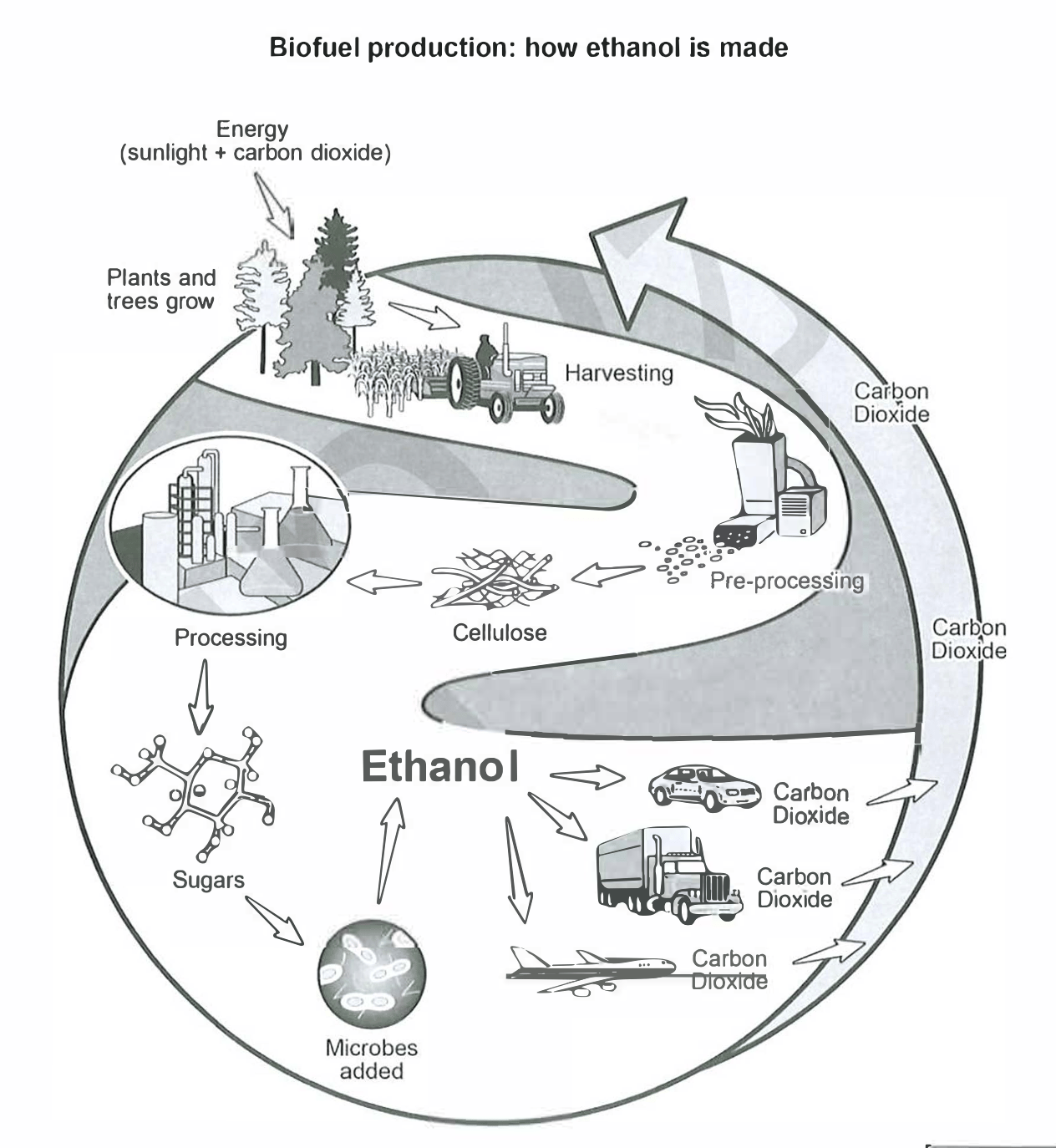
The diagram below shows how a biofuel called ethanol is produced.
Summarise the information by selecting and reporting the main features, and make comparisons where relevant.
Student answer (Band 5.5)
The given diagram descirbe the production of biofuel. Which explain how ethanol fuel is made up and used by living organisms in day to day life. However, it returned to the atmosphere.
It is clearly seen from the diagram that most of the energy plant and trees want to grow taken by the sunlight and carbon dioxide.The tress exhale carbon dioxide for source of energy. The farmer haarvesting plants and the harvest products goes to the pre-processing, after that cellulose made up after process which further use in laboratory for processing. After complete the process sugars produced and then microbes added to these sugars. The sugars and microbes transformed to Ethanol and final product used as biofuel.
The biofuel is the fuel is widely used by humans as fuel for different kind of transport vehicles where it is run on roads or fly in sky. The fuel is used in car, truck , plane etc. and these all vehicles left carbon dioxide byproduct in atomsphere. Further, carbon dioxide mix with the air and again exhale by plants and tress.
AI examiner evaluation
| Criterion | Band |
|---|---|
| Task Achievement / Task Response | 5.5 |
| Coherence and Cohesion | 5.5 |
| Lexical Resource | 5.0 |
| Grammatical Range and Accuracy | 5.0 |
| Overall | 5.5 |
Task Achievement / Task Response: Band 5.5
You identify the main subject and describe much of the sequence, from plant growth and harvesting through processing, sugar production, and transport use. You also recognise the cycle in which carbon dioxide returns to the plants. However, the overview is not clearly stated, and some details are inaccurate or unclear: the diagram shows sunlight and carbon dioxide supporting plant growth, not trees exhaling carbon dioxide as an energy source; it also shows microbes being added before ethanol is produced, rather than sugars and microbes being transformed together. The stages are reported, but their relationships and the cycle’s key features need more precise explanation. A clearer overview and accurate description of the inputs, outputs, and transport-related emissions would make the response more complete and developed.
Coherence and Cohesion: Band 5.5
The response follows a broadly sensible order: it begins with plant growth, moves through production, and ends with transport and carbon dioxide returning to the atmosphere. The paragraph break also separates the production stages from the use of ethanol. However, progression is not always clear because several stages are compressed into long sentences, and links such as “after that” and “after complete the process” are repetitive or awkward. The opening sentence is difficult to follow, while “However, it returned to the atmosphere” does not clearly identify what “it” refers to. Use distinct stages or paragraphs and clearer references—for example, explain that the carbon dioxide released by vehicles is absorbed during plant growth—to make the sequence easier to track.
Lexical Resource: Band 5.0
You use relevant process vocabulary, including “pre-processing,” “cellulose,” “microbes,” “ethanol,” and “byproduct,” which helps communicate the topic. However, the range is limited and several word choices or collocations are inaccurate, making some descriptions unclear. “The trees exhale carbon dioxide for source of energy” misrepresents the diagram and uses an unsuitable expression; “the harvest products goes” is also an awkward phrase. Spelling errors such as “descirbe,” “haarvesting,” “tress,” and “atomsphere” are noticeable. Aim for precise process language and check spelling, while avoiding repeated general terms such as “process” and “fuel.”
Grammatical Range and Accuracy: Band 5.0
The response attempts to connect ideas with longer sentences, but control is inconsistent, and errors sometimes make relationships difficult to understand. For example, “The given diagram descirbe the production” has subject–verb agreement problems, while “Which explain how ethanol fuel is made up” is an incomplete sentence. In “The farmer haarvesting plants and the harvest products goes,” the verb forms and agreement are faulty; “after complete the process sugars produced” also lacks a correctly formed clause. Articles, plurals, and punctuation need attention, as in “in car, truck, plane.” Use a reliable mix of short, accurate sentences and carefully formed complex sentences, checking that each clause has a subject and a correctly conjugated verb.
See this exact question answered at other band scores. The same prompt compared across bands.
Browse more IELTS Writing model answers or get your own writing scored by the same AI examiner.