Band 5.5 IELTS Writing Task 1 Model Answer
Overall Band Score: 5.5 · Cambridge IELTS 19 · 2026-11-19
IELTS Writing Task 1 question
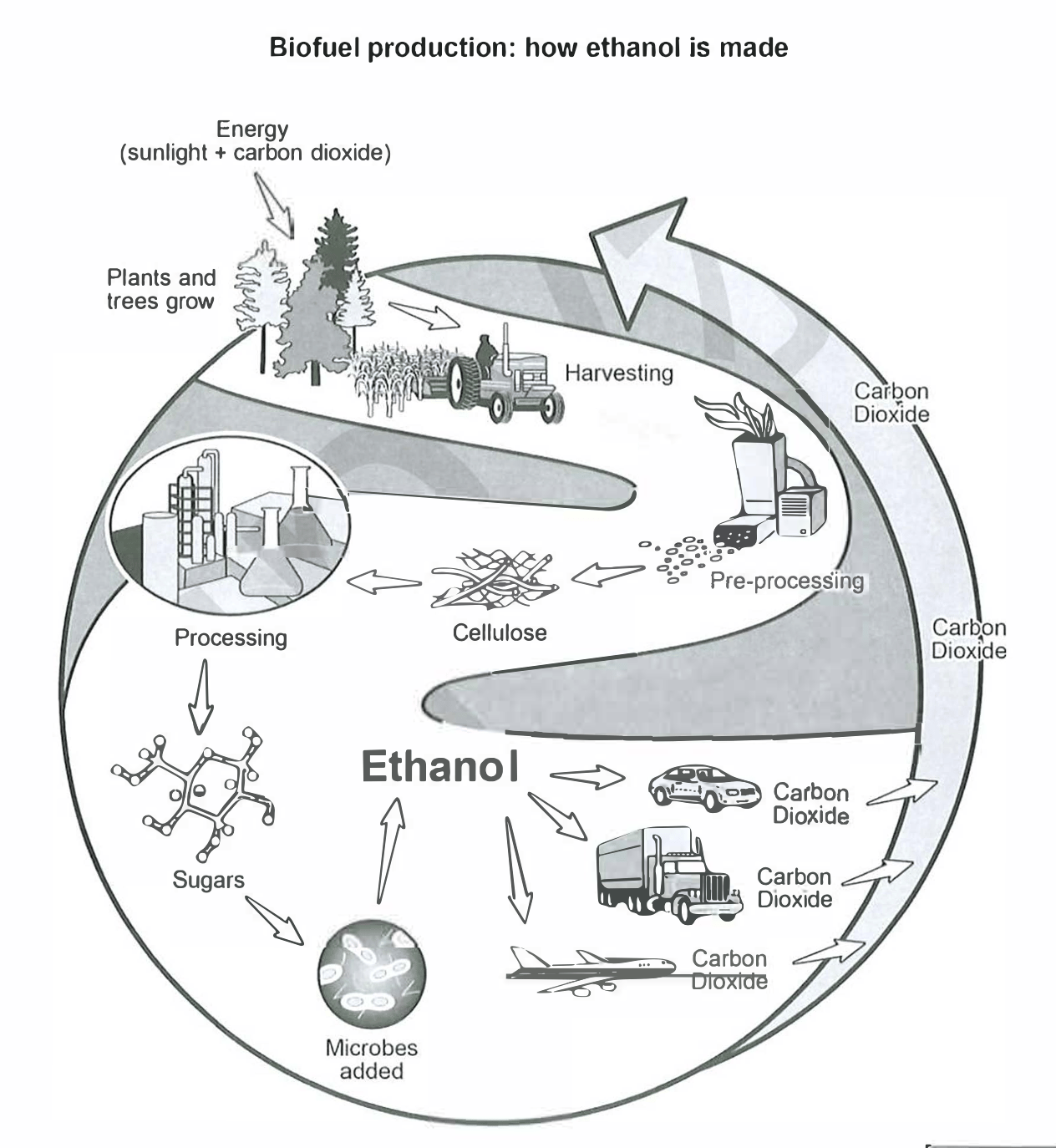
The diagram below shows how a biofuel called ethanol is produced.
Summarise the information by selecting and reporting the main features, and make comparisons where relevant.
Student answer (Band 5.5)
The diagram illustrates the production of ethanol that is also called biofuel.
Overall, the whole process is given and it has seven basic steps to make ethanol. The process starts from emission of carbon dioxide from different vehicles and then further processing.
In a beginning, the gas that emits from vehicles like cars, trucks, aeroplanes called carbon dioxide. This gas mix in air and plants also need this gas to grow. So, the trees gets sunlight and carbon dioxide to grow faster. After this natural process, we do harvesting means we cut these trees into small pieces. Then we do further pre processing to convert into cellolose. After converting it into cellulose, we do some changes to it in a lab and this is the key point where ethanol get into shape. In lab, by doing further process we reach at that point to make sugars from cellulose after processing. Then we add microbes to made finally ethanol.
AI examiner evaluation
| Criterion | Band |
|---|---|
| Task Achievement / Task Response | 5.5 |
| Coherence and Cohesion | 5.5 |
| Lexical Resource | 5.5 |
| Grammatical Range and Accuracy | 5.0 |
| Overall | 5.5 |
Task Achievement / Task Response: Band 5.5
You identify the subject and describe several central stages, including plant growth, harvesting, pre-processing, cellulose, processing, sugars and the addition of microbes. However, the overview is inaccurate: the diagram shows a cycle, not simply seven steps, and the process begins with plants using sunlight and carbon dioxide rather than with vehicle emissions. The account also stops at ethanol and omits its use in cars, trucks and aircraft, as well as the carbon dioxide released by these vehicles and returned to the plants. Some details, such as cutting trees into small pieces and processing in a lab, are not shown. To make the summary more complete and accurate, give a clear overview of the cycle and report the transport and carbon-dioxide stages without adding unsupported information.
Coherence and Cohesion: Band 5.5
The response has a recognisable sequence, and time markers such as “After this” and “Then” help the reader follow the production stages. The opening also separates the general description from the process details. However, the progression is not fully clear because the overview says the process starts with vehicle emissions, while the later account begins with plant growth. Several stages are crowded into one paragraph, and links such as “After converting it into cellulose” and “Then we add microbes” do not clearly distinguish the processing stage from the production of sugars. The final sentence also ends without completing the cycle. Organising the stages into a clear sequence and using references consistently would improve the flow.
Lexical Resource: Band 5.5
You use relevant process vocabulary, including “harvesting,” “pre processing,” “cellulose,” “microbes” and “carbon dioxide,” which allows the reader to recognise the main subject and stages. However, the range is limited and some choices are imprecise or repetitive. Phrases such as “do some changes to it,” “get into shape” and “reach at that point” are informal or unclear for an academic process description. There are also spelling and word-form problems, including “cellolose” and “pre processing.” Aim for precise process verbs and standard forms, such as “is converted,” “is processed” and “is produced.” This would make the description more concise and appropriately formal.
Grammatical Range and Accuracy: Band 5.0
You attempt some longer sentences and use sequencing clauses, for example, “After converting it into cellulose, we do some changes to it in a lab.” However, the range is limited, and errors occur frequently in basic sentence structures, verb forms and agreement. Examples include “the trees gets,” “This gas mix in air,” “ethanol get into shape” and “we add microbes to made.” Articles and sentence construction are also problematic in “In a beginning” and “the gas that emits from vehicles.” These errors sometimes make the relationships between stages harder to follow. Practise accurate present-simple passive forms for process descriptions, such as “the material is processed” and “microbes are added,” alongside correct subject–verb agreement.
See this exact question answered at other band scores. The same prompt compared across bands.
Browse more IELTS Writing model answers or get your own writing scored by the same AI examiner.