Band 5.5 IELTS Writing Task 1 Model Answer
Overall Band Score: 5.5 · Cambridge IELTS 19 · 2026-11-20
IELTS Writing Task 1 question
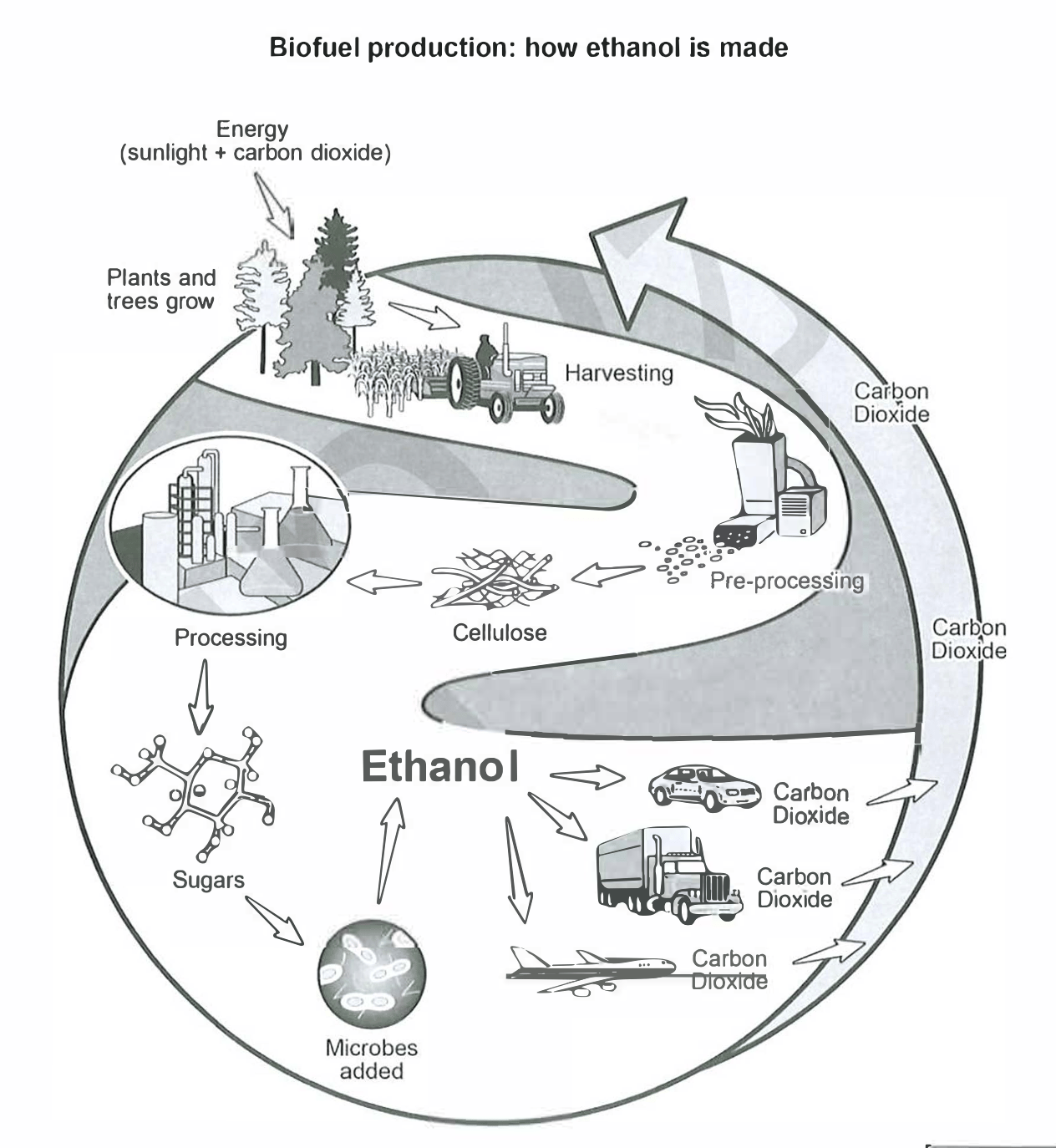
The diagram below shows how a biofuel called ethanol is produced.
Summarise the information by selecting and reporting the main features, and make comparisons where relevant.
Student answer (Band 5.5)
The given process illustrates the information about the production of ethanol.
Overall,the process consist of seven stages which is started from trees and ending with the production of ethanol as a final product.further more the ethanol burned and produce carbon dioxide and this gas gives energy to plants and trees.
According to the process, the plants grow through carbon dioxide in the presence of sun light. After that, trees are harvesting and forword for pre processing, in the following step they produce cellulose. The cellulose again forword for processing to factory.
In the factory processing stage cellulose converts into sugar followed by this step the microbes are added to the sugar and make ethanol as a final product. Ethanol is uesd as a fuel in different factories, cars and airoplanes which born and produce carbon dioxide. This carbon dioxide is reabsorbe by the plants and trees and this process is again recycling.
AI examiner evaluation
| Criterion | Band |
|---|---|
| Task Achievement / Task Response | 6.0 |
| Coherence and Cohesion | 5.5 |
| Lexical Resource | 5.5 |
| Grammatical Range and Accuracy | 5.0 |
| Overall | 5.5 |
Task Achievement / Task Response: Band 6.0
You identify the main stages from plant growth through processing to ethanol, and you also recognise the diagram’s central feature: carbon dioxide released during fuel use returns to support plant growth. This gives the response a relevant overview and covers the broad process. However, the overview says there are “seven stages,” which does not accurately represent the sequence, and some details are unclear or incomplete. For example, the diagram shows ethanol used by a car, truck and aeroplane, not “different factories,” and it does not explicitly show the fuel being burned. The account also compresses the conversion to sugars and the addition of microbes. More precise reporting of the stages and transport uses would make the summary more complete.
Coherence and Cohesion: Band 5.5
The response has a recognisable overall order: an introduction and overview are followed by stages of the process, and phrases such as “After that” and “In the following step” help signal sequence. The final reference to carbon dioxide returning to plants also brings the cycle back to its starting point. However, progression is sometimes difficult to follow because several stages are crowded into long sentences, and links such as “followed by this step” are awkward. The paragraphing is limited, while punctuation and spacing—such as “Overall,the” and “product.further”—interrupt the flow. Use clearer sentence boundaries and organise the description into distinct early and later stages.
Lexical Resource: Band 5.5
You use relevant process vocabulary, including “pre processing,” “cellulose,” “microbes,” and “carbon dioxide,” which helps communicate the subject. There is also some attempt to vary wording with “final product” and “reabsorbe.” However, the range is limited and several word-choice, collocation, and spelling problems make parts less precise: “trees are harvesting,” “forword,” “uesd,” “airoplanes,” and “born” are inaccurate. “Different factories” also mislabels the transport modes shown. Aim for accurate process verbs and standard spelling, and avoid repeating “produce” where a more exact verb such as “release” or “convert” is appropriate. These improvements would make the description clearer and more natural.
Grammatical Range and Accuracy: Band 5.0
You attempt both simple and more complex sentence forms, including a relative clause in “which is started from trees” and a sequence linked by “followed by.” The overall meaning is generally recoverable, but grammatical control is uneven. Subject–verb agreement is incorrect in “the process consist,” and tense and passive forms are faulty in “trees are harvesting” and “cellulose converts into sugar.” The opening overview also has a sentence-boundary problem: “product.further more” joins separate ideas without appropriate punctuation. Articles and sentence construction need attention as well. Practise accurate present-simple descriptions of processes, including passive forms such as “the trees are harvested” and “cellulose is converted,” while checking agreement and punctuation.
See this exact question answered at other band scores. The same prompt compared across bands.
Browse more IELTS Writing model answers or get your own writing scored by the same AI examiner.