Band 5.5 IELTS Writing Task 1 Model Answer
Overall Band Score: 5.5 · Cambridge IELTS 19 · 2026-11-20
IELTS Writing Task 1 question
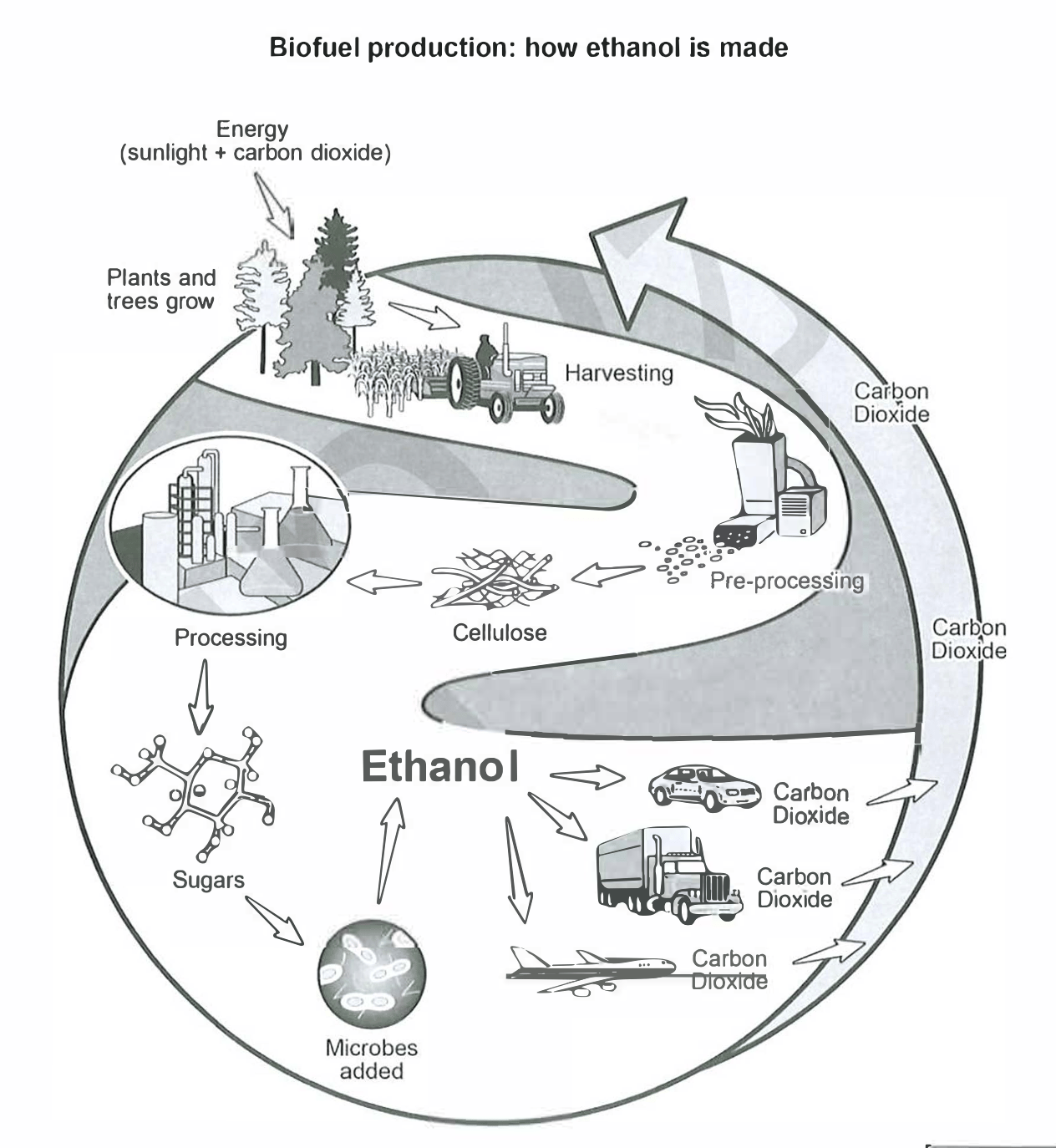
The diagram below shows how a biofuel called ethanol is produced.
Summarise the information by selecting and reporting the main features, and make comparisons where relevant.
Student answer (Band 5.5)
The diagram illustrates gives information about how to produce the biofuel called ethanol.
In the overview, the biofuel production how to made ethanol. There are lot of process in this diagram to made ethanol. In this diagram, shows lastly reduce carbon dioxide to grows tree.
Looking at the first, the energy sunlight and carbon dioxide to plan tress and grow and the next step in diagram is harvestin to collecting this. However, the next step is pre-processing then they made cellulose. On the other hand, the cellulose move into processing. Then, they made sugar and they added microbes. Lastly in this process the ethanol is ready.
Turning to the next, in this ethanol used to made by car, truck, airplane. Morever, truck, car, airplane reduce carbon dioxide, then the carbon dioxide move into tress for grow for the ethanol making process. This ciecle of diagram is process to mentioning this way.
AI examiner evaluation
| Criterion | Band |
|---|---|
| Task Achievement / Task Response | 6.0 |
| Coherence and Cohesion | 5.5 |
| Lexical Resource | 5.0 |
| Grammatical Range and Accuracy | 4.5 |
| Overall | 5.5 |
Task Achievement / Task Response: Band 6.0
You cover the main stages from plant growth and harvesting through pre-processing, cellulose, processing, sugars, microbes and ethanol, and you also mention the transport uses and the return of carbon dioxide to the plants. This addresses the process as a whole, and the cyclical feature is relevant. However, the overview is unclear and partly inaccurate: “lastly reduce carbon dioxide to grows tree” does not clearly explain that carbon dioxide released by transport returns to support plant growth. Some stages are also reported imprecisely, such as saying the vehicles “reduce carbon dioxide” rather than release it. To strengthen the response, give a concise, accurate overview of the cycle and describe the final emissions stage more precisely; some details are currently less clear than the sequence itself.
Coherence and Cohesion: Band 5.5
The response has a basic overall order: it first follows the production stages and then turns to transport and carbon dioxide, so the reader can broadly follow the diagram. Paragraphing also separates the overview from the process description. However, progression is weakened by unclear or mechanical linking phrases such as “In the overview,” “Looking at the first,” and “Turning to the next.” The overview repeats the task rather than summarising the main pattern, and the final sentence, “This ciecle of diagram is process to mentioning this way,” does not provide a clear conclusion. Use straightforward sequencing language and make each paragraph perform a distinct role: overview, production stages, and the cycle’s return to plant growth.
Lexical Resource: Band 5.0
You use several relevant process terms, including “harvesting,” “pre-processing,” “cellulose,” “microbes,” and “ethanol,” which help identify the stages. However, the range is limited and some word choices or collocations make the meaning difficult to follow. For example, “reduce carbon dioxide” misrepresents the emissions, while “ethanol used to made by car” does not clearly express that ethanol is used as fuel in transport. There are also spelling errors such as “harvestin,” “tress,” “Morever,” and “ciecle.” Aim for accurate process vocabulary and natural combinations such as “carbon dioxide is released” and “used as fuel in vehicles.” Proofreading spelling and avoiding repeated “made” would improve precision.
Grammatical Range and Accuracy: Band 4.5
You attempt both simple and linked sentences, and the sequence is generally recognisable despite grammatical problems. However, control of sentence structure and verb forms is weak in several places. The opening, “The diagram illustrates gives information,” combines two verb patterns; “There are lot of process … to made ethanol” has errors in the article, plural and infinitive; and “In this diagram, shows lastly…” lacks a clear subject and complete clause. Later, “the cellulose move into processing” also has subject–verb agreement trouble. Build accurate simple sentences first, then add a limited number of complex clauses. Check that each sentence has a subject and finite verb, and review articles, plurals, agreement and verb forms.
See this exact question answered at other band scores. The same prompt compared across bands.
Browse more IELTS Writing model answers or get your own writing scored by the same AI examiner.