Band 6.5 IELTS Writing Task 1 Model Answer
Overall Band Score: 6.5 · Cambridge IELTS 19 · 2026-11-20
IELTS Writing Task 1 question
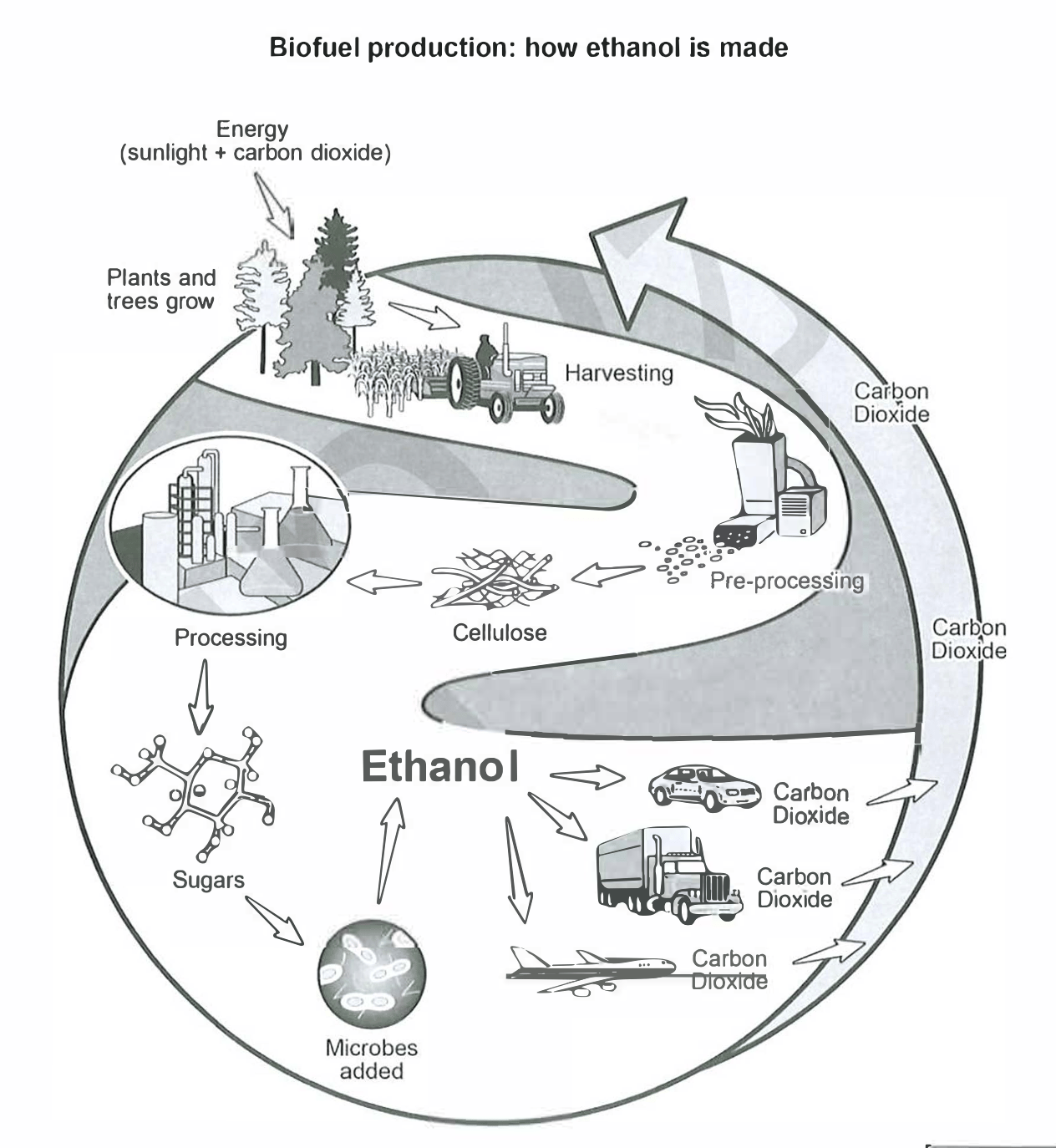
The diagram below shows how a biofuel called ethanol is produced.
Summarise the information by selecting and reporting the main features, and make comparisons where relevant.
Student answer (Band 6.5)
The diagram describes the process of producing a biofuel which is called an ethanol.
Overall, This is a cyclic process consist of mainly seven steps to produce an ethanol, begins with the growth of plants and tress and ends by producing an ethanol which is then used as a fuel in several vehicles that produce CO2 which again helps in plants growth.
The biofuel production starts when plants and trees consumed energy in the form of a sunlight and the carbon dioxide to grow, when the plants get mature, it is then harvested by the help of a tractor. The harvested plants and tress went through a pre-processing process that results as crushed particles which is then converted into a cellulose.
After that, chemical process is taken out with a cellulose and sugar molecules are produced, these sugar molecules are combined with microbes and as a result finished product is achieved in the form of an ethanol. This ethanol is used as a fuel in different vehicles such as cars, trucks, airplanes which produce carbon dioxide and this carbon dioxide again used by plants and tress as energy to grow.
AI examiner evaluation
| Criterion | Band |
|---|---|
| Task Achievement / Task Response | 7.0 |
| Coherence and Cohesion | 6.5 |
| Lexical Resource | 6.0 |
| Grammatical Range and Accuracy | 5.5 |
| Overall | 6.5 |
Task Achievement / Task Response: Band 7.0
You give a clear overview of the cycle, identifying plant growth as the starting point and the return of carbon dioxide from transport as part of the loop. The main stages are also reported in sequence: harvesting, pre-processing, cellulose, processing, sugars, microbes and ethanol. This covers the key features and is generally accurate. Some details, however, go beyond what the diagram shows: it does not specify that plants are harvested when “mature,” that pre-processing produces “crushed particles,” or that the processing is chemical. Also, the overview says there are mainly seven steps, although the diagram presents more stages. For a stronger response, describe only visible information and make the overview’s account of the cycle and its stages more precise.
Coherence and Cohesion: Band 6.5
The response is organised into an introduction, an overview and two paragraphs that follow the production sequence, so the reader can trace the process from plant growth to fuel use. Linking expressions such as “After that” and “as a result” help signal progression, and the final sentence reconnects transport emissions to plant growth. This is a coherent overall arrangement. However, some links are repetitive or awkward, and the long sentences in the process paragraphs combine several stages, making the sequence less easy to follow. The overview also repeats information that appears later. To move further, use clearer sentence boundaries and more varied, precise transitions, while keeping each sentence focused on one or two connected stages.
Lexical Resource: Band 6.0
You use a suitable range of process vocabulary, including “harvested,” “pre-processing,” “cellulose,” “microbes” and “fuel,” which allows you to describe the main stages. The terms “cyclic process” and “finished product” also show an attempt to use more formal language. However, some word choices and collocations are inaccurate or unnatural, such as “plants consumed energy,” “chemical process is taken out,” and “combined with microbes.” There are also repeated forms such as “plants and tress” and “an ethanol.” Aim for more precise process language and check common collocations; for example, plants “absorb” energy, a process “is carried out,” and sugars are “combined with” or “fermented by” microbes.
Grammatical Range and Accuracy: Band 5.5
You attempt a mixture of simple and complex sentences, including clauses beginning “when” and “which,” and the overall meaning is usually clear. However, errors in verb forms, agreement, articles and sentence construction recur. For example, “This is a cyclic process consist” needs a finite verb form such as “consists,” while “plants and trees consumed” should use the present simple for a general process. In “the harvested plants … went through,” the past tense is inconsistent with the rest of the description. Article use is also problematic in “a sunlight” and “an ethanol.” Some sentences are overloaded with clauses, so punctuation and sentence boundaries need attention. Practise accurate present-simple process descriptions and review articles and subject–verb agreement.
See this exact question answered at other band scores. The same prompt compared across bands.
Browse more IELTS Writing model answers or get your own writing scored by the same AI examiner.