Band 6.0 IELTS Writing Task 1 Model Answer
Overall Band Score: 6.0 · Cambridge IELTS 19 · 2026-11-21
IELTS Writing Task 1 question
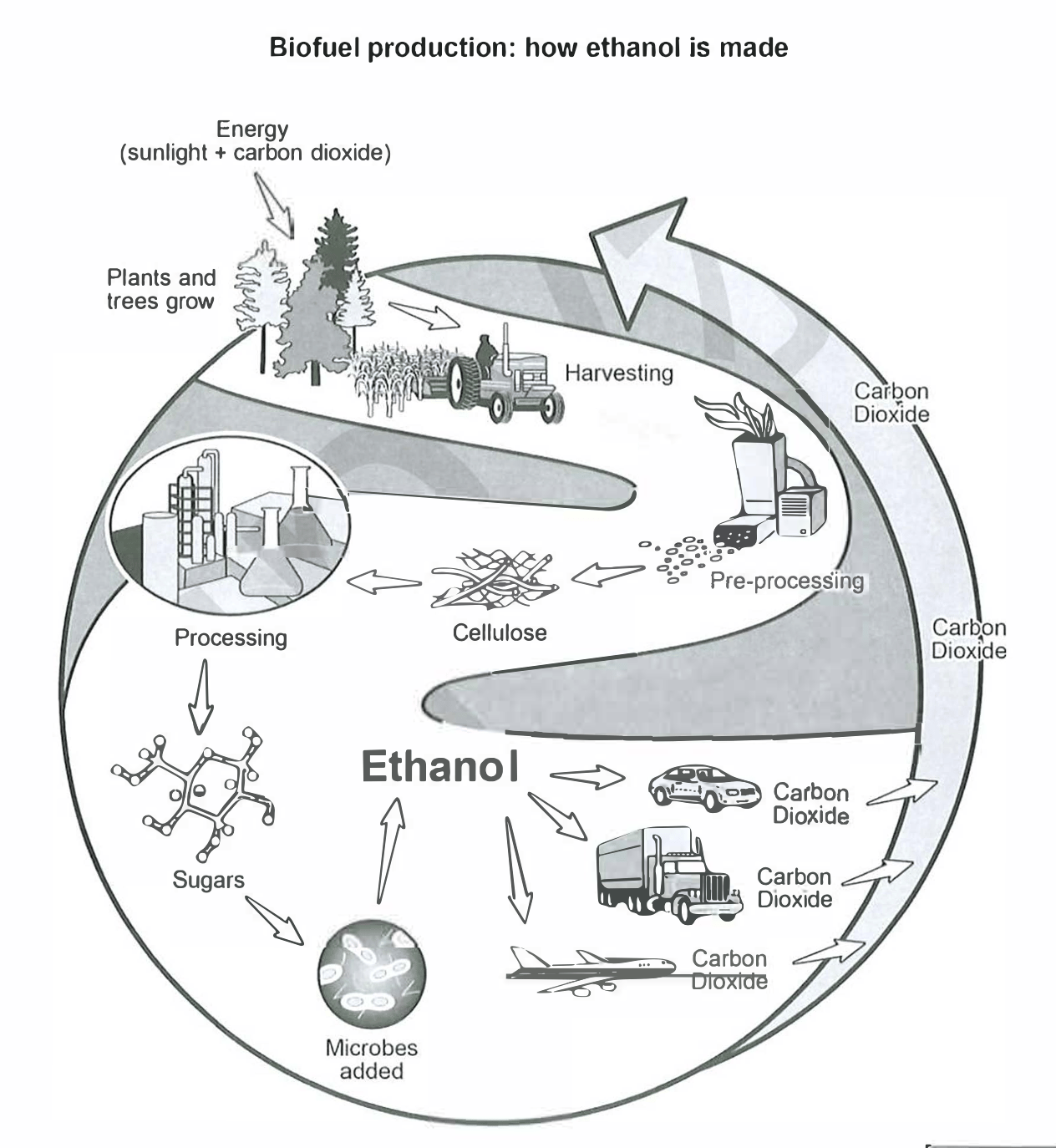
The diagram below shows how a biofuel called ethanol is produced.
Summarise the information by selecting and reporting the main features, and make comparisons where relevant.
Student answer (Band 6.0)
The diagram explains how a biofuel named as ethanol is being manufactured.
Overall, It can be seen the major contributor for this entire procedure are trees and plant and the final product can be used mainly in vehicles such as Cars, trucks and aeroplanes.
To begin with, the manufacturing process of ethanol begins with the cutting down of the trees which goes through a pre-processing which extracts the main particles which is the crucial part. The remaining particles are transformed into a product called cellulose. These cellulose goes through another step, that is processing in the lab. This transform the remainings into a formula of sugars. Furthermore additional changes are done to sugars such as adding microbes into it.
This gives us the final product which is Ethonal. This final product is later used in vehicles such as Cars, lorries and Aeroplanes that results in releasing carbon dioxide in the air.
AI examiner evaluation
| Criterion | Band |
|---|---|
| Task Achievement / Task Response | 6.0 |
| Coherence and Cohesion | 6.5 |
| Lexical Resource | 5.5 |
| Grammatical Range and Accuracy | 5.5 |
| Overall | 6.0 |
Task Achievement / Task Response: Band 6.0
You identify the process as ethanol production and include several central stages, from pre-processing and cellulose to sugars, microbes and the final fuel. You also note its use in cars, trucks and aircraft and the release of carbon dioxide. However, some stages are unclear or inaccurately described: the diagram shows plants growing with sunlight and carbon dioxide before harvesting, not simply trees being cut down, and pre-processing produces cellulose rather than extracting unspecified “main particles” before cellulose appears. The overview identifies plants and transport but misses the defining feature of the diagram: carbon dioxide released during fuel use returns to support plant growth, making the process cyclical. Covering this cycle and describing the stages more precisely would make the summary more complete.
Coherence and Cohesion: Band 6.5
The response has a clear overall arrangement: an introduction and overview are followed by the production stages and then the fuel’s use. Sequencing phrases such as “To begin with,” “Furthermore,” and “This gives us the final product” help the reader follow the process, and the paragraph breaks are appropriate. This meets the lower-band expectation of coherent organisation and shows some effective progression. However, the links between stages are occasionally unclear, particularly in “The remaining particles are transformed into a product called cellulose,” which makes the relationship between pre-processing and cellulose difficult to follow. The final paragraph also stops at carbon dioxide release without connecting it back to plant growth. Use precise stage-to-stage links and a concluding reference to the cycle to strengthen progression.
Lexical Resource: Band 5.5
You use relevant process vocabulary, including “pre-processing,” “cellulose,” “processing,” “sugars,” and “microbes,” which allows you to report several technical stages. There is also some variety in how you refer to the product, such as “final product” and “ethanol.” However, word choice and collocation are often imprecise: “biofuel named as ethanol,” “main particles,” and “a formula of sugars” do not express the process naturally. “Manufactured” is also less suitable than “produced” for describing this process. Spelling and form errors such as “Ethonal” and “remainings” further reduce accuracy. Aim for standard process-reporting phrases and check technical terms and spelling; this would make the account clearer and more precise.
Grammatical Range and Accuracy: Band 5.5
You attempt a mix of simple and more developed sentences, including a relative clause in “vehicles … that results in releasing carbon dioxide” and sequencing clauses in the process description. The overall meaning is generally recoverable, but some grammatical errors affect clarity. For example, “the major contributor … are trees and plant” has subject–verb and number agreement problems, while “These cellulose goes” and “This transform” also show agreement errors. The opening overview has an incomplete construction in “It can be seen the major contributor,” and the sentence about vehicles has an unclear relative-clause reference. Use complete clauses, check singular and plural agreement, and make sure pronouns clearly refer to the intended noun. More consistently accurate sentence patterns would improve control.
See this exact question answered at other band scores. The same prompt compared across bands.
Browse more IELTS Writing model answers or get your own writing scored by the same AI examiner.