Band 5.0 IELTS Writing Task 1 Model Answer
Overall Band Score: 5.0 · Cambridge IELTS 19 · 2026-11-21
IELTS Writing Task 1 question
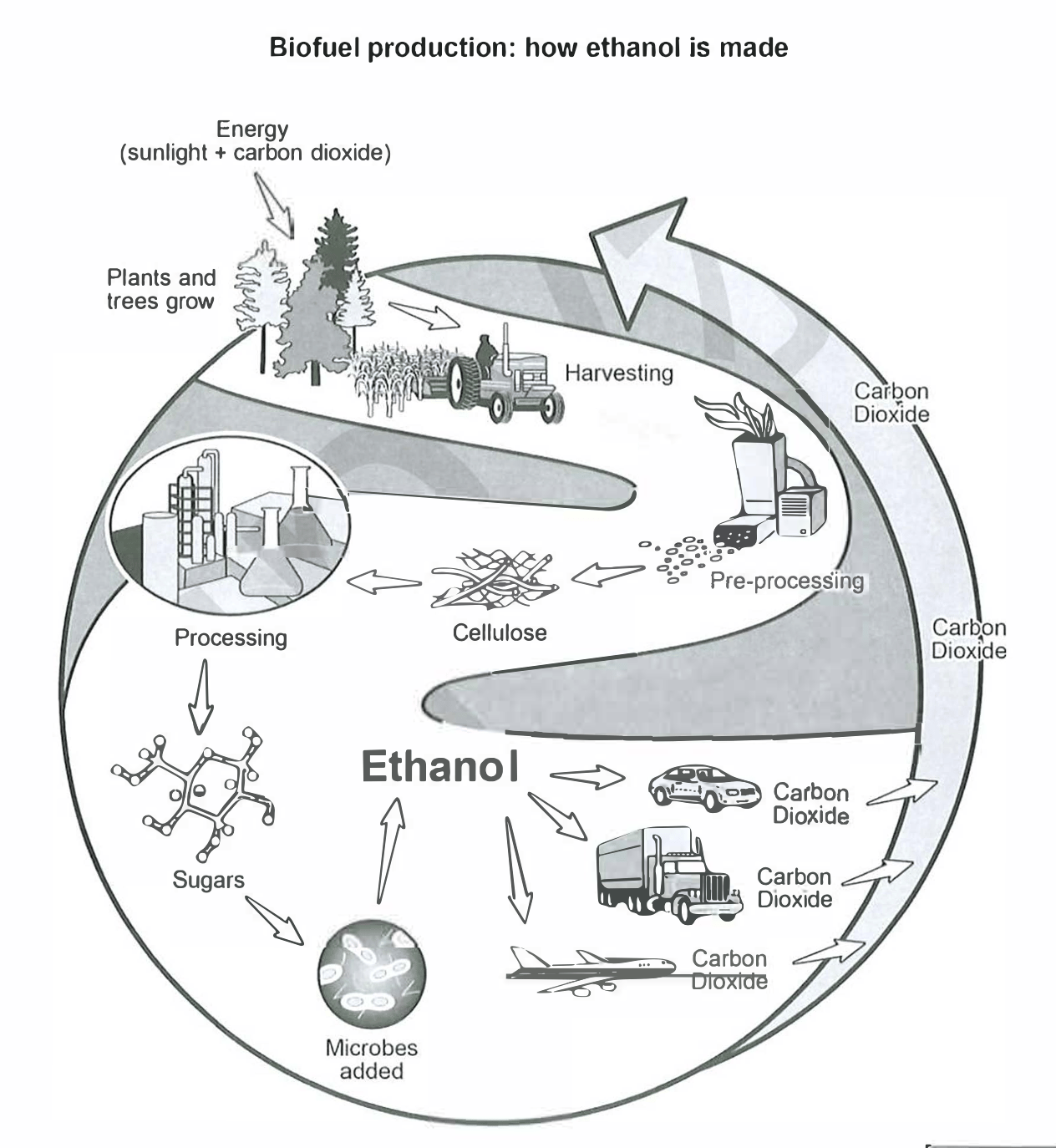
The diagram below shows how a biofuel called ethanol is produced.
Summarise the information by selecting and reporting the main features, and make comparisons where relevant.
Student answer (Band 5.0)
The picture given represent a Biofuel production steps in nature starting with production to the consumption along a full procedure that contien two parts .
Firstly , we plant trees which use natural energy like sunlight and carbon dioxide to grow before being harvesting by the farmer and send them to pre-processing so they made cellulose from them .
Secondly , after the mecanical part we went to the chimical one , we pass our cellulose under processing with chimical liquides to produce sugars then add microbes , so finaly we can have ethanol which used in cars , plans ...
In conclusion , carbon dioxide is a vital gaz fabriced by nature
AI examiner evaluation
| Criterion | Band |
|---|---|
| Task Achievement / Task Response | 4.5 |
| Coherence and Cohesion | 5.0 |
| Lexical Resource | 5.0 |
| Grammatical Range and Accuracy | 5.0 |
| Overall | 5.0 |
Task Achievement / Task Response: Band 4.5
You identify the broad sequence from plant growth through processing to ethanol, and mention that the fuel is used in transport. However, the report covers the diagram only partially: it omits the conversion of ethanol into carbon dioxide through the car, truck and aeroplane, and the return of that carbon dioxide to support plant growth. The conclusion, “carbon dioxide is a vital gaz fabriced by nature,” does not clearly summarise the cycle and includes an unsupported claim. The response is also 37 words below the required minimum, leaving too little space to describe the main stages fully. To improve, give a clear overview of the circular nature of the process, then report each key stage and the carbon-dioxide loop accurately.
Coherence and Cohesion: Band 5.0
The response has a basic sequence, with “Firstly” and “Secondly” helping the reader distinguish the growth and processing stages. The stages are generally presented in the correct order, so the main process can be followed. However, the two-part division is not fully clear or useful, and the final “In conclusion” sentence does not connect the production stages to the cycle shown in the diagram. Some links between steps are compressed—for example, “produce sugars then add microbes”—and the response ends without explaining what happens after ethanol is used. Organise the report into a brief overview and a fuller chronological description, using clear links between each stage and the return of carbon dioxide.
Lexical Resource: Band 5.0
You use some relevant process vocabulary, including “pre-processing,” “cellulose,” “sugars,” “microbes” and “ethanol,” which allows the reader to recognise several stages. However, the range is limited, and noticeable spelling and word-choice errors sometimes make the description difficult to understand. For example, “chimical liquides” is not supported by the diagram, while “plans” appears to mean planes and “gaz fabriced” is unclear. Phrases such as “full procedure” and “mechanical part” are also imprecise for describing a process diagram. Aim for accurate, neutral terms such as “stage,” “converted into,” and “released,” and avoid adding details about chemicals that are not shown.
Grammatical Range and Accuracy: Band 5.0
You attempt both simple and longer sentences, including a sequence linked with “before” and a sentence beginning “after the mecanical part.” However, control is inconsistent, and errors in sentence structure, verb forms, agreement and articles occur frequently. For instance, “The picture given represent” has a subject–verb agreement error, and “which used in cars” is missing a verb form. The phrase “before being harvesting” also uses an incorrect form after “being.” Punctuation and spacing around commas are uneven, and the final sentence is not a clear grammatical summary. Practise accurate present-simple descriptions of processes, checking each clause for a subject and verb, and use passive forms such as “is harvested” where appropriate.
See this exact question answered at other band scores. The same prompt compared across bands.
Browse more IELTS Writing model answers or get your own writing scored by the same AI examiner.