Band 6.5 IELTS Writing Task 1 Model Answer
Overall Band Score: 6.5 · Cambridge IELTS 19 · 2026-11-22
IELTS Writing Task 1 question
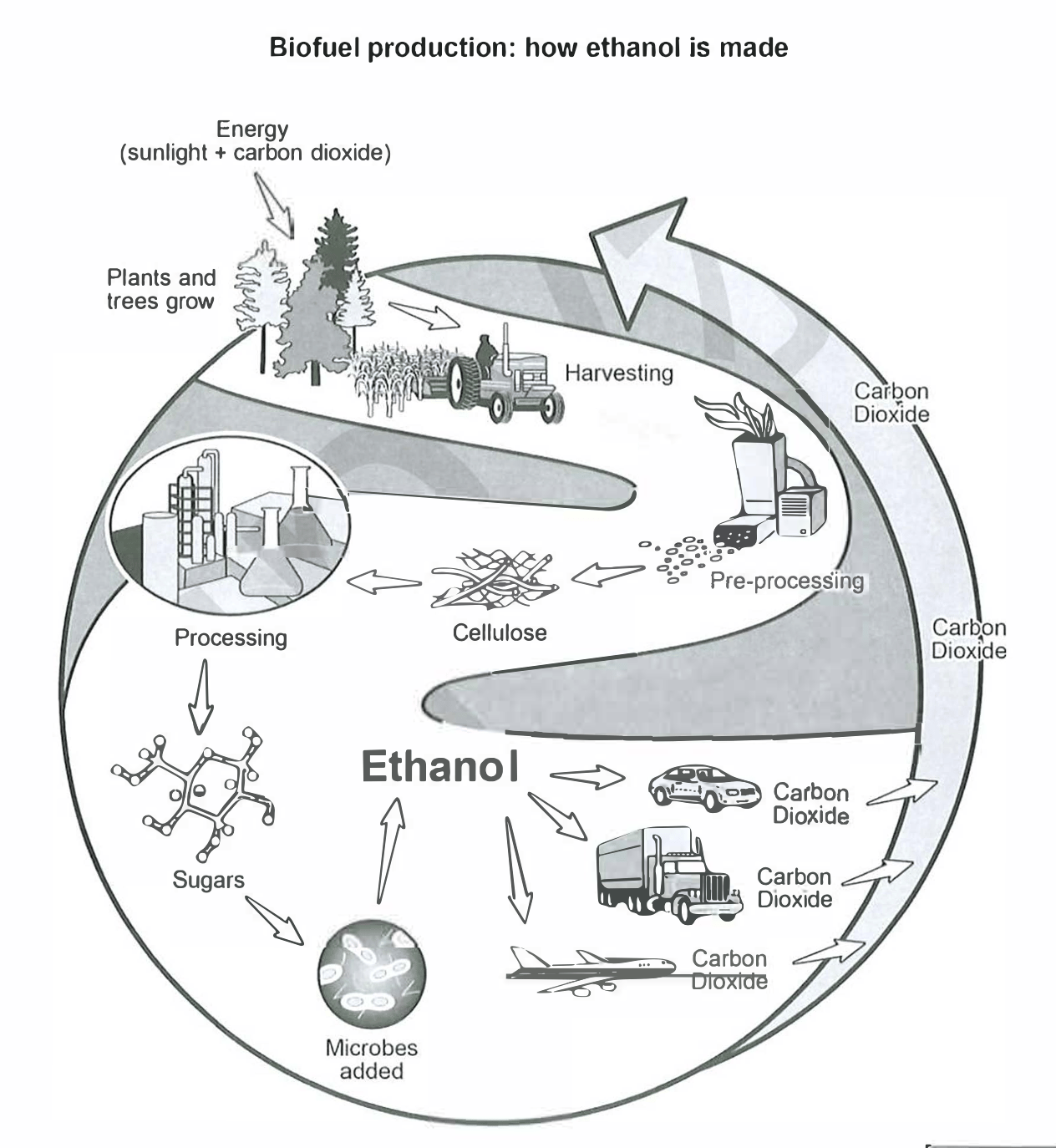
The diagram below shows how a biofuel called ethanol is produced.
Summarise the information by selecting and reporting the main features, and make comparisons where relevant.
Student answer (Band 6.5)
This diagram illustrates the process of production of the ethanol biofuel.
This process consists of nine main stages. This cycle starts with planting and growing of trees and ends with leaving carbon dioxide by different modes of transportation in the atmosphere which is again reabsorbed by plants.
Firstly, plants and trees grow with the help of sunlight and carbon dioxide from the atmosphere. Then, these mature plants and trees are harvested with the help of tractors. After this, these harvested plants and trees go into a pre-processing stage where cellulose is extracted.
Following this, this cellulose goes into lab for further processing where they got sugars separated. In the next stage, microbes are added in the produced sugars to make ethanol. Consequently, this ethanol powered various modes of transportation like cars, trucks and aeroplanes and emit carbon-dioxide. In the last stage, this carbon-dioxide is reabsorbed by plants for their growth.
AI examiner evaluation
| Criterion | Band |
|---|---|
| Task Achievement / Task Response | 6.5 |
| Coherence and Cohesion | 6.5 |
| Lexical Resource | 6.0 |
| Grammatical Range and Accuracy | 6.0 |
| Overall | 6.5 |
Task Achievement / Task Response: Band 6.5
You cover the main stages and give a clear overview of the cycle, noting that it begins with plant growth and that carbon dioxide from transport is returned to the plants. The sequence from harvesting through pre-processing, cellulose, processing, sugars, microbes and ethanol is also broadly accurate. This meets the task well, though some details are less fully or precisely reported: the diagram shows ethanol being used by cars, trucks and aeroplanes, rather than explicitly saying it powers them, and it does not show cellulose being “extracted” or sugars being “separated.” The overview could also identify the conversion stages more clearly. More exact descriptions of what the diagram depicts, alongside a concise summary of the cycle’s key stages, would make the account more complete and precise.
Coherence and Cohesion: Band 6.5
The response follows the process in a logical order, and the sequence markers “Firstly,” “Then,” “After this,” and “Following this” help the reader track the stages. The opening overview also gives the account a clear direction, from plant growth to carbon dioxide returning to the plants. However, the writing is presented as one continuous block, so the overview and the detailed stages are not visually distinguished. Some links feel mechanical, and “Consequently” does not clearly express the relationship between ethanol production and its use in transport. The reference in “this carbon-dioxide” is understandable, but the repeated use of “this” makes connections less precise. Separate the overview from the process description and use a wider range of accurate links and references to improve flow.
Lexical Resource: Band 6.0
You use a suitable range of process vocabulary, including “harvested,” “pre-processing,” “cellulose,” “microbes” and “reabsorbed,” which allows you to describe the main stages. Some less common terms are attempted, but several choices are imprecise or unnatural: “leaving carbon dioxide … in the atmosphere” is awkward for describing emissions, and “go into a lab” is not the best description of the diagram’s processing stage. “Carbon-dioxide” is also not conventionally hyphenated in this context. These choices do not prevent understanding, but they reduce precision and naturalness. Aim for standard process collocations and use the diagram’s labels where possible, such as “is processed into sugars” and “carbon dioxide is released.”
Grammatical Range and Accuracy: Band 6.0
You use both simple sentences and longer clauses, for example, “After this, these harvested plants and trees go into a pre-processing stage where cellulose is extracted.” The sequence is generally understandable, and some sentence structures are controlled. However, there are some errors in verb form and agreement: “where they got sugars separated” should use a passive construction such as “where sugars are produced,” while “this ethanol powered … and emit” shifts tense and does not maintain agreement. The opening overview also has an awkward construction in “ends with leaving carbon dioxide.” Most stages are described in the present, so keep that tense consistent and check that subjects and verbs agree. More accurate control of these forms, alongside varied complex sentences, would strengthen the account.
See this exact question answered at other band scores. The same prompt compared across bands.
Browse more IELTS Writing model answers or get your own writing scored by the same AI examiner.