Band 5.5 IELTS Writing Task 1 Model Answer
Overall Band Score: 5.5 · Cambridge IELTS 19 · 2026-11-22
IELTS Writing Task 1 question
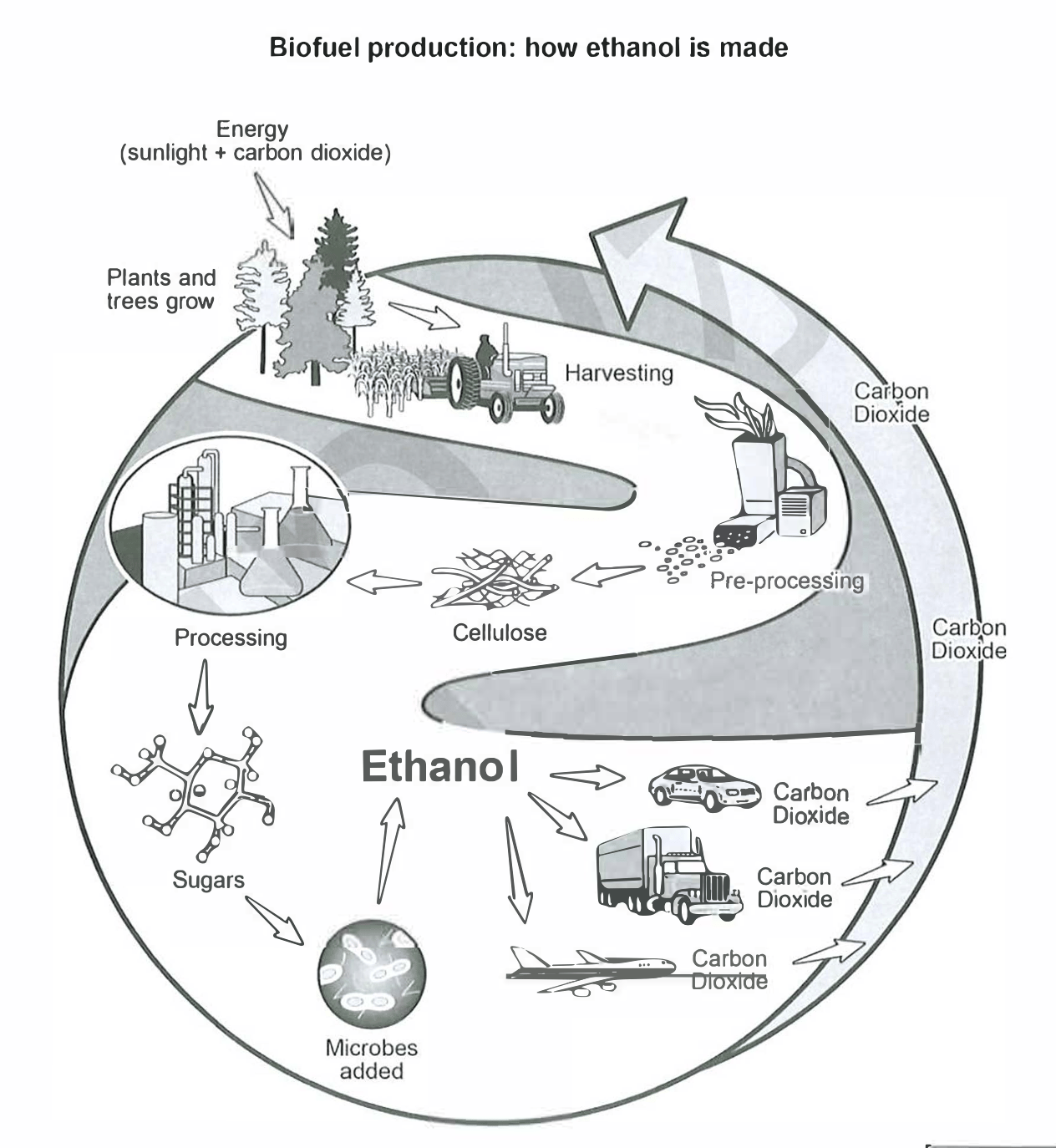
The diagram below shows how a biofuel called ethanol is produced.
Summarise the information by selecting and reporting the main features, and make comparisons where relevant.
Student answer (Band 5.5)
The diagram demonstrates the six main stages of biofuel productions in ethonal. The main component is energy.
Overall, it is evident that the energy source includes sunlight and carbon dioxide for the process. Another feature is that carbon dioxide which is increasing by the transportation.
The first stage includes plants and trees grows which leads to harvesting in the particular session. Next stage is pre-prcessing the harvest into the raw material which will be coverted into cellulose that makes a conserable change. Cellulose is the product which is arise through pre-processing. Furthermore, cellulose will pass to processing.
Turning to the remaining stages, through processing it will result in sugars. After this microbes has added into the sugars. At the end, ethonal will made through microbes added which produce carbon dioxide through vehicles. And this whole process will continue as CO2 will be consume by plants and trees and harvest, so on.
AI examiner evaluation
| Criterion | Band |
|---|---|
| Task Achievement / Task Response | 6.0 |
| Coherence and Cohesion | 6.0 |
| Lexical Resource | 5.0 |
| Grammatical Range and Accuracy | 5.0 |
| Overall | 5.5 |
Task Achievement / Task Response: Band 6.0
You cover the main sequence from plant growth and harvesting through processing, sugars, microbes and ethanol, and you recognise the diagram’s circular carbon-dioxide cycle. The overview also identifies sunlight and carbon dioxide as inputs. However, some important details are unclear or inaccurate: the diagram shows carbon dioxide released when ethanol is used by cars, trucks and aircraft, rather than simply “increasing by the transportation,” and the final cycle returns this carbon dioxide to plant growth. The description of cellulose is also repetitive, and “six main stages” does not clearly represent the full sequence shown. To strengthen the response, summarise the cycle precisely and distinguish the production stages from ethanol’s use in transport and the resulting emissions.
Coherence and Cohesion: Band 6.0
The response has a recognisable overall structure: an introduction and overview are followed by the early and later stages, with transitions such as “The first stage,” “Next stage,” and “Turning to the remaining stages.” This gives the reader a generally coherent route through the process. However, some links are mechanical or unclear, and the repeated explanation of cellulose interrupts progression. For example, “which will be converted into cellulose” is followed by “Cellulose is the product which is arise through pre-processing,” repeating the same point without advancing the sequence. The final sentence also compresses several stages into an unclear chain. Grouping the production stages together, then explaining transport and the return of carbon dioxide, would make the progression easier to follow.
Lexical Resource: Band 5.0
You use relevant process vocabulary, including “harvesting,” “pre-processing,” “cellulose,” “processing,” “sugars” and “microbes,” which helps communicate the diagram’s stages. However, the range is limited and several word-choice, collocation and spelling problems make parts less clear. “Carbon dioxide which is increasing by the transportation” is not a natural way to describe emissions, while “makes a considerable change” does not explain what happens to cellulose. There are also misspellings such as “ethonal,” “pre-prcessing” and “coverted.” Aim for precise process language and check spelling carefully; for example, describe ethanol as being “used as fuel in transport,” with carbon dioxide “released” and then “absorbed” by growing plants.
Grammatical Range and Accuracy: Band 5.0
You attempt both simple and more complex sentence forms, including clauses with “which” and sequencing phrases such as “After this.” The overall meaning is usually recoverable, but errors in verb forms, agreement and sentence construction occur often enough to affect clarity. Examples include “plants and trees grows,” “microbes has added,” and “ethonal will made”; these need forms such as “plants and trees grow,” “microbes are added,” and “ethanol is produced.” The final sentence, “CO2 will be consume by plants and trees and harvest, so on,” also has an unclear grammatical structure. Practise accurate passive forms for process descriptions and check that each clause has a correctly formed verb and a clear subject.
See this exact question answered at other band scores. The same prompt compared across bands.
Browse more IELTS Writing model answers or get your own writing scored by the same AI examiner.