Band 6.0 IELTS Writing Task 1 Model Answer
Overall Band Score: 6.0 · Cambridge IELTS 19 · 2026-11-22
IELTS Writing Task 1 question
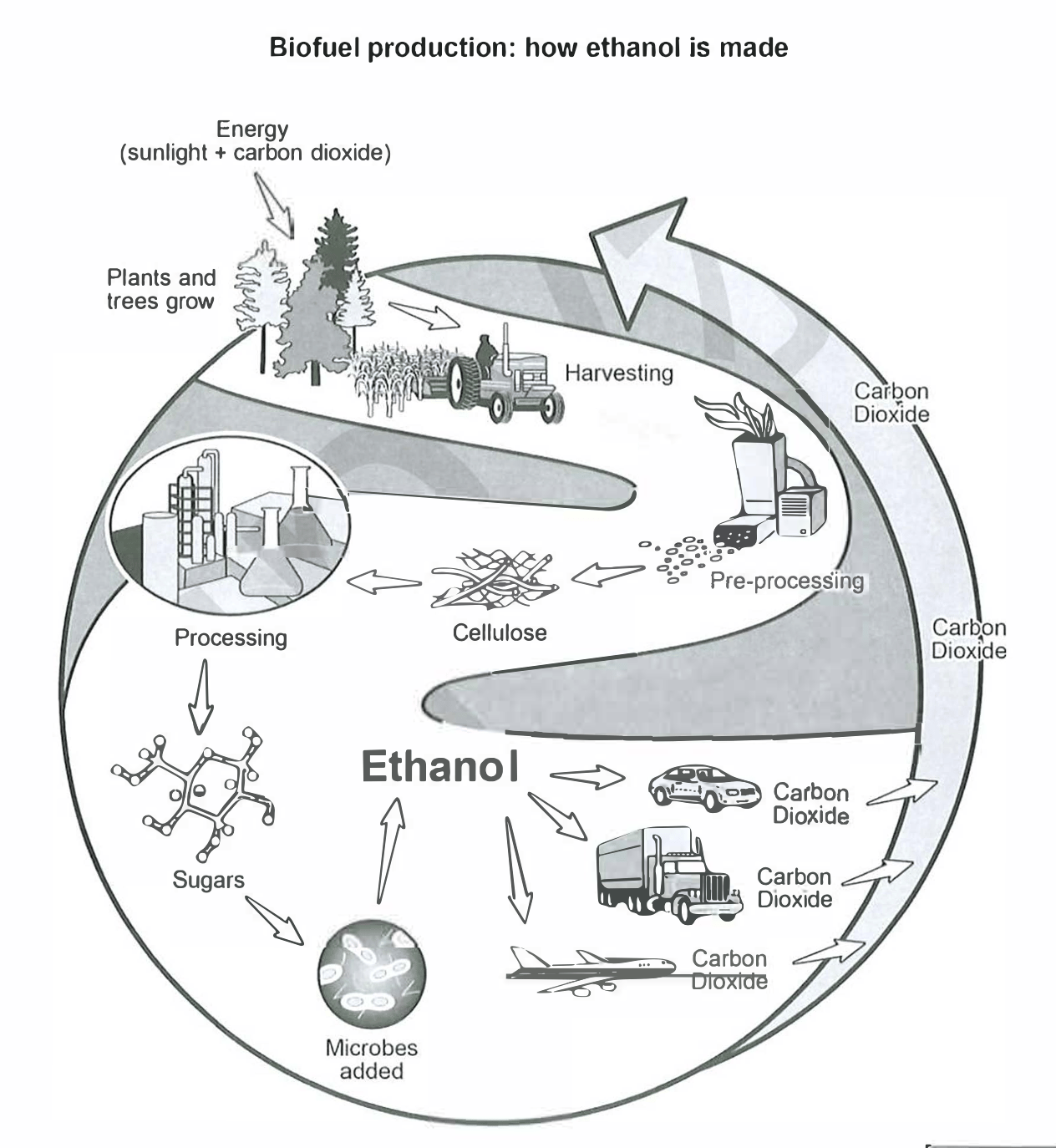
The diagram below shows how a biofuel called ethanol is produced.
Summarise the information by selecting and reporting the main features, and make comparisons where relevant.
Student answer (Band 6.0)
Thr diagram displays the process of how a biofuel called ethanol is produced.
Overall, the production of biofuel called ethanol involves a continuous cyclic process. It begins with growing plants and tress and processing them into sugar which is then used to make Ethanol. Its a continuous cyclic process because ethanol is used in vehicles and then these vehicles produces carbon dioxide which is required by trees and plants to grow.
The production of ethanol starts with growing of plants & trees with the help of sunlight and carbon dioxide. Once the trees and plants are grown substainlly they are harvested, it can be done with the help of tractor or manually. Using tractor for harvesting is more popular these days as it is conveinent as well as time saving. The procedure is then followed by pre-processing the plants and tress to get cellulose out of it.
Cellulose is very essential as it is then processed to get sugars. Additionally, microbes are added to sugars and finally the resultant solution is Ethanol. Ethanol is used by multiple modes of transportation like airplanes, cars and trucks as fuel. The carbon dioxide produced from these vehichiles is again used by plants and trees for their development. Ethanol is bio-degradable.
AI examiner evaluation
| Criterion | Band |
|---|---|
| Task Achievement / Task Response | 6.5 |
| Coherence and Cohesion | 6.5 |
| Lexical Resource | 6.0 |
| Grammatical Range and Accuracy | 5.5 |
| Overall | 6.0 |
Task Achievement / Task Response: Band 6.5
You cover the main stages in a generally accurate sequence, from plant growth and harvesting through pre-processing, cellulose, sugars, microbes and ethanol, and you identify the diagram’s central feature: the cycle linking transport use and carbon dioxide returning to plant growth. This gives the report a clear overview and addresses the task well. Some details, however, are either unsupported or imprecise. The diagram does not say harvesting is done manually or that tractor use is more popular, and the claim that ethanol is biodegradable is not shown. Also, the overview says plants are processed into sugar, skipping the cellulose stage. To strengthen the response, report only visible information and describe the stages and carbon cycle more precisely.
Coherence and Cohesion: Band 6.5
The response is arranged in a sensible progression: an introduction and overview are followed by the early production stages and then the conversion to ethanol and its use. Paragraphing helps distinguish these parts, and links such as “Once,” “Additionally” and “finally” guide the reader through the sequence. Overall, the organisation is coherent. Some connections are less controlled, however: “The procedure is then followed by pre-processing” is awkwardly linked to the preceding harvesting stage, while “Cellulose is very essential” does not clearly explain the transition to processing. The overview also repeats “continuous cyclic process.” Use more precise stage-to-stage links and avoid repetition so the progression feels more consistently smooth.
Lexical Resource: Band 6.0
You use an adequate range of process vocabulary, including “harvested,” “pre-processing,” “cellulose,” “microbes” and “resultant solution,” which helps communicate the stages. There are also attempts at more descriptive wording, such as “continuous cyclic process.” However, several spelling and word-choice errors reduce precision: “substainlly,” “conveinent” and “vehichiles” are misspelled, while “sugar” should be plural in this context and “development” is less precise than growth. Some phrases are also unnatural for a process report, including “get cellulose out of it” and “very essential.” Aim for accurate spelling and concise technical collocations, and avoid adding evaluative language such as “more popular” when the diagram provides no such information.
Grammatical Range and Accuracy: Band 5.5
You use a mix of simple and complex forms, including a relative clause in “which is then used to make Ethanol” and a reason clause explaining the carbon cycle. The sequence is usually understandable, but some grammatical errors remain. In “these vehicles produces,” the plural subject requires “produce”; “it can be done” has an unclear reference and does not agree naturally with “they are harvested”; and “plants and trees … get cellulose out of it” shifts from plural nouns to a singular pronoun. The sentence beginning “Once the trees and plants are grown…” also joins clauses with a comma. Check subject–verb agreement, pronoun reference and sentence boundaries, while retaining the range of sentence structures you already attempt.
See this exact question answered at other band scores. The same prompt compared across bands.
Browse more IELTS Writing model answers or get your own writing scored by the same AI examiner.