Band 5.0 IELTS Writing Task 1 Model Answer
Overall Band Score: 5.0 · Cambridge IELTS 19 · 2026-11-22
IELTS Writing Task 1 question
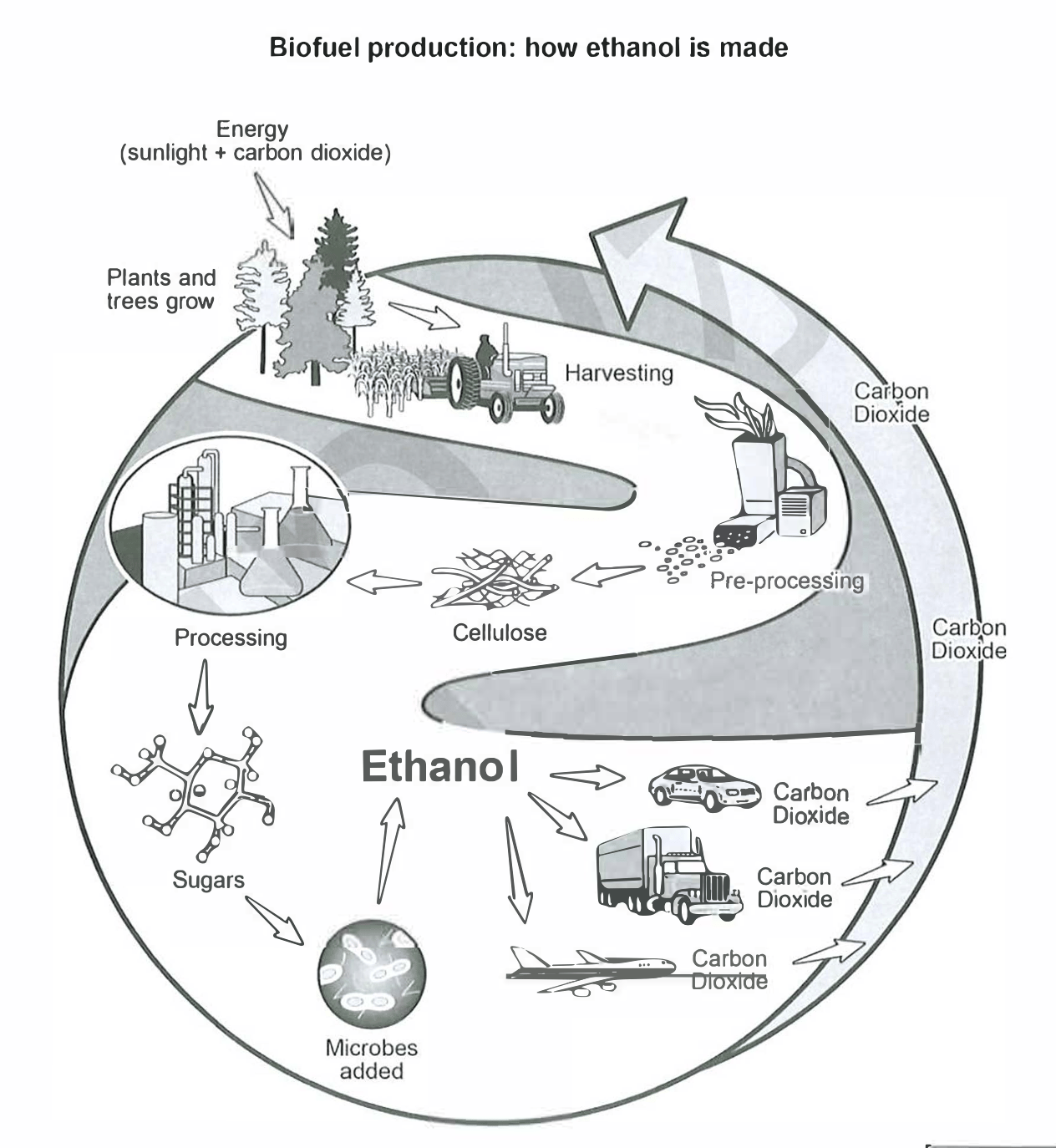
The diagram below shows how a biofuel called ethanol is produced.
Summarise the information by selecting and reporting the main features, and make comparisons where relevant.
Student answer (Band 5.0)
The process gives information about biofuel production and making of ethanol and we will reporting and selecting the highlight features also make comparisons.
The process begins with growing of plants and trees then a person harvesting the plants and subsequently the pre-processing is start with the advanced machinery and the product which we gain from this is cellulose, after that the main processing is start and sugar is ready.
Next, from sugar, mibrobes can be added, so after all these seven processes ethanol is made and we can use in different resourses such as cars, trucks and airplane, so the process is end with carbon dioxide and how the recycle is start.
AI examiner evaluation
| Criterion | Band |
|---|---|
| Task Achievement / Task Response | 4.5 |
| Coherence and Cohesion | 5.5 |
| Lexical Resource | 5.0 |
| Grammatical Range and Accuracy | 5.0 |
| Overall | 5.0 |
Task Achievement / Task Response: Band 4.5
You identify the general subject and report several central stages, including plant growth, harvesting, pre-processing, cellulose, processing, sugars, microbes and ethanol. You also mention the three transport types and the return of carbon dioxide, so the response is relevant to the diagram. However, the account is very brief and does not clearly explain the cycle’s key feature: carbon dioxide from transport returns to support plant growth, alongside sunlight. Some details are vague or inaccurate, such as saying “a person” harvests the plants and that the process “end[s] with carbon dioxide.” The required minimum of 150 words is not met; at 112 words, the response is 38 words short. Develop the overview and describe the stages and cycle more fully.
Coherence and Cohesion: Band 5.5
The stages are presented in a broadly sensible order, and phrases such as “The process begins,” “after that,” and “Next” help the reader follow the sequence. The response also moves from production to the uses of ethanol and then to carbon dioxide, which gives it a basic overall progression. However, nearly all the information is compressed into two long paragraphs, with several stages joined by repeated “and” or “so.” This makes relationships between steps less clear, particularly in the final sentence. Organise the description into clearer stages—for example, plant growth and preparation, conversion to ethanol, and the carbon cycle—and use linking expressions more precisely.
Lexical Resource: Band 5.0
You use some relevant process vocabulary, including “pre-processing,” “cellulose,” “processing,” “ethanol,” and “carbon dioxide,” which allows the reader to recognise the main subject and stages. However, the range is limited, and several choices are inaccurate or awkward: “highlight features,” “different resourses,” and “how the recycle is start” do not express the intended meaning naturally. There are also spelling errors, including “mibrobes,” “resourses,” and “sugar” where the diagram refers to “sugars.” Aim for precise process language and accurate collocations, such as describing materials being converted or carbon dioxide being released and absorbed. This will make the account clearer and more appropriate for an academic report.
Grammatical Range and Accuracy: Band 5.0
The response attempts to connect ideas in longer sentences, using forms such as “then,” “after that,” and “so,” but the structures are often faulty and the range remains limited. Errors include “we will reporting,” “the pre-processing is start,” and “the main processing is start,” where verb forms are not correctly constructed. The phrase “after all these seven processes ethanol is made” also has an unclear reference and needs punctuation. These problems sometimes make the sequence difficult to interpret. Practise accurate present-simple descriptions of processes, for example, “The material is pre-processed to produce cellulose,” and check subject–verb agreement, articles, and sentence boundaries before finishing.
See this exact question answered at other band scores. The same prompt compared across bands.
Browse more IELTS Writing model answers or get your own writing scored by the same AI examiner.