Band 5.5 IELTS Writing Task 1 Model Answer
Overall Band Score: 5.5 · Cambridge IELTS 19 · 2026-11-23
IELTS Writing Task 1 question
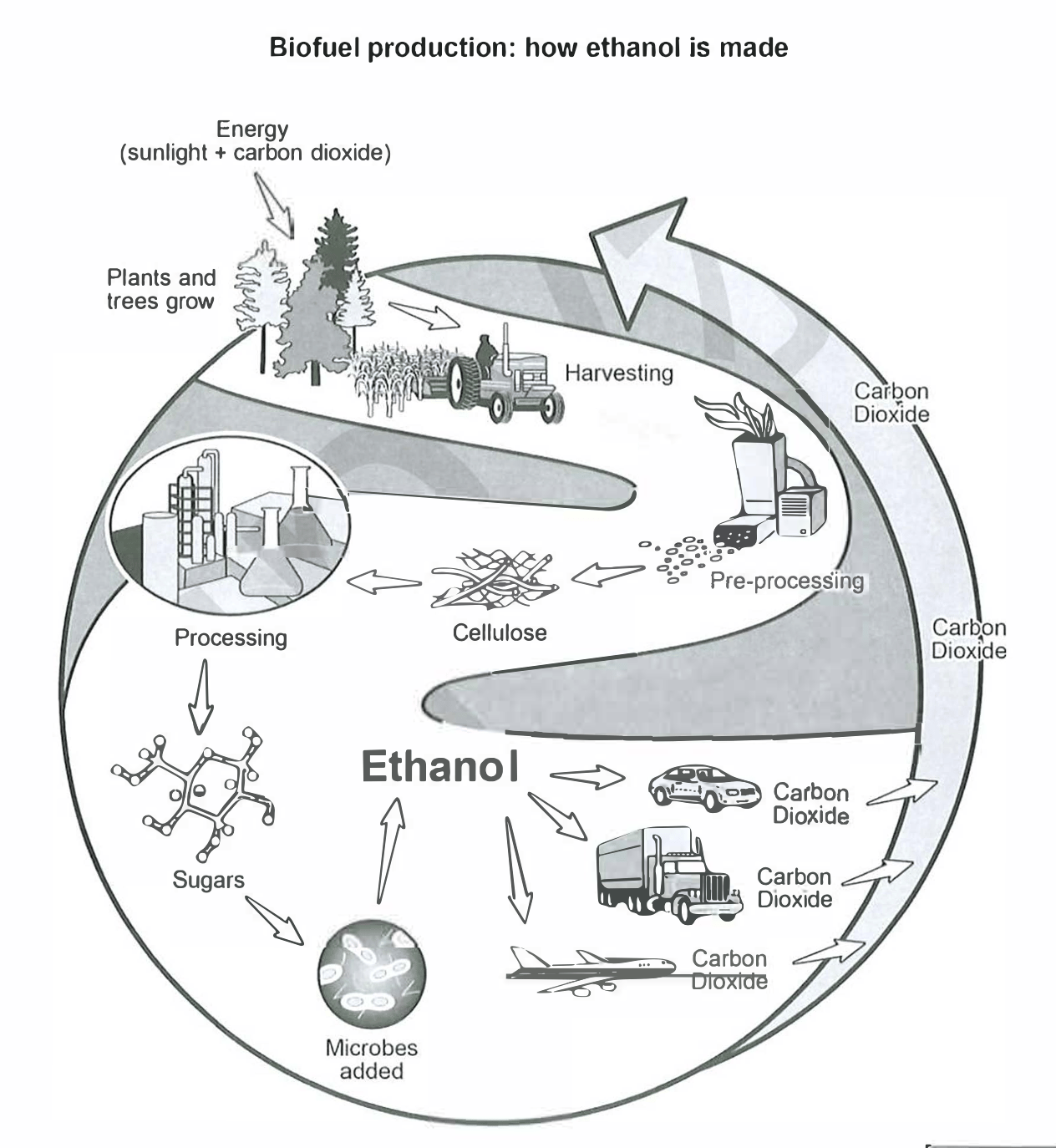
The diagram below shows how a biofuel called ethanol is produced.
Summarise the information by selecting and reporting the main features, and make comparisons where relevant.
Student answer (Band 5.5)
The given diagram illustrates the information about how to produced ethanol from biofule.
Overall, threr are seven sections of making ethanol from biofule. Major part are harvesting the plants and trees then process the plants and trees then plants and trees convert into cellose.
Plants and trees grow with the help of sunlight plus carbon dioxide. when plants and trees are grow up the next step is harvesting the trees and plants aftre the harvesting pr-processing harvested plants and trees. Plants and trees convert into the cellulose. The further process is processing the cellulose.
After the processing of cellulose we find sugars. The other process is microbes added into the sugars after that we find ethanol. We usees ethanol in our transportion like planes, personal cars and trucks . They all produced carbon dioxide. Carbon dioxide helps plants and trees for growing up. After that the all process of production startes again
AI examiner evaluation
| Criterion | Band |
|---|---|
| Task Achievement / Task Response | 5.5 |
| Coherence and Cohesion | 5.5 |
| Lexical Resource | 5.0 |
| Grammatical Range and Accuracy | 5.0 |
| Overall | 5.5 |
Task Achievement / Task Response: Band 5.5
You identify the main stages from plant growth through processing, sugars, microbes and ethanol, and you also mention transport use and the return of carbon dioxide to support further growth. This gives the reader a broadly accurate account of the cycle. However, the overview is not fully reliable: you say there are “seven sections,” although the diagram presents a longer sequence, and the claim that the “major part” is harvesting and processing is not a clear summary of the process’s main features. Some stages are also compressed, particularly the conversion to cellulose and the role of the three transport modes. To strengthen the response, give a concise overview of the complete cycle and describe the stages in their correct order with greater precision.
Coherence and Cohesion: Band 5.5
The response has a basic paragraph structure: an introduction and overview are followed by the early stages and then the later stages and recycling of carbon dioxide. The sequence is generally understandable, and phrases such as “The further process” and “After that” help signal progression. However, the overview repeats information rather than clearly guiding the reader, and several transitions are awkward or unclear, especially “aftre the harvesting pr-processing harvested plants and trees.” The final paragraph also moves quickly from ethanol to transport and back to plant growth. Organise the stages into a clearer chronological sequence, use paragraphing to separate the production stages from the cycle’s return, and choose linking phrases that show precise relationships rather than relying repeatedly on “after.”
Lexical Resource: Band 5.0
You use relevant process vocabulary, including “harvesting,” “cellulose,” “sugars,” “microbes” and “carbon dioxide,” so the topic is recognisable throughout. However, the range is limited and several word-choice, word-form and spelling problems make parts less clear, such as “biofule,” “cellose,” “pr-processing” and “transportion.” Some expressions are also imprecise or unnatural, including “Major part are” and “we find sugars.” Aim for accurate technical terms and more natural process language, such as describing materials as being converted or processed and ethanol as being used as fuel. Proofreading spelling and choosing precise verbs will make the description easier to follow.
Grammatical Range and Accuracy: Band 5.0
Most sentences use simple structures, and the reader can usually follow the intended sequence. There are attempts to link clauses, for example, “when plants and trees are grow up the next step is harvesting,” but the verb forms and sentence construction are often faulty. Examples include “how to produced ethanol,” “plants and trees are grow up,” and “They all produced carbon dioxide”; these forms obscure whether the process is being described in the present or past. Agreement and sentence boundaries also need attention, as in “Major part are harvesting” and the run-on sequence beginning “when plants and trees are grow up.” Use the present simple consistently for a process diagram, check subject–verb agreement, and build shorter, correctly punctuated sentences before attempting more complex ones.
See this exact question answered at other band scores. The same prompt compared across bands.
Browse more IELTS Writing model answers or get your own writing scored by the same AI examiner.