Band 5.5 IELTS Writing Task 1 Model Answer
Overall Band Score: 5.5 · Cambridge IELTS 19 · 2026-11-24
IELTS Writing Task 1 question
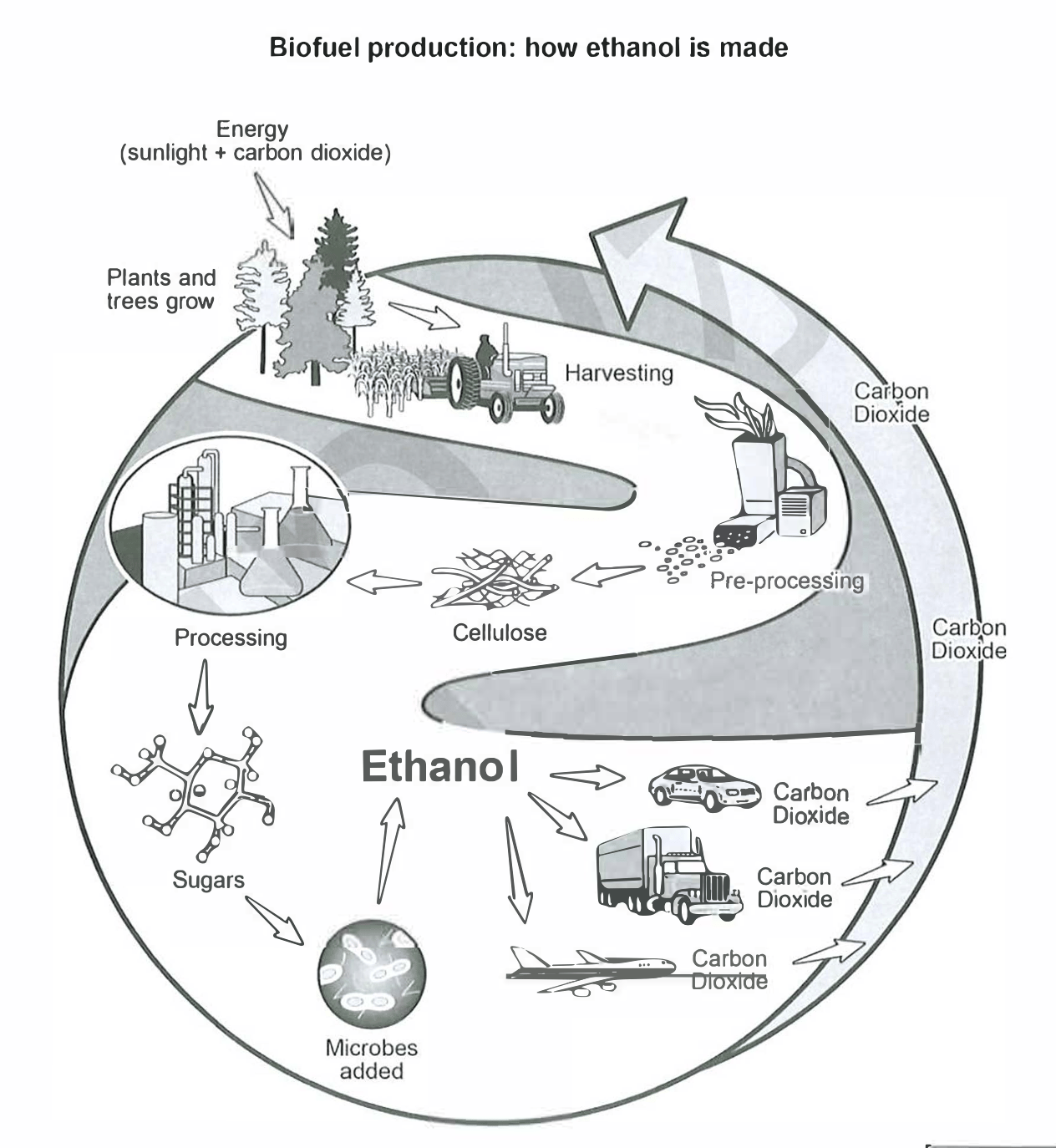
The diagram below shows how a biofuel called ethanol is produced.
Summarise the information by selecting and reporting the main features, and make comparisons where relevant.
Student answer (Band 5.5)
The flow chart illustrate process of making biofuel called ethanol from trees and plants.
Overall, The biofuel producation contains eight steps to make ethanol. It starts from growing trees and plants for one or more years then harvested. Then processed liquid further added microbes to make ethanol which is used many transportation vechiles and aviation industry.
Firstly, Trees are planted and some of them grow for many years and crops like sugarcane were harvested every year. some crops takes multiple years. Next, Pre-processing of plants and trees which involves cutting them into small parts. The Cellulose of the plants were separated and sent them to processing stage were liquid is created without cellulose cells.
Furthermore, From processed liquid sugar is removed and microbes added to the liquid. As a results formation of the biofuel called ethanol is produced which later used in several automobile and aviation industry. These vechiles produced lot harmfull gases after combution one of them is carbon dioxide which is used by plants to grow this is a contineous cycle.
AI examiner evaluation
| Criterion | Band |
|---|---|
| Task Achievement / Task Response | 6.0 |
| Coherence and Cohesion | 6.0 |
| Lexical Resource | 5.5 |
| Grammatical Range and Accuracy | 5.0 |
| Overall | 5.5 |
Task Achievement / Task Response: Band 6.0
You cover the main stages from plant growth and harvesting through pre-processing, cellulose, processing, microbes and ethanol, and you identify the cycle in which carbon dioxide returns to support plant growth. This gives the reader a relevant account of the process. However, the overview is not fully accurate: the diagram does not specify “eight steps” or say that plants grow for “one or more years.” It also shows sugars as an output of processing, rather than sugar being “removed” from a liquid. The account would be stronger if it described the diagram’s key inputs and outputs precisely, including sunlight and carbon dioxide at the growth stage and ethanol being used by transport. Some details, such as crop types and growing periods, are not shown.
Coherence and Cohesion: Band 6.0
The response has a clear overall shape: an introduction and overview are followed by stages in sequence, with “Firstly,” “Next,” and “Furthermore” helping the reader follow the process. The final sentence also connects transport emissions back to plant growth, reflecting the cycle. However, some links are mechanical, and the long final sentence joins several ideas without clear boundaries. The transition from cellulose to “processed liquid” is also difficult to follow because the stages are not explained in a consistently clear sequence. Use paragraphing to separate the growth and preparation stages from processing and the carbon cycle, and use clearer references such as “this material” or “the resulting sugars” to show what each stage refers to.
Lexical Resource: Band 5.5
You use relevant process vocabulary, including “pre-processing,” “cellulose,” “microbes,” and “carbon dioxide,” which helps communicate the topic. There is also some attempt to vary wording with phrases such as “formation” and “continuous cycle.” However, inaccurate word forms, spelling and collocations reduce precision: “producation,” “vechiles,” “harmfull,” and “combution” are misspelled, while “sugar is removed” and “liquid is created without cellulose cells” do not express the diagram’s stages naturally. Some phrases, such as “several automobile and aviation industry,” are also awkward. Build accuracy by checking spelling and choosing standard process collocations, for example, “sugars are produced” and “ethanol is used as a fuel.”
Grammatical Range and Accuracy: Band 5.0
You attempt both simple and more complex sentences, including a relative clause in “which involves cutting them into small parts” and a time clause beginning “after combustion.” This shows some range, and the general sequence remains understandable. However, errors in agreement, articles, tense and sentence boundaries occur in several places. For example, “The flow chart illustrate” needs a singular verb, and “some crops takes” has a plural subject with a singular verb. “Then processed liquid further added microbes” is missing grammatical elements, while the final sentence runs several clauses together without adequate punctuation. Aim to form complete clauses with clear subjects and verbs, and check agreement and articles when revising.
See this exact question answered at other band scores. The same prompt compared across bands.
Browse more IELTS Writing model answers or get your own writing scored by the same AI examiner.