Band 6.0 IELTS Writing Task 1 Model Answer
Overall Band Score: 6.0 · Cambridge IELTS 19 · 2026-11-24
IELTS Writing Task 1 question
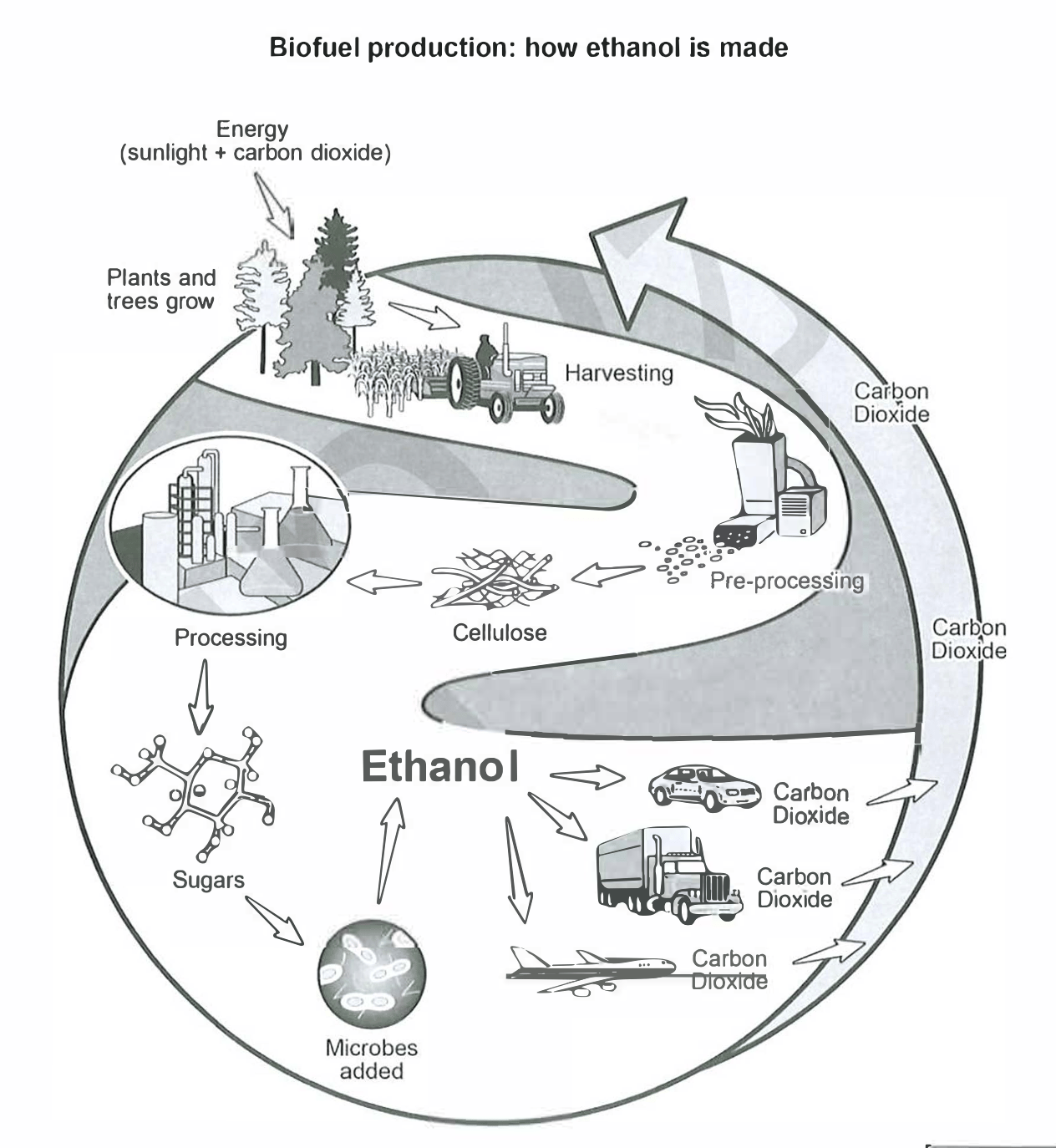
The diagram below shows how a biofuel called ethanol is produced.
Summarise the information by selecting and reporting the main features, and make comparisons where relevant.
Student answer (Band 6.0)
The picture provides information about the procedure of making ethanol with different resources.
Overall, the diagram has total nine steps, the first is the growth of plant and trees and the last one is carbon dioxide. The picture shows the circular process like first plants enhale the carbon dioxide and then at the end the vehicles emit it again.
First, the carbon dioxide is necessary for the growth of plants and trees and these plants and crops start harvesting by the humans. After that it goes to the pre processing step where the grains are seperated from the crops and these grains is used for humans food and the remaining cellulose and stems is go through a processing unit in different labbotries and experiment centres.
There cellulose will go through a complete process of making sugars and after that in this sugar the microbes will be added and finally the ethanol is ready for use and this ethanol is used as a fuel for running the vehicles and different machines and these machines emits the pollution which is called carbon dioxide and in this way the whole system runs.
AI examiner evaluation
| Criterion | Band |
|---|---|
| Task Achievement / Task Response | 6.5 |
| Coherence and Cohesion | 6.0 |
| Lexical Resource | 5.5 |
| Grammatical Range and Accuracy | 5.0 |
| Overall | 6.0 |
Task Achievement / Task Response: Band 6.5
You cover the main stages from plant growth through harvesting, pre-processing, cellulose, sugars, microbes and ethanol, and you identify the cycle in which carbon dioxide from vehicle use returns to support plant growth. This gives the response a relevant overview and a generally accurate account of the process. However, some details are not shown in the diagram: it does not say that grains are separated for human food, that processing occurs in laboratories, or that the fuel powers different machines. The overview also calls the process nine steps, although the diagram presents more stages and includes transport and emissions. To strengthen the response further, report the diagram’s specific transport modes—cars, trucks and aeroplanes—and avoid adding unsupported explanations.
Coherence and Cohesion: Band 6.0
The response has a clear overall shape: an introduction, an overview, and two paragraphs describing the process. Sequencing expressions such as “First,” “After that,” and “finally” help the reader follow the stages, and the circular relationship between plant growth and emissions is placed prominently in the overview. However, the process description becomes difficult to track in the long second paragraph, where several stages and added details are joined together. References such as “it,” “these grains,” and “There cellulose” are not always clear, and “in this way” provides only a loose link to the cycle. Use shorter sentences, refer explicitly to each material or stage, and group the production stages separately from the transport-and-emissions loop.
Lexical Resource: Band 5.5
You use relevant process vocabulary, including “pre-processing,” “cellulose,” “microbes,” “ethanol,” and “carbon dioxide,” which allows you to describe the subject specifically. There is also some useful variation in phrases such as “procedure of making” and “used as a fuel.” However, several word choices or spellings reduce precision: “enhale” is not the correct form, “labbotries” is misspelled, and “machines emits the pollution” is an awkward description of the diagram’s transport emissions. “Different resources” is also vague for this process. Aim for accurate technical terms and natural collocations, and use the diagram’s labels rather than introducing imprecise alternatives. The vocabulary is sufficient to communicate the main stages, but control is not yet consistently precise.
Grammatical Range and Accuracy: Band 5.0
You attempt both simple and longer sentences, and the sequence is generally understandable. The overview’s contrast between the beginning and end of the cycle is a useful attempt to connect stages in a complex sentence. However, errors in agreement, verb forms and sentence construction recur. For example, “these grains is used” should have a plural verb, while “the remaining cellulose and stems is go through” combines incompatible verb forms. In “these machines emits,” the subject and verb do not agree. Some sentences also run on, particularly the final paragraph, making relationships between stages less clear. Practise building accurate clauses with a clear subject and verb, then connect them with appropriate conjunctions; check agreement and verb forms during revision.
See this exact question answered at other band scores. The same prompt compared across bands.
Browse more IELTS Writing model answers or get your own writing scored by the same AI examiner.