Band 5.5 IELTS Writing Task 1 Model Answer
Overall Band Score: 5.5 · Cambridge IELTS 19 · 2026-11-25
IELTS Writing Task 1 question
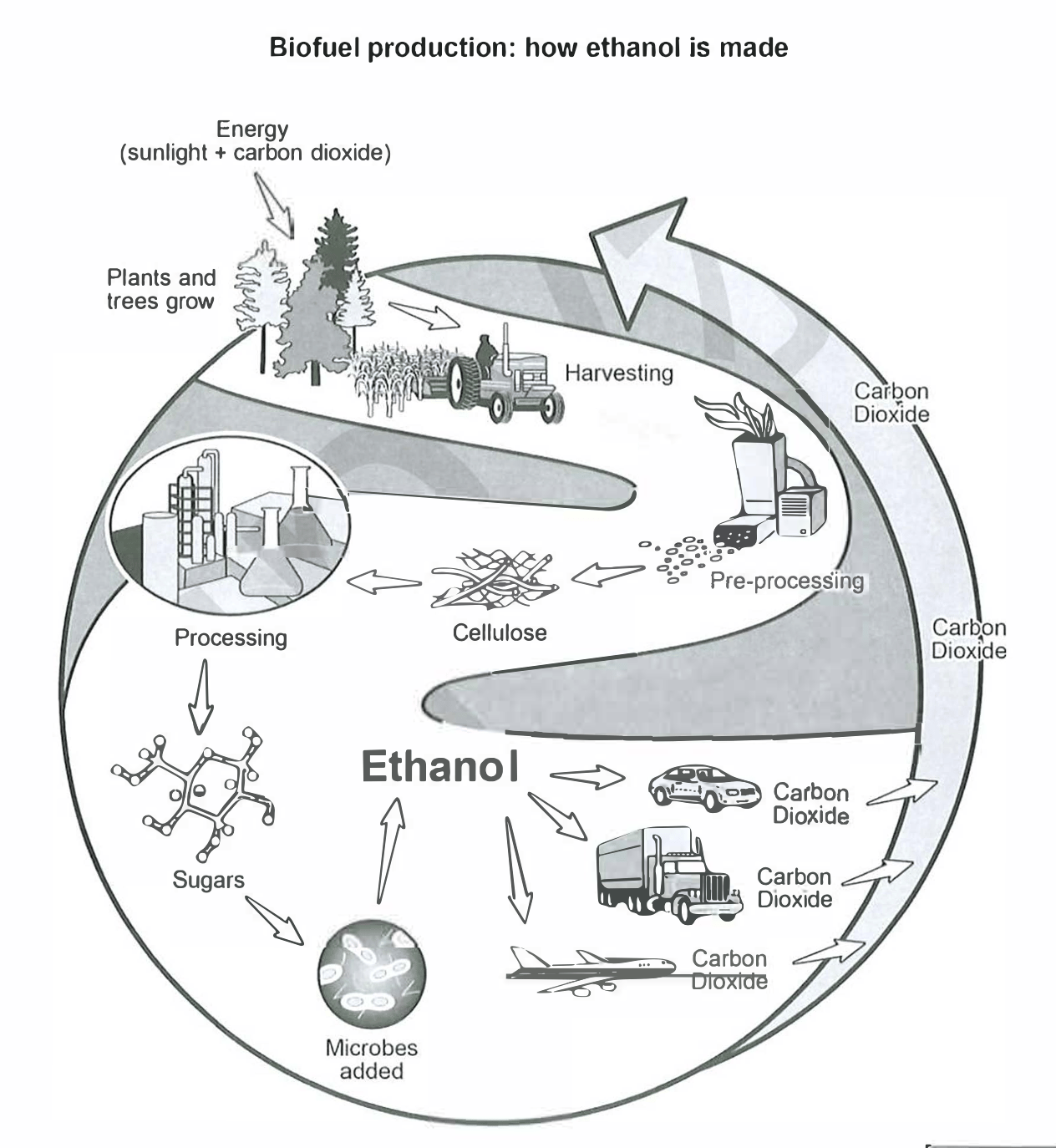
The diagram below shows how a biofuel called ethanol is produced.
Summarise the information by selecting and reporting the main features, and make comparisons where relevant.
Student answer (Band 5.5)
The digram illustrates about how a biofuel called ethanol is produced. ethnol is used to run the vehicle like motorbikes,cars, buses,rail etc.
overall this digram provide information about ethanol produced process.
firstly the sun provides the energy and carbon dixide is also present in atmosphere plants and trees also observe the energy and growing up and few time plants and crop harvesting by some farmars the harvesting is done and pre processing is carry on and obtain cellulose then the proccessing of cellulose its coverted into sugar then it is interacted into microbes then the ethanol is produced.
As eathnol is mixed with petrol the mixture of eathnol and petrol is used for vechile also eathnol is chemical substance which is also use in other chemical substances it is also use a fuel and the fuel is burns it leaves carbon dioxide in the environment then this process is in a continous cycle and this goes on.
AI examiner evaluation
| Criterion | Band |
|---|---|
| Task Achievement / Task Response | 6.0 |
| Coherence and Cohesion | 5.5 |
| Lexical Resource | 5.0 |
| Grammatical Range and Accuracy | 5.0 |
| Overall | 5.5 |
Task Achievement / Task Response: Band 6.0
You cover the main stages from plant growth and harvesting through cellulose, sugars, microbes and ethanol, and you recognise that carbon dioxide returns to the cycle. This gives the reader a relevant account of the process. However, the overview is vague (“this digram provide information about ethanol produced process”), and some details are unclear or not shown in the diagram: for example, the claims that ethanol is mixed with petrol and that it is used in motorbikes, buses and rail are unsupported. The diagram specifically shows ethanol powering a car, truck and aeroplane, with carbon dioxide from these vehicles returning to the plants. Make that cycle the central overview and report the depicted stages precisely; some parts of your account are more fully covered than others.
Coherence and Cohesion: Band 5.5
There is a recognisable sequence, signalled by “firstly” and “then,” and the response broadly moves from plant growth to fuel use and carbon dioxide returning to the environment. This provides some organisation. However, most of the process is compressed into one long paragraph and sentence, so the stages and their relationships are difficult to follow. The opening and overview also repeat the idea that the diagram shows ethanol production without adding a clear summary. Use separate paragraphs for the overview and the detailed stages, and connect each stage with precise transitions such as “after harvesting” and “once sugars are produced.” This would create clearer progression and reduce the reliance on repetitive sequencing.
Lexical Resource: Band 5.0
You use several relevant process terms, including “harvesting,” “pre processing,” “cellulose,” “microbes” and “carbon dioxide,” which help communicate the subject. However, the range is limited and some word choices or collocations are inaccurate or vague, such as “observe the energy,” “interacted into microbes” and “the fuel is burns.” Spelling errors, including “digram,” “ethnol” and “eathnol,” also make the account less clear and less controlled. Aim for accurate process vocabulary and consistent spelling, and avoid adding general claims about chemical uses that are not represented in the diagram. More precise verbs such as “absorb,” “convert” and “release” would make the description more effective.
Grammatical Range and Accuracy: Band 5.0
The response attempts to link several stages in longer sentences, and the sequence can generally be understood. However, the range of sentence structures is limited, and attempts to combine ideas often produce faulty clauses. For example, “plants and trees also observe the energy and growing up” lacks a clear grammatical structure, while “the fuel is burns” combines incompatible verb forms. There are also problems with agreement and sentence boundaries, as in “this digram provide information,” and punctuation is often missing between stages. Use shorter, complete sentences with a clear subject and verb, then add a few controlled complex sentences using “which,” “after” or “when.”
See this exact question answered at other band scores. The same prompt compared across bands.
Browse more IELTS Writing model answers or get your own writing scored by the same AI examiner.