Band 6.0 IELTS Writing Task 1 Model Answer
Overall Band Score: 6.0 · Cambridge IELTS 19 · 2026-11-25
IELTS Writing Task 1 question
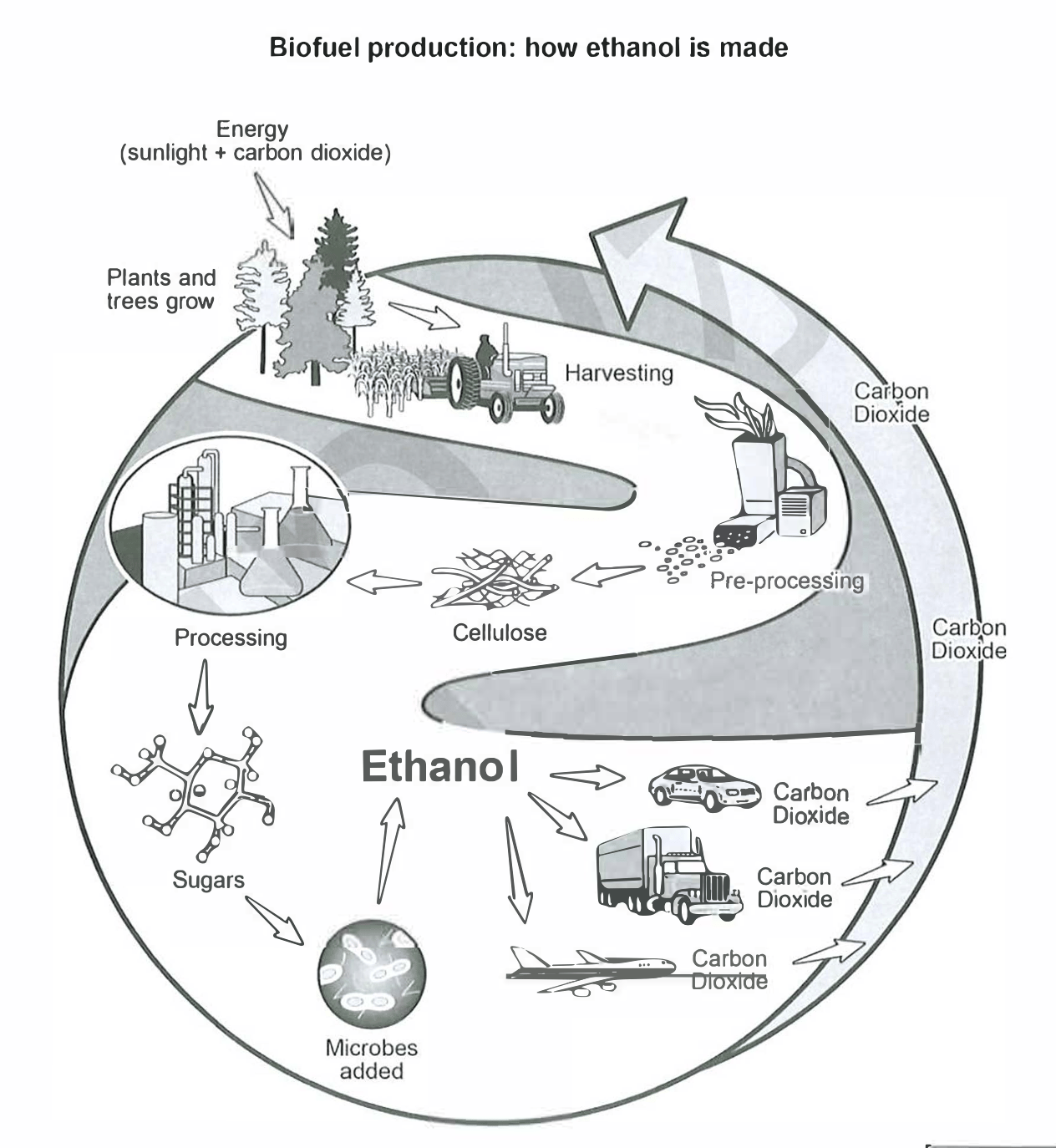
The diagram below shows how a biofuel called ethanol is produced.
Summarise the information by selecting and reporting the main features, and make comparisons where relevant.
Student answer (Band 6.0)
The given diagram illustrates the procedure of manufacturing ethanol.
Overall, the production takes place in three major steps; plants harvesting, processing and finally we get ethanol.
First of all, mature plants and trees are harvested, which are then pre processed by chopping into smaller pieces by an instrument. This pre-processing step helps extract cellulose from chopped pieces. Next cellulose is further treated with chemicals and reagents so that only complex sugar remains. Furthermore, the complex sugars such as starch is kept to ferment.
Fermentation takes place is a closed container, this is the most important part of the process. Microorganisms are produced in the air tight container, they breakdown the complex starch. Finally, once the fermentation process is completed ethanol is produced. Later, ethanol is mixed with gasolin which goes into the vehicles. The combustion engine vehicles release Carbon dioxide into the air which is absorbed by plants for their growth and release oxygen for living beings. With the release of Carbon dioxide into the air the whole process of ethanol production begins again.
AI examiner evaluation
| Criterion | Band |
|---|---|
| Task Achievement / Task Response | 6.5 |
| Coherence and Cohesion | 6.5 |
| Lexical Resource | 6.0 |
| Grammatical Range and Accuracy | 5.5 |
| Overall | 6.0 |
Task Achievement / Task Response: Band 6.5
You cover the main stages from plant growth and harvesting through processing, fermentation and ethanol use, and your overview identifies a broad sequence. You also recognise the diagram’s central cycle by explaining that carbon dioxide from transport returns to plants. These relevant features support a clear account. However, some details are not shown in the visual: it does not specify chopping with an instrument, chemical treatment, complex starch, an airtight container, gasoline mixing, oxygen release, or that combustion is the mechanism. It shows cellulose becoming sugars, microbes being added, and ethanol being used by three transport types. The overview also groups the process into three steps without explaining the carbon cycle. More precise reporting of the labelled stages would make the coverage more complete.
Coherence and Cohesion: Band 6.5
The response has a clear overall progression, moving from plant harvesting to ethanol production and then to the return of carbon dioxide. Paragraphing separates the overview from the detailed account, and signposts such as “First of all,” “Next,” “Finally,” and “Later” help the reader follow the sequence. This gives the report a coherent overall arrangement. At times, however, the linking is somewhat mechanical, and the sequence becomes less clear when several unsupported details are added. For example, the shift from “complex sugars” to “complex starch” and then to fermentation is not clearly explained. Grouping the stages into plant growth and preparation, conversion to ethanol, and fuel use/carbon recycling would create smoother progression and clearer links between each stage.
Lexical Resource: Band 6.0
You use a reasonable range of process vocabulary, including “pre-processing,” “cellulose,” “fermentation,” “microorganisms,” and “absorbed,” which helps communicate the topic. Some less common terms are attempted, but several choices are inaccurate or imprecise for this diagram. “Manufacturing” is understandable, though “production” is more natural here; “complex sugar” and “complex starch” do not accurately name the diagram’s “sugars”; and “produced in the air tight container” gives an unclear description of the microbes. There are also spelling and form issues, including “gasolin” and “pre processed.” Aim to use the diagram’s labels consistently and check spelling and collocations, especially for technical process descriptions.
Grammatical Range and Accuracy: Band 5.5
You attempt a mix of simple and complex forms, including a relative clause in “which are then pre processed” and a passive construction in “ethanol is produced.” The overall meaning is generally understandable, but some grammatical errors remain and occasionally make relationships between stages unclear. For example, “Fermentation takes place is a closed container” contains an extra verb, while “the complex sugars such as starch is kept” has a subject–verb agreement problem. “They breakdown” also needs a different verb form, and the comma in “Fermentation takes place …, this is the most important part” joins two independent clauses incorrectly. Review agreement, verb forms, articles and sentence boundaries; accurate control of these patterns would strengthen your varied sentence structures.
See this exact question answered at other band scores. The same prompt compared across bands.
Browse more IELTS Writing model answers or get your own writing scored by the same AI examiner.