Band 5.5 IELTS Writing Task 1 Model Answer
Overall Band Score: 5.5 · Cambridge IELTS 19 · 2026-11-25
IELTS Writing Task 1 question
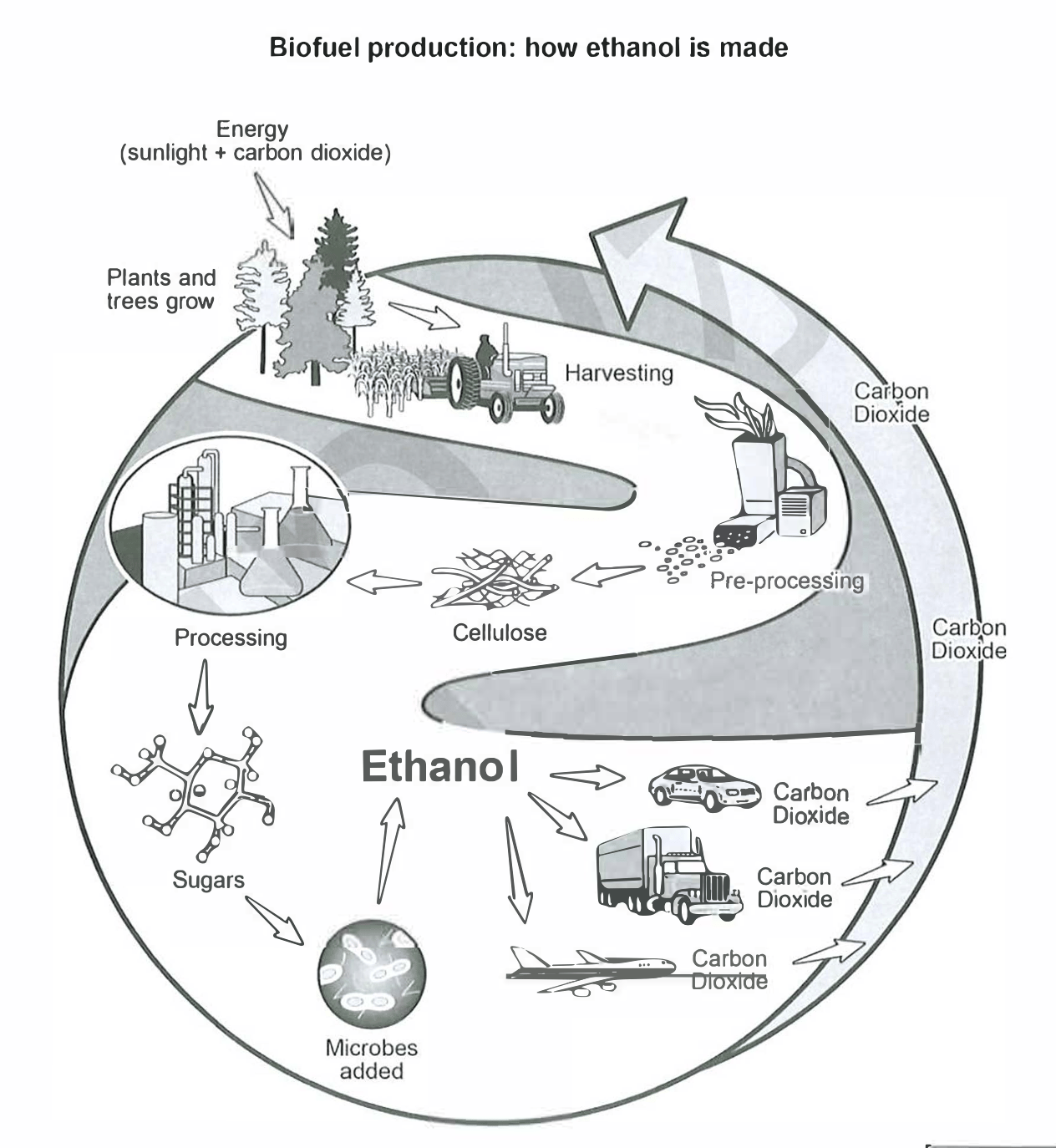
The diagram below shows how a biofuel called ethanol is produced.
Summarise the information by selecting and reporting the main features, and make comparisons where relevant.
Student answer (Band 5.5)
The illustration below demonstrates the step of a natural fuel productions named ethanol
overall, the main thing in the ethanol production is the carbon dioxide which produced by the transportation such as cars , and also with the nature hand . the production follow 4 steps essential the human involve and other left for the earth.
in the first step, the woods grow using the energy from sunlight and carbon dioxide left by the transportation ways , those trees and plants get harvested by the farmers and carry them to the pre-processing method which crash the plants and separate a tiny thing from them called cellulose .
after this , it comes the processing step which produce the sugars from the cellulose result of the pre-processing . the last step is adding a microbes to the sugars which create the ETHANOL used by cars and trucks and also planes to move
AI examiner evaluation
| Criterion | Band |
|---|---|
| Task Achievement / Task Response | 5.5 |
| Coherence and Cohesion | 5.5 |
| Lexical Resource | 5.5 |
| Grammatical Range and Accuracy | 5.0 |
| Overall | 5.5 |
Task Achievement / Task Response: Band 5.5
You identify the main stages from plant growth and harvesting through pre-processing, processing, and the addition of microbes to produce ethanol. You also recognise the cycle’s connection to carbon dioxide and transport. However, the overview is unclear (“the production follow 4 steps essential”) and does not accurately summarise the full cycle. The diagram shows carbon dioxide released by vehicles returning to support plant growth, but your description says it is “left by the transportation ways” without clearly explaining this return. Some details are also imprecise: pre-processing is not specifically shown as crushing or separating a “tiny thing,” and the diagram does not say farmers carry the plants. Covering the cycle more clearly and reporting only supported details would strengthen the response.
Coherence and Cohesion: Band 5.5
The response has a basic sequence, moving from plant growth to harvesting, processing, and ethanol use, and paragraph breaks help distinguish the overview from the stages. Connectors such as “in the first step” and “after this” also guide the reader. However, progression is not consistently clear: the overview’s reference to “4 steps” conflicts with the stages that follow, and the final paragraph ends with transport without returning to the carbon-dioxide cycle. Several long sentences join multiple stages with commas, making relationships harder to follow. Organise the report into a concise overview and clearly separated stage groups, and use precise links between each input and output.
Lexical Resource: Band 5.5
You use some relevant process vocabulary, including “harvested,” “pre-processing,” “cellulose,” “processing,” “sugars,” and “microbes,” which helps communicate the subject. However, the range is limited and several choices are inaccurate or unnatural, such as “natural fuel productions,” “the nature hand,” and “a tiny thing.” “Crash the plants” does not clearly describe the pre-processing stage, while “transportation ways” is an awkward substitute for vehicles or modes of transport. These choices sometimes make the process difficult to interpret. Aim for precise, diagram-based terms and check common collocations and word forms; for example, describe ethanol as a biofuel and refer to carbon dioxide released by vehicles.
Grammatical Range and Accuracy: Band 5.0
You attempt to connect stages in longer sentences, for example, “after this, it comes the processing step,” and use sequencing phrases to show order. However, the range of sentence structures is limited, and errors occur frequently enough to make some relationships unclear. Examples include “the production follow,” “which produce the sugars,” and “adding a microbes,” where subject–verb agreement and article use are faulty. The opening sentence also lacks a clear grammatical structure, and several clauses are joined with commas rather than being punctuated as separate sentences. Practise accurate simple sentences first, then combine stages using controlled relative clauses and conjunctions, checking agreement, articles, and sentence boundaries.
See this exact question answered at other band scores. The same prompt compared across bands.
Browse more IELTS Writing model answers or get your own writing scored by the same AI examiner.