Band 5.5 IELTS Writing Task 1 Model Answer
Overall Band Score: 5.5 · Cambridge IELTS 19 · 2026-11-27
IELTS Writing Task 1 question
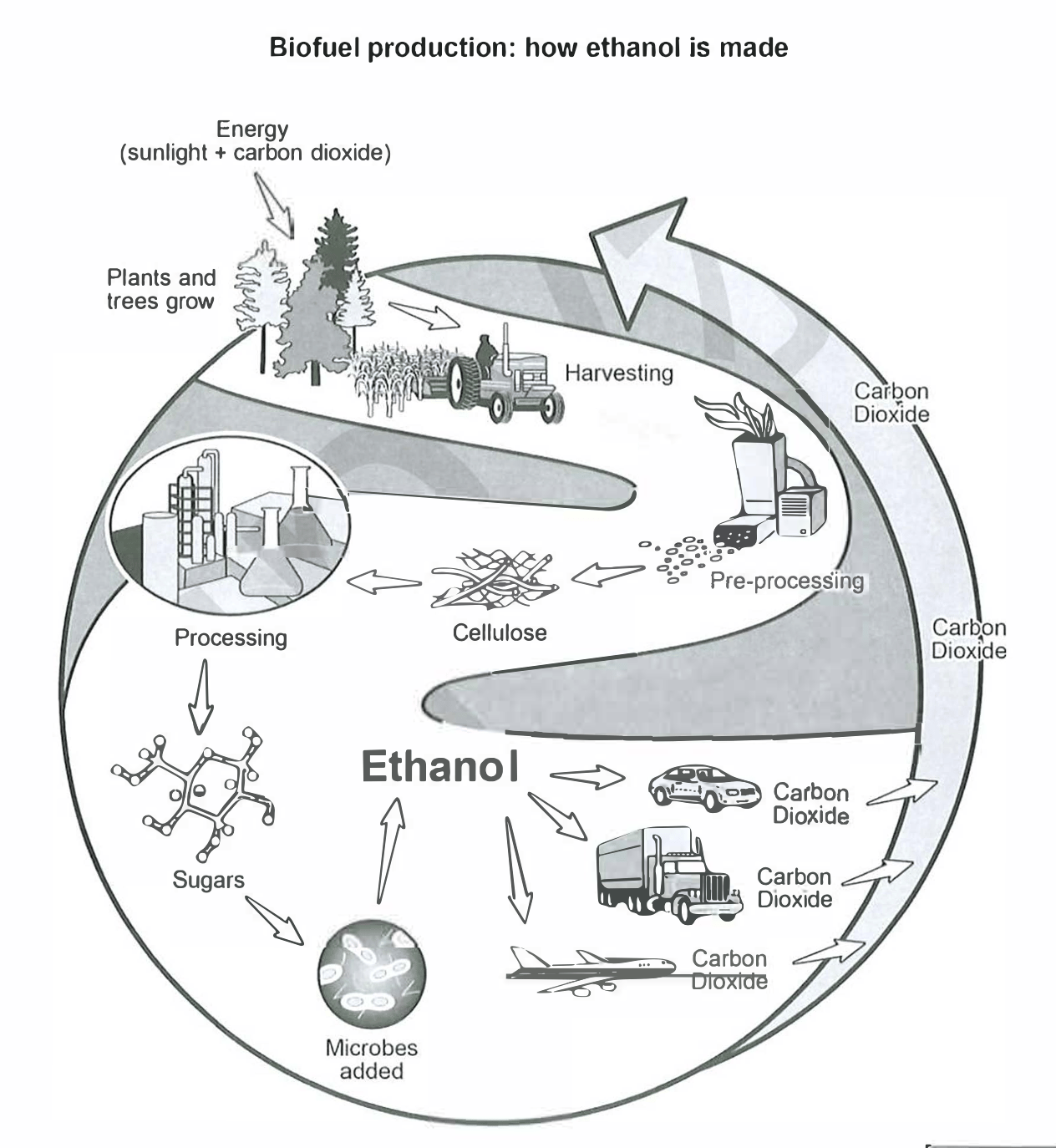
The diagram below shows how a biofuel called ethanol is produced.
Summarise the information by selecting and reporting the main features, and make comparisons where relevant.
Student answer (Band 5.5)
The given diagram illustrates the progress of how a biofuel called ethanol is made.
Overall, the given diagram is a cyclical process involving both man-made and natural stages. Beginning with the energy of sunlight and carbon dioxide and ending with the release of carbon dioxide, which is then absorbed by growing vegetation.
Firstly, plants and trees will get the energy which is sunlight and carbon dioxide after they grow people will harvest the plants and trees then it is transferred to get the pre-process our plant by machine after it will became a cellulose.Once this is done cellulose is processing after is combined which in turn sugars.
Next, microbes added in sugars as a result this became a ethanol. After that, ethanol is used by transports such as cars, trunks also planes and after that this is gathered into a carbon dioxide placed in air where it end and begins
AI examiner evaluation
| Criterion | Band |
|---|---|
| Task Achievement / Task Response | 6.0 |
| Coherence and Cohesion | 6.0 |
| Lexical Resource | 5.5 |
| Grammatical Range and Accuracy | 5.0 |
| Overall | 5.5 |
Task Achievement / Task Response: Band 6.0
You identify the diagram as a cycle and report its main stages, including plant growth, harvesting, pre-processing, cellulose, processing, sugars, microbes and ethanol. You also mention the use of ethanol in transport and the return of carbon dioxide, so the response addresses the central process. However, some stages are unclear or inaccurately described: “after they grow people will harvest” muddles the order, and the account does not clearly explain that sunlight and carbon dioxide support plant growth. The overview says the cycle ends with carbon dioxide being absorbed by vegetation, but this return link could be stated more precisely. To strengthen the report, describe each transformation clearly and distinguish the production stages from the final use of ethanol in vehicles and aircraft.
Coherence and Cohesion: Band 6.0
The response has a recognisable overall structure: an introduction, an overview, and two paragraphs describing the process in sequence. Sequencing expressions such as “Firstly,” “Once this is done,” and “Next” help the reader follow the stages. However, cohesion becomes less effective in the long first process sentence, where several steps are joined together without clear boundaries. Phrases such as “after that this is gathered into a carbon dioxide” also leave the relationship between transport use and the carbon-dioxide cycle unclear. The final sentence ends abruptly, weakening the progression. Use shorter sentences to separate stages, and make references explicit—for example, state that carbon dioxide released by transport returns to the plants.
Lexical Resource: Band 5.5
You use relevant process vocabulary, including “cyclical process,” “harvest,” “cellulose,” “microbes,” and “carbon dioxide,” which allows you to cover the diagram’s main subject. There is some variety in how the stages are described, but several word choices and collocations are inaccurate or awkward, making parts of the process difficult to interpret. For example, “the progress of how” is not a natural way to introduce a process, “get the energy” is imprecise, and “trunks” appears to mean trucks. “Gathered into a carbon dioxide” is also unclear. Aim for precise process verbs and standard terms, such as “is converted into,” “is processed,” and “is released.”
Grammatical Range and Accuracy: Band 5.0
You attempt both simple and more complex sentence forms, including the overview sentence beginning “Beginning with…” and the result clause “as a result…”. However, control is uneven, and some errors make relationships between stages unclear. The sentence “plants and trees will get the energy … after they grow people will harvest” has faulty clause structure and tense use. Other examples include “it will became” and “microbes added in sugars,” where verb forms and sentence construction need correction. Articles and punctuation also need attention, as in “a cellulose” and the run-on sequence of stages in the first body paragraph. Use present simple consistently for a process, and divide long sequences into complete, clearly punctuated sentences.
See this exact question answered at other band scores. The same prompt compared across bands.
Browse more IELTS Writing model answers or get your own writing scored by the same AI examiner.