Band 5.0 IELTS Writing Task 1 Model Answer
Overall Band Score: 5.0 · Cambridge IELTS 19 · 2026-11-27
IELTS Writing Task 1 question
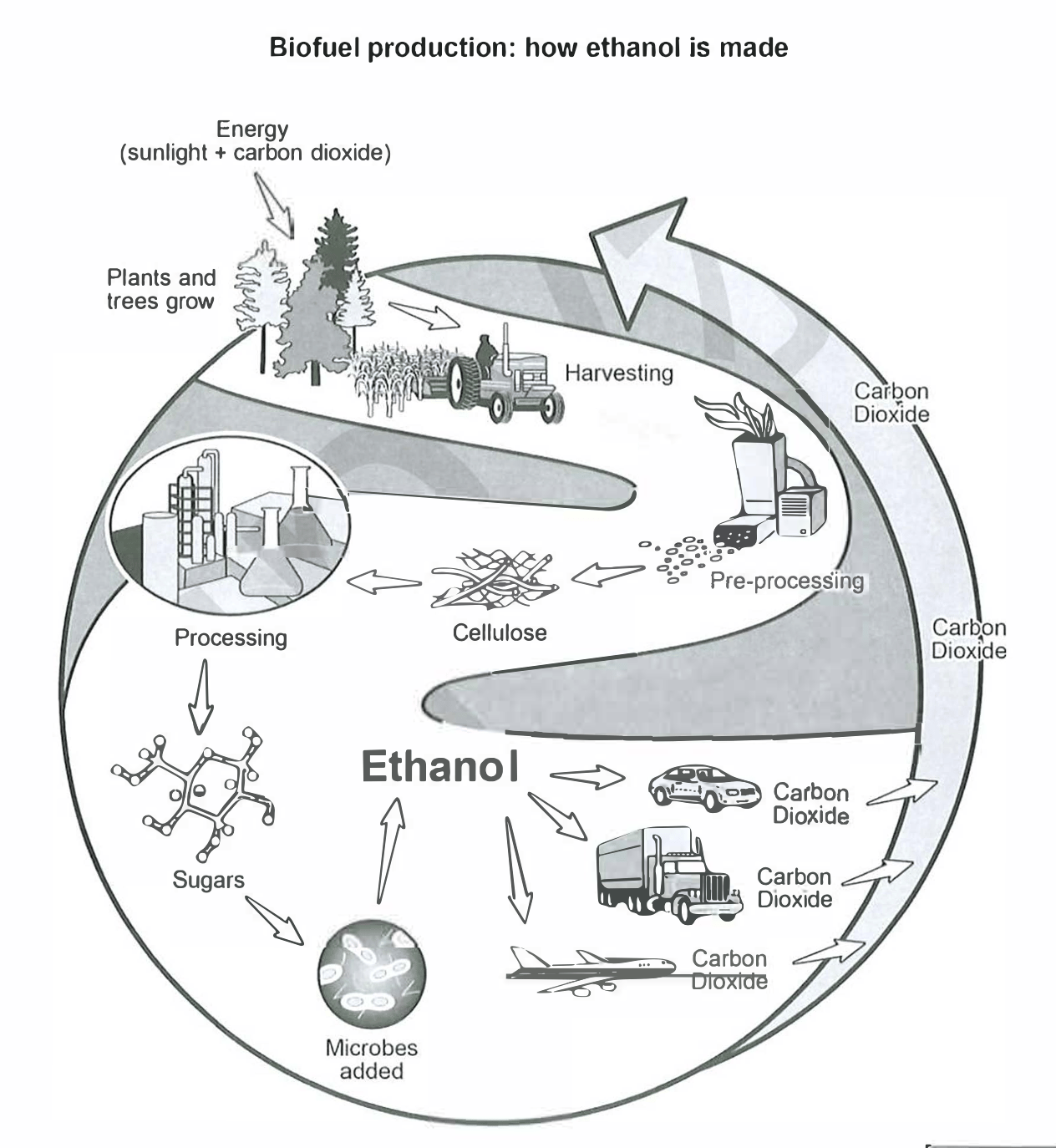
The diagram below shows how a biofuel called ethanol is produced.
Summarise the information by selecting and reporting the main features, and make comparisons where relevant.
Student answer (Band 5.0)
The diagram here illustrates how to product Biofuel where we can use it in diffrent sectors such as transportation (car, plane...etc).
overall, Biofuel has a procedures to product it starting from energy then we we turn it to ethanol.
Firstly, we need energy such as: sunlight and carbon dioxyde, after that, the tres and plants would have been harvesting and have bee turned into cellulose, in addition, they would take the cellulose to labour to make them sugars that look like long chains, then at the last stge, microbes would have added to have the dinal product we want.
ad a result, these are the steps we need to make biofuel, so this product can help is with trasportation like carsm trucks, plane...etc), which provide us a better, easy, comfortable life. any one can use it anytime, anywhere.
AI examiner evaluation
| Criterion | Band |
|---|---|
| Task Achievement / Task Response | 4.5 |
| Coherence and Cohesion | 5.0 |
| Lexical Resource | 5.0 |
| Grammatical Range and Accuracy | 5.0 |
| Overall | 5.0 |
Task Achievement / Task Response: Band 4.5
You identify the topic and mention several relevant stages, including sunlight and carbon dioxide, plant growth, cellulose, sugars, microbes and ethanol, so the response shows some understanding of the process. However, the account is incomplete and sometimes misrepresents the sequence: harvesting is described as happening to the plants before they are turned into cellulose, and the processing stage is not clearly explained. The overview is vague (“we turn it to ethanol”) and does not explain the cycle in which carbon dioxide from transport returns to support plant growth. The final comment about a “better, easy, comfortable life” is not required by the diagram. The response is also 12 words below the 150-word minimum. To improve, give a clear overview and accurately describe the main stages and the carbon-dioxide cycle.
Coherence and Cohesion: Band 5.0
There is a basic attempt to organise the response, with an opening, an overview, and a sequence introduced by “Firstly” and “after that.” This gives the reader some sense that the process has stages. However, the progression is not consistently clear: several steps are compressed into one long sentence, and the links between harvesting, pre-processing, cellulose, and processing are difficult to follow. “In addition” does not clearly show the relationship between the ideas, while “ad a result” introduces a conclusion that shifts to the benefits of transport rather than summarising the process. Paragraphing is limited, and the final sentence adds loosely connected claims. Use separate sentences for the main stages and connect them with precise sequence markers such as “next,” “following this,” and “finally.”
Lexical Resource: Band 5.0
The response uses some relevant process vocabulary, including “cellulose,” “sugars,” “microbes,” and “ethanol,” and it recognises transport as an end use. However, the range is limited and several word choices or spelling errors make the description less clear, such as “product” for “produce,” “labour” for the processing facility, and “dinal” for “final.” “Biofuel has a procedures” and “long chains” are also imprecise for describing the diagram. Informal expressions such as “etc.” and “anytime, anywhere” are not suitable for a concise academic process report. Aim to use accurate process terms, avoid unsupported claims, and check spelling. For example, “pre-processing,” “convert,” and “fuel is used in transport” would describe the stages more precisely.
Grammatical Range and Accuracy: Band 5.0
You attempt to connect ideas in longer sentences, for example with “after that” and “in addition,” but the response relies on a narrow range of sentence patterns, and these longer constructions are often faulty. Errors include “Biofuel has a procedures,” “the tres and plants would have been harvesting,” and “microbes would have added,” where agreement and verb forms are not controlled. The opening phrase “how to product Biofuel” also has an incorrect grammatical construction. Punctuation and sentence boundaries are inconsistent, particularly in the final lines, which makes some relationships harder to understand. Practise writing clear present-simple descriptions of processes: “Plants and trees grow,” “They are harvested,” and “Microbes are added.” Then combine stages only when the grammar remains accurate.
See this exact question answered at other band scores. The same prompt compared across bands.
Browse more IELTS Writing model answers or get your own writing scored by the same AI examiner.