Band 6.0 IELTS Writing Task 1 Model Answer
Overall Band Score: 6.0 · Cambridge IELTS 19 · 2026-11-28
IELTS Writing Task 1 question
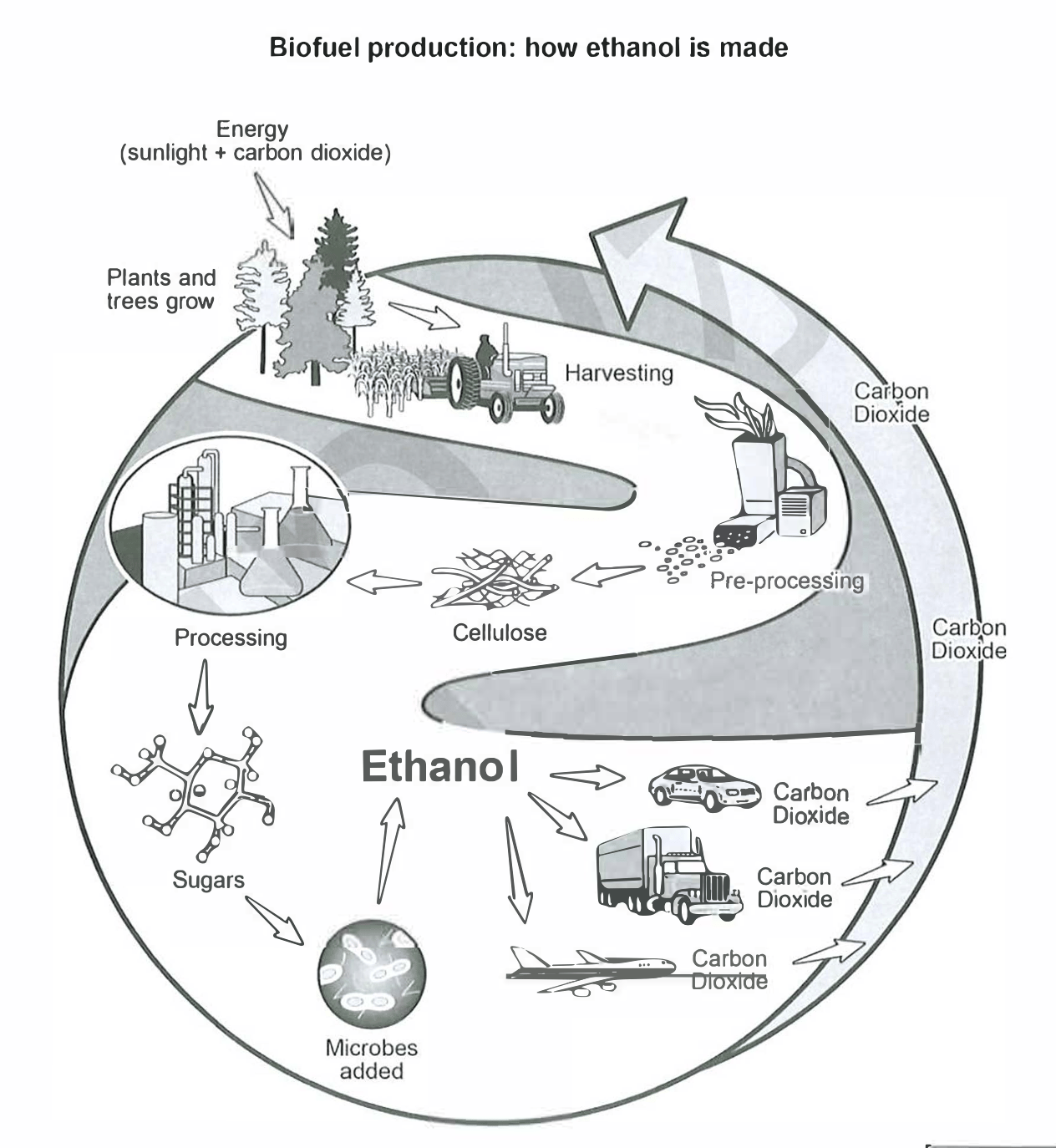
The diagram below shows how a biofuel called ethanol is produced.
Summarise the information by selecting and reporting the main features, and make comparisons where relevant.
Student answer (Band 6.0)
The picture depicts the stepwise process of ethanol production.
Overall, the cycle make use of 8 steps starting with the trees' absorption of sunlight and carbon dioxide. Passing through the intermediate steps and ending on the emisisons of carbon dioxide once again, majorly by the transport industry.
The pre processing (3rd step) takes place once the plants and trees that had made used of the sunlight and carbondioxide (1st step) are haevested (2nd step). The product of pre processing leads to cellulose formation (4th step) which is coverted into sugars (6th step) when processed in the laboratory (5th step).
Afterwards, the microbes are added to the sugars (7th step) which acts as its food source and the byproduct of microbes leads to the formation of ethanol (8th step). The ethanol is majorly utilized in the transport industry as a form of fuel (9th) for cars, trucks and even aeroplanes. The production of carbondioxide, actually the first raw material in the whole cycle, is achieved once ethanol is combusted in the engine.
AI examiner evaluation
| Criterion | Band |
|---|---|
| Task Achievement / Task Response | 6.5 |
| Coherence and Cohesion | 6.5 |
| Lexical Resource | 6.0 |
| Grammatical Range and Accuracy | 5.5 |
| Overall | 6.0 |
Task Achievement / Task Response: Band 6.5
The response identifies the process as a cycle and covers the main stages from plant growth through harvesting, pre-processing, cellulose, sugars, microbes and ethanol, then links fuel use to carbon dioxide returning to the plants. This gives a relevant overview and a generally clear account of the sequence. However, some details are misreported: the diagram shows sunlight and carbon dioxide supporting plant growth, not trees absorbing sunlight as a numbered first step, and the stages are not accurately numbered. It also says processing occurs “in the laboratory,” which is not specified, and describes carbon dioxide as produced by combustion, an inference rather than a labelled process detail. More precise reporting of the diagram, without added assumptions, would make coverage more complete.
Coherence and Cohesion: Band 6.5
The response is arranged in a sensible sequence: an introduction and overview are followed by the early production stages and then the conversion to ethanol and its use. Connectors such as “Overall,” “Afterwards,” and “once” help the reader follow the cycle. The progression is coherent, though some links are mechanical or unclear. For example, “The product of pre processing leads to cellulose formation” does not clearly distinguish the pre-processing stage from the cellulose output, while the parenthetical step numbers interrupt the flow and are inaccurate. The final paragraph also moves quickly from microbes to transport use. Clearer stage-to-stage links and more consistent reference to each output would strengthen cohesion.
Lexical Resource: Band 6.0
There is adequate vocabulary for describing a process, including “intermediate steps,” “cellulose,” “byproduct,” “utilized,” and “transport industry.” These choices show some range beyond basic sequencing language, and the intended meaning is generally understandable. However, several word choices or forms are inaccurate or awkward: “the cycle make use of,” “made used of,” and “the byproduct of microbes leads to the formation” do not express the process naturally. Spelling errors such as “emisisons,” “haevested,” “coverted,” and “carbondioxide” also reduce precision. Use standard process collocations such as “plants absorb,” “is converted into,” and “carbon dioxide is released,” and check spelling carefully.
Grammatical Range and Accuracy: Band 5.5
The response attempts a mix of simple and complex forms, including a relative clause (“plants and trees that had made used of…”) and a time clause (“once ethanol is combusted…”). The overall meaning remains understandable, but some grammatical errors recur. In “the cycle make use,” the subject and verb do not agree; “which acts as its food source” has an unclear reference and agreement, and “the product … leads to cellulose formation” is an awkwardly constructed relationship. The opening overview also has a sentence fragment-like structure: “Passing through the intermediate steps and ending on…” would work better as part of a complete sentence. Aim for accurate passive forms for process stages and check agreement, clause structure, and punctuation.
See this exact question answered at other band scores. The same prompt compared across bands.
Browse more IELTS Writing model answers or get your own writing scored by the same AI examiner.