Band 6.0 IELTS Writing Task 1 Model Answer
Overall Band Score: 6.0 · Cambridge IELTS 19 · 2026-11-28
IELTS Writing Task 1 question
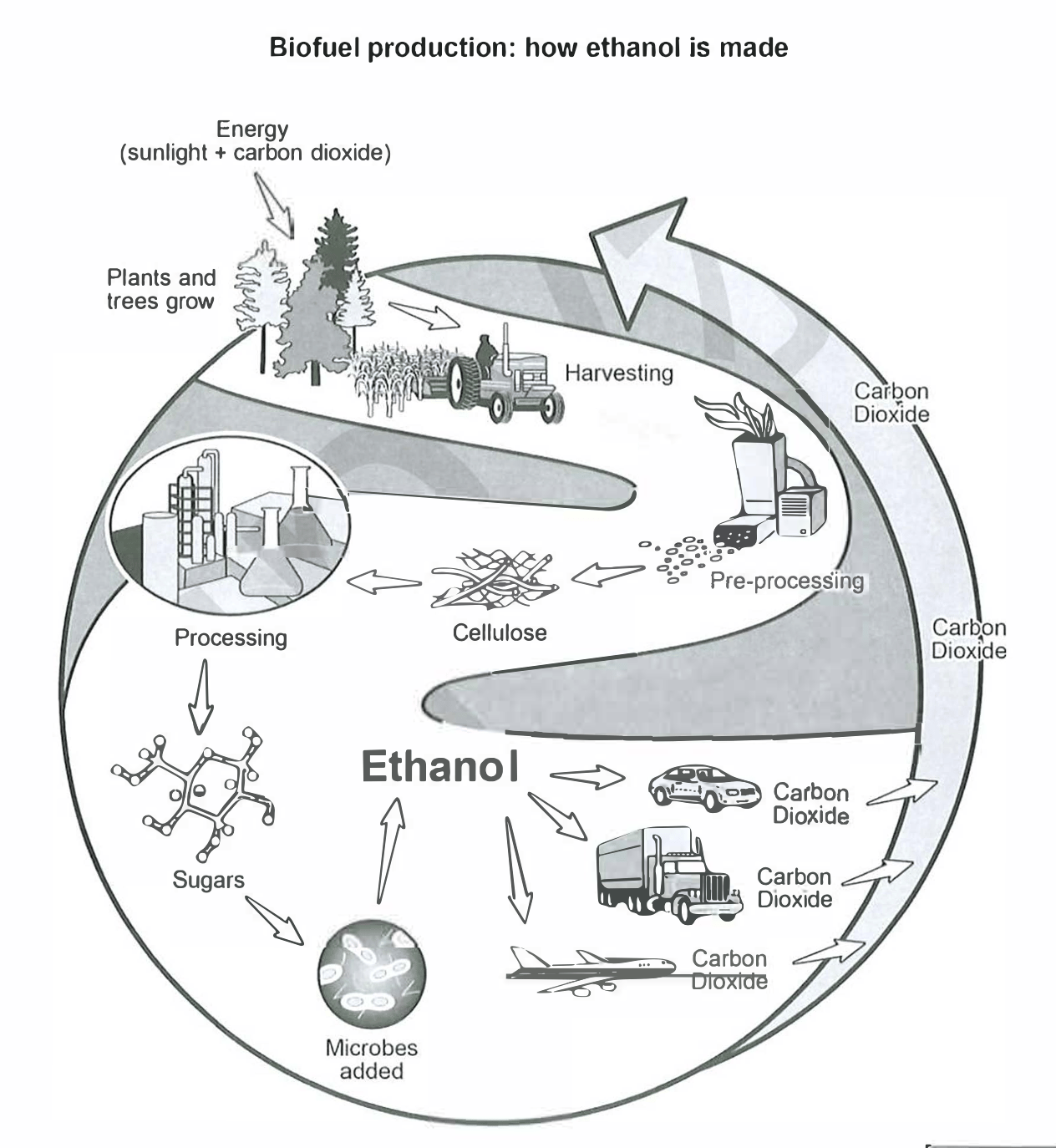
The diagram below shows how a biofuel called ethanol is produced.
Summarise the information by selecting and reporting the main features, and make comparisons where relevant.
Student answer (Band 6.0)
The diagram illustrates the vaious steps involved in producing ethanol, a type of biofuel from plants and trees and how the process forms a continuous cycle with carbon dioxide.
Overall, the process has mainly seven stages beginning with the growth of plants and trees by absorbing energy through sunlight and carbon dioxide. The carbon dioxide released in the air after the ethanol is burnt is used in the growth of plants, hence the process is cyclic.
The process starts with growing plants and tress with the help of absorbing energy from sunlight and carbon dioxide. After they grew, they were harvested with the help of a farmer using a tractor. It was later sent for pre-processing of the material which is break down into small pieces known as cellulose.
The cellusose were later sent into a factory or laboratory for further processing where it is converted into sugars. Onto the next chage, microbes are added into the sugars which produce ethanol.
Once produced, ethanol is used as a fuel for various types of transport. Each of this produce carbon dioxide in the air when the fuel is burnt. The carbon dioxide is used by plant and trees as a form of energy.
AI examiner evaluation
| Criterion | Band |
|---|---|
| Task Achievement / Task Response | 6.0 |
| Coherence and Cohesion | 6.0 |
| Lexical Resource | 6.0 |
| Grammatical Range and Accuracy | 5.5 |
| Overall | 6.0 |
Task Achievement / Task Response: Band 6.0
You cover the main stages and give a relevant overview, identifying both the plant-growth starting point and the cycle in which carbon dioxide returns to support further growth. The account also follows the sequence from harvesting through cellulose, processing, sugars and microbes to ethanol, then notes its use in transport. Some details are less fully or precisely reported: the diagram shows three transport modes, but these are not named, and the description of pre-processing as breaking material into small pieces is not explicit in the visual. The overview’s claim of “mainly seven stages” is also unclear given the several labelled stages. A more precise overview and closer reporting of the diagram’s labels would strengthen coverage.
Coherence and Cohesion: Band 6.0
The response is arranged in a clear sequence, with an introduction, an overview and paragraphs that move from plant growth to fuel use and carbon dioxide returning to the plants. This makes the overall process easy to follow. Linking expressions such as “Overall,” “After,” “Once produced” and “hence” help connect the stages, although some transitions are mechanical or imprecise. For example, “It was later sent” has an unclear reference, and “Onto the next chage” does not form a smooth link. Grouping the stages more deliberately and using clear references to the material, cellulose and ethanol would make cohesion more consistent.
Lexical Resource: Band 6.0
You use an adequate range of process vocabulary, including “harvested,” “pre-processing,” “cellulose,” “converted,” “microbes” and “continuous cycle.” These terms help communicate the sequence, and the meaning remains clear despite some inaccurate or awkward choices. Spelling slips include “vaious,” “tress” and “cellusose”; “chage” also appears in place of “stage.” Some collocations are unnatural, such as “with the help of absorbing energy” and “Each of this produce carbon dioxide.” Aim for accurate spelling and more natural process descriptions, for example, “plants absorb sunlight and carbon dioxide” and “each mode of transport releases carbon dioxide.”
Grammatical Range and Accuracy: Band 5.5
You attempt both simple and more complex sentences, including the overview’s explanation of the cycle and the clause beginning “where it is converted into sugars.” The sequence is generally understandable, but some grammatical errors remain. In “After they grew, they were harvested,” the past-tense framing is inconsistent with a general process description; use the present simple throughout. Agreement is also inaccurate in “The cellulose were later sent” and “Each of this produce”; these subjects require singular agreement or a plural construction. The sentence “which is break down into small pieces” has an incorrect verb form, and “It was later sent” leaves the pronoun reference unclear. More consistent tense, agreement and clause construction would improve accuracy.
See this exact question answered at other band scores. The same prompt compared across bands.
Browse more IELTS Writing model answers or get your own writing scored by the same AI examiner.