Band 6.5 IELTS Writing Task 1 Model Answer
Overall Band Score: 6.5 · Cambridge IELTS 19 · 2026-11-28
IELTS Writing Task 1 question
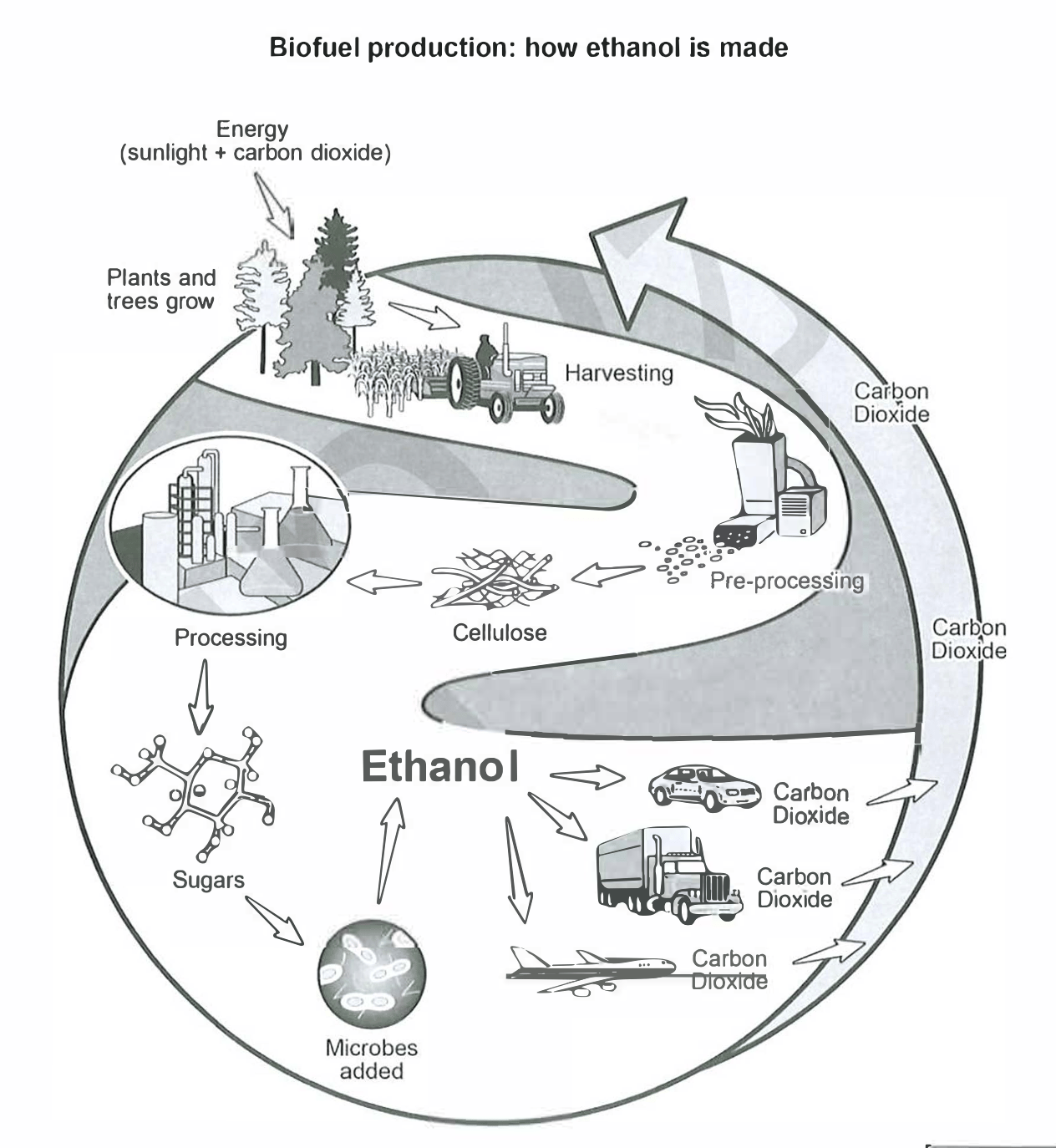
The diagram below shows how a biofuel called ethanol is produced.
Summarise the information by selecting and reporting the main features, and make comparisons where relevant.
Student answer (Band 6.5)
The diagram illustrates the processes involved in the production of a biofuel called ethanol.
Overall, the production of ethanol is a self-sustaining cycle and it involves different stage which include the obtaining energy from plant sources, harvesting, processing and production
Firstly, vehicles and airplanes release carbon dioxide into the atmosphere. This carbon dioxide emitted is then utilized by the plants and trees sown along with sunlight to produce energy which enable them to grow.Once the trees reach the level of maturation, they are felled and harvested.
These raw materials are preproccessed which synthesizes cellulose.Cellulose is carried to the laboratory for further processing. The processing of cellulose gives rise o the formation of sugars. After sugars have been formed , microbial agents are then added to the sugar which then emits ethanol. Once ethanol is produced, it becomes a biofuel. This fuel is then used to power vehicles and aeroplanes which then releases carbon dioxide into the atmosphere
AI examiner evaluation
| Criterion | Band |
|---|---|
| Task Achievement / Task Response | 7.0 |
| Coherence and Cohesion | 7.0 |
| Lexical Resource | 6.0 |
| Grammatical Range and Accuracy | 5.5 |
| Overall | 6.5 |
Task Achievement / Task Response: Band 7.0
You cover the main stages and give a clear overview that ethanol production forms a cycle. The account correctly follows plant growth, harvesting, pre-processing, cellulose, processing, sugars, the addition of microbes and ethanol production, then links fuel use to carbon dioxide returning to plants. This is a well-focused summary of the diagram. However, a few details are imprecise: the diagram shows ethanol being used by a car, truck and aeroplane, whereas you mention vehicles and aeroplanes but omit the truck; it also shows sunlight and carbon dioxide supporting plant growth, rather than plants being “sown along with sunlight.” To strengthen the response further, describe the cycle’s inputs and outputs more precisely and avoid adding unsupported details such as trees being felled.
Coherence and Cohesion: Band 7.0
The response is organised into an introduction, an overview and a chronological account, so the reader can follow the process from plant growth through to fuel use and carbon dioxide release. Sequencing expressions such as “Firstly,” “Once,” and “After” help signal the stages, and the final sentence brings the cycle back to its starting point. The progression is generally clear, although the overview is somewhat compressed and the transition from the opening cycle description to the detailed stages could be smoother. Some sentences also run together because spaces are missing after full stops, for example “grow.Once” and “cellulose.Cellulose.” Use consistent sentence spacing and clearer links between stages to make the cohesion more polished and flexible.
Lexical Resource: Band 6.0
You use an adequate range of process vocabulary, including “pre-processed,” “cellulose,” “processing,” “formation,” and “microbial agents,” which helps explain the stages without excessive repetition. Some choices are less precise or do not fit the diagram naturally: “obtaining energy from plant sources” misrepresents the sunlight and carbon dioxide input, while “carried to the laboratory” is not shown. There are also spelling and word-choice slips, including “preproccessed” and “emits ethanol”; microbes are added and ethanol is produced. These do not prevent the reader from understanding the overall process, but more accurate collocations and careful spelling would improve precision. Aim to use technical terms consistently and avoid embellishing the diagram.
Grammatical Range and Accuracy: Band 5.5
You attempt a mixture of simple and complex sentences, including time clauses such as “Once the trees reach the level of maturation” and a relative clause in “which then emits ethanol.” The sequence remains understandable, but some grammatical errors and punctuation problems limit accuracy. For example, “different stage” needs a plural, and “which enable them to grow” does not agree with the singular noun “carbon dioxide.” The phrase “gives rise o the formation” contains a missing letter, and “After sugars have been formed ,” has incorrect spacing before the comma. There are also run-on sentence boundaries, such as “grow.Once.” Check agreement, articles and sentence punctuation, and proofread each sentence while retaining your attempts at complex structures.
See this exact question answered at other band scores. The same prompt compared across bands.
Browse more IELTS Writing model answers or get your own writing scored by the same AI examiner.